The Best Truck Bed Tents, Where the Bed Length Decides Everything
A truck bed tent is the only tent you can buy in the wrong size without noticing. Every model below ships in bed-length-specific versions, and the tape measure comes before the brand.
Every truck bed tent on this page is sold in bed-length-specific versions, and the lengths are narrow: Napier's full-size short bed is 5 ft 5 in to 5 ft 8 in, its regular bed is 6 ft 4 in to 6 ft 7 in. Measure the inside of your bed from the bulkhead to the closed tailgate, in inches, and buy to that number. A tent one size out does not fit loosely, it does not fit.
This is the single commonest way to get a truck tent wrong, and it has nothing to do with quality. Trucks are sold with bed lengths that do not match their marketing names: a "short bed" on a full-size pickup is longer than a "long bed" on a mid-size. The listing variant you pick at checkout is the real decision, and the brand you pick is the smaller one.
Measure with the tailgate up, along the floor, bulkhead to tailgate. Then check whether your bed is a mid-size or a full-size platform, because Kodiak and Napier split their ranges on exactly that line. If a bed liner or a tonneau rail changes your usable length, measure what you actually have rather than what the brochure says.
What to look for
Specification
What to want
Why
Bed length fit
the exact range your measurement falls in
there is no tolerance; wrong size means the straps will not reach
Floor
sewn-in for comfort, floorless to keep your gear in the bed
this is the real design fork, and both answers are defensible
Waterproofing
2,000 mm or more on the shell, taped seams either way
a truck bed has no drainage, so water that gets in stays in
Center height
5 ft if you will sit out weather in it
3 ft is lie-down-only, and you will find that out on a wet afternoon
Frame
steel clamp-on for durability, fiberglass poles for weight and price
a flexing pole sleeve is what fails in wind
Strap hardware
nylon buckles and padded straps
metal hardware against paint is how a tent costs you a respray
What decides whether a truck tent suits your truck and your trips, rather than how it photographs.
Nothing on that list is about brand. The fit is arithmetic, the floor is a preference, and the rest follows from how many nights a year you will use it.
Compared on published numbers
Tent
Fits
Floor
Waterproof
Height
Frame
Napier Backroadz 13
full-size 5 ft 5 in to 8 ft 2 in
sewn-in polyethylene
1,500 mm PU
5 ft
4 fiberglass poles
Rightline Gear 110750
full-size short, 5.5 ft
none
2,000 mm PU
not published
fiberglass poles
Kodiak Canvas 7211
mid-size 5 to 6.5 ft
none
Hydra-Shield canvas
3 ft peak
3/4 in steel, clamp-on
Figures as published by each manufacturer. Prices on this page carry their own as-of date.
The blank cell is not an oversight. Rightline does not publish a center height for the 110750, and a floorless tent's usable height depends on your bed rails anyway, so there is no honest single number to put there. Kodiak's figure is published as a peak height that varies with the truck, for the same reason.
Canvas is not weatherproofed the way nylon is
Hydra-Shield canvas is described as watertight and breathable, and it works by the cotton fibers swelling when wet rather than by a coating. That is why it does not sweat the way a sealed polyester shell does in a truck bed, and also why it must be bone dry before it goes into storage. A damp canvas tent in a garage is a mildewed canvas tent in a month. The drying routine is the same one in how to clean and store a tent, only less forgiving.
A truck bed is a hard, cold, ribbed surface
The thing nobody warns you about is the floor of your own truck. A bed liner is corrugated plastic over steel, and steel at 3am takes heat out of you faster than the ground does. This is an R-value problem, not a sleeping bag problem, and the fix is a pad with real insulation rather than a thicker bag.
A self-inflating pad is the right answer here because it adds thickness over the ribs as well as insulation, and a full-width double pad fits a truck bed almost exactly. If you are cold in a truck tent, start at sleeping pad R-value explained before you buy anything warmer to sleep in.
Condensation is worse in a truck than in a tent on the ground
A ground tent loses some moisture into the soil. A truck bed is a sealed plastic tray, so every bit of water you breathe out overnight has nowhere to go but the inside of the fabric above you. Two people in a coated polyester truck tent with the windows zipped will wake up under a wet ceiling.
The fix is airflow you set up before you sleep, not a drier tent: open the roof vent, crack the far window, and accept a couple of degrees of cold for a dry morning. The full version of that argument is in how to stop tent condensation, and it is the single reason the breathable canvas option is on this page at all.
Which to buy
Buy the Napier Backroadz 13 Series if you have a full-size pickup and this is your first truck tent. The sewn-in floor and 5 ft of headroom make it feel like a tent rather than a tarp over a tray, and the 10 minute pitch is realistic rather than aspirational. Measure your bed, pick the matching variant on the listing, and that is the decision.
Buy the Rightline Gear 110750 if your full-size bed is 5.5 ft and you would rather not unload it. Pitching over your own gear is worth more on a real trip than a floor is, the 2,000 mm shell is the better rating of the two polyester tents, and the price leaves room for the pad you now definitely need.
Buy the Kodiak Canvas 7211 if you drive a mid-size truck and camp often enough that durability and breathability beat headroom. It is the only one here with a steel frame and the only one that will not sweat on you, and it is several times the price of the others for exactly those two reasons. If you are still choosing between sleeping in the truck and sleeping on the ground, read best rooftop tents and how to pack a car for camping first.
The picks in full
1. Best overall
Napier Backroadz Truck Tent (13 Series)
Napier Outdoors
A 1,500 mm polyester shell over a polyethylene bathtub floor, 5 ft of headroom, 15 to 16 lb, and a 10 minute pitch.
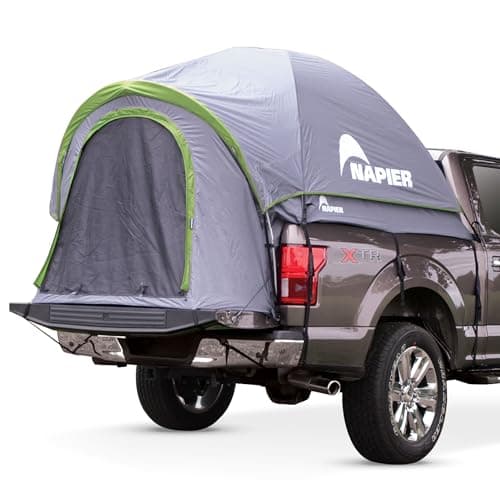
Napier publishes a capacity of two, a 5 ft center height, a polyester taffeta wall and roof with a 1,500 mm PU coating, a polyester taffeta rainfly with taped seams, a polyethylene bathtub floor, four shock-corded color-coded fiberglass poles, two mesh windows, one door with a storm flap, a 15 to 16 lb weight, a 28 by 9 by 10 in pack size and a 10 minute setup. It fits full-size long beds at 8 ft to 8 ft 2 in, regular beds at 6 ft 4 in to 6 ft 7 in, and short beds at 5 ft 5 in to 5 ft 8 in.
This wins because of the floor, which is the thing beginners actually notice. A sewn-in floor turns the bed into a sealed room: no dust off the liner, no draught up through the drain holes, and nothing crawling in from the tailgate gap. Everything else here is floorless, which is a legitimate design with a real benefit, but it is not the one that feels like a tent on night one.
Five feet of headroom is the other reason. You cannot stand up in any truck tent, but 5 ft means you can sit upright, kneel to dress and reach the far corner without crawling. If a tent is where you will spend a rainy afternoon rather than only the night, that number matters more than the fabric.
The drawback
The sewn-in floor means the bed has to be empty before you pitch, so your gear sleeps in the cab or outside. At 1,500 mm the shell is the lowest waterproof rating here.
Published specs
Capacity
2 persons
Center height
5 ft
Fits
full-size long 8-8 ft 2 in, regular 6 ft 4 in-6 ft 7 in, short 5 ft 5 in-5 ft 8 in
2. Best value, and the one that pitches over loaded gear
Rightline Gear Full-Size Short Bed Truck Tent (110750)
Rightline Gear
A floorless 2,000 mm tape-sealed shell for well under a hundred dollars, with a sky-view roof vent.
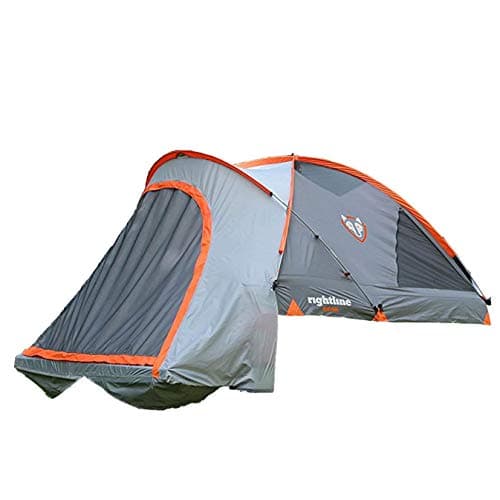
Rightline Gear publishes a two-adult capacity, a fit for full-size 5.5 ft short beds, a floorless design that pitches over gear already in the bed, water-resistant fabric at PU 2,000 mm with tape-sealed seams, color-coded fiberglass poles with pole pockets, heavy-duty straps with finish-safe nylon buckles, a sky-view roof vent, two gear pockets, a lantern hook, glow-in-the-dark zipper pulls, a tent, rainfly and stuff sack with a sewn-in setup guide, and a one-year warranty.
Floorless is the feature, not the compromise. The usual problem with a truck tent is that the bed is also your storage, so pitching means moving everything out and then finding somewhere for it. This one goes up over the load: wheel-well boxes, a cooler, a toolbox, all still in place, and you sleep in the space that is left. On a weekend trip that is the difference between twenty minutes of shuffling and five minutes of poles.
Two thousand millimeters is also meaningfully better than the Napier's 1,500 on the number that describes how long fabric resists a column of water. Read tent waterproof ratings explained for what the figure does and does not promise, and be clear that a floorless tent's weak point is below you, not above.
The drawback
No floor at all. You sleep on the bed liner, so a pad is mandatory rather than optional, and dust and draughts come up from underneath.
Hydra-Shield cotton duck canvas on an integrated 3/4 in steel frame that clamps to the bed rails.
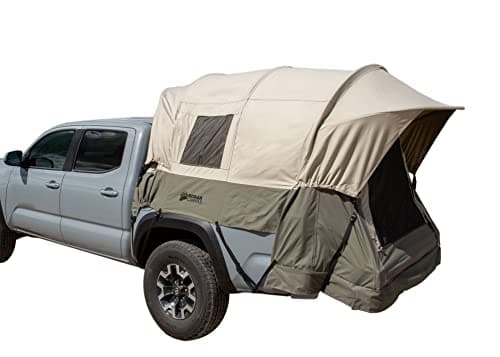
Kodiak Canvas publishes Hydra-Shield 100% cotton duck canvas, a fit for mid-size 5 to 6.5 ft beds covering the Tacoma, Frontier, Colorado, Canyon, Ranger and Gladiator, a 3 ft peak height that varies with the truck, and an integrated 3/4 in steel tube frame in a clamp-on rail design. There is no floor; the frame clamps to the bed rails.
Canvas and a steel frame are a different proposition from polyester and fiberglass. The canvas breathes, which is the real answer to the condensation that plagues coated polyester in a sealed truck bed, and the steel frame does not flex in wind the way a pole sleeve does. If you camp twenty nights a year rather than three, that is where the money goes.
Be honest about the headroom. Three feet is sitting-with-a-bent-neck, not sitting upright, and Kodiak says it varies with the truck because the frame sits on your rails rather than above them. Buy this for the build and the breathability, and read canvas vs nylon tents before you commit to the drying routine canvas requires.
The drawback
Three feet of peak height against the Napier's five, several times the price, and canvas has to be dried before storage or it will mildew. It is also the heaviest thing here by a wide margin.
Published specs
Fabric
Hydra-Shield 100% cotton duck canvas
Fits
mid-size 5-6.5 ft beds: Tacoma, Frontier, Colorado, Canyon, Ranger, Gladiator
Peak height
3 ft, varying with the truck
Frame
integrated 3/4 in steel tube, clamp-on rail design
No. They are sold in bed-length-specific versions and the ranges are narrow - Napier's full-size short bed fits 5 ft 5 in to 5 ft 8 in and its regular bed fits 6 ft 4 in to 6 ft 7 in. Measure the inside of your bed from the bulkhead to the closed tailgate and buy the variant that matches, because the straps on the wrong size will not reach.
QDo you need a floor in a truck bed tent?
It is a genuine fork rather than a quality difference. A sewn-in floor, like the Napier's polyethylene bathtub, seals out dust and draughts but means the bed has to be empty before you pitch. A floorless tent, like the Rightline 110750 or either Kodiak, goes up over gear that is already in the bed, which on a real trip saves more trouble than the floor solves.
QDo you need a sleeping pad in a truck bed tent?
Yes, and a properly insulated one. A bed liner is corrugated plastic over steel, which conducts heat out of you faster than soil does, so this is an R-value problem rather than a sleeping bag problem. A self-inflating pad adds both thickness over the ribs and insulation beneath you.
QAre truck bed tents waterproof?
The shells are coated to a published rating - 1,500 mm on the Napier Backroadz and 2,000 mm on the Rightline - with taped seams on the rainflies. The real risk in a truck is not rain through the fabric but water that gets in and cannot drain, because a bed is a sealed tray rather than ground that soaks.
QWill a truck tent damage my paint?
Not if the hardware is right. Rightline specifies heavy-duty straps with nylon buckles chosen so they do not damage the truck's finish, and Kodiak clamps to the bed rails rather than strapping over them. Check what touches paint before you tension anything, and put a cloth under any buckle that sits on a painted surface.
How we picked
Everyone else in this category will tell you they tested twenty of these. We have not tested any of them, and we would rather say so than pretend. There is no gear closet here and no test lab.
What we did instead: pulled the published specifications from each manufacturer's own spec sheet or manual, named the standard behind every rating so you can check what it actually promises, did the arithmetic that turns a spec into a decision, and pulled today's real retail price rather than quoting one from memory. Every pick states a drawback, because a list where nothing is wrong with anything is an advert.
The limits of that method, stated plainly: published specs do not capture zipper quality, seam durability, or how a tent behaves at 2am in a storm. Where that matters, we say so on the pick. The full method is here.