The Best Hot Tents with Stove Jacks, and the Risk You Take On
A wood stove turns a winter tent into a room you can dry clothes in. It also puts a fire and a carbon monoxide source inside your shelter, and that is not a small thing.
A stove does two things a sleeping bag cannot: it dries wet clothing overnight, and it makes the tent a place you can sit in the evening rather than a bag you get into at dark. In genuine winter, drying gear is the one that matters, because wet layers on day two are what end trips.
What it does not do is keep you warm all night. A tent stove burns down in two to four hours and nobody is feeding it at 3am, so the tent is back to ambient temperature by morning. Your sleeping bag and pad still have to handle the actual low — see best zero degree sleeping bags and sleeping pad R-value explained.
Compared on published numbers
Item
Fabric or material
Weight
Size
Stove jack
OneTigris Rock Fortress
70D coated nylon, 3,000 mm
9.2 lb
12.4 ft diameter, 7.8 ft high
pre-cut, 3.3 x 3.3 in
Kodiak Cabin Lodge SR 10 x 10
10 oz ceiling / 8.5 oz wall Hydra-Shield canvas, 13.5 oz vinyl floor
about 75 lb packed
10 x 10 ft, 7 ft 6 in peak
5 in, fitted from the factory
Winnerwell Nomad Medium
304 stainless steel
20 lb
15 x 20 in, 90 in total height
2.5 in chimney, 5 sections
Figures as published by each manufacturer.
Canvas or synthetic
Canvas chars instead of melting, breathes so it condenses far less, and is quieter in wind. It is six to seven times heavier, it absorbs water and gets heavier still, and it must be dried fully before storage or it will mildew.
Coated nylon or polyester is a fraction of the weight, dries fast and packs small. It melts on contact with an ember, it is noisy in wind, and a single-wall synthetic hot tent condenses heavily once the stove goes out.
The decision is really about transport. If the tent goes in a vehicle and stays up for days, canvas is the better shelter. If you are carrying it, synthetic is the only realistic option and you accept the spark risk by managing it.
Carbon monoxide is the real hazard, not the fire
A wood stove consumes oxygen and produces carbon monoxide continuously, and a sealed tent is exactly the enclosed space where that becomes lethal. CO is colorless and odorless, and its early symptoms — headache, nausea, confusion — are indistinguishable from being cold and tired. Never run a stove in a tent without a working low-level CO detector, never seal every vent, and never go to sleep with the stove damped down to keep it burning. The mechanism is in carbon monoxide and stove safety when camping and the detectors are in best carbon monoxide detectors for camping.
The setup rules that are not optional
A spark arrestor on the chimney, every time. Winnerwell includes one; if yours did not come with one, buy one before the stove.
A fireproof mat under the stove, and clearance on every side to the fabric. Stove legs get hot enough to scorch a floor.
Two vents open, low and high, so air can enter and exhaust. This is what the stove needs to draw properly and what keeps CO from accumulating.
A CO detector at head height where you sleep, tested before the trip.
A small firebox eats wood fast and needs it cut short. The Winnerwell publishes an 800 cubic inch firebox, which takes pieces roughly a foot long, so every log you gather has to be cut down. That is a real ongoing chore in camp and the strongest argument for carrying a saw — see best camping saws.
Wood also has to be dry. Green or wet wood produces far more smoke, far less heat and far more creosote in the chimney, and where fire restrictions apply, gathering may be prohibited entirely. Check before you plan around it.
Who should not buy one
Anyone camping in three seasons rather than winter. A hot tent is heavier, more expensive and more work than an equivalent conventional tent, and outside genuine cold the stove is a liability you carry and never light. For cold-weather shelter without fire, a 4-season tent is the safer and lighter answer.
A 12.4 ft diameter tipi at 9.2 lb in 70D nylon rated 3,000 mm, with a pre-cut 3.3 in stove jack.
OneTigris publishes a pitched size of 12.4 ft / 3.8 m diameter by 7.8 ft / 2.4 m high, a weight of 9.2 lb / 4.2 kg, 70D coated nylon rated to 3,000 mm, a pre-cut 3.3 by 3.3 in stove jack, and a package including the tent, pole, stove jack, 24 pegs and 10 guy lines.
Nine pounds is what makes this a genuine option rather than a curiosity. Canvas hot tents start around 60 lb, which is a vehicle-only proposition; this one can be split between two people and carried, which is the whole reason the synthetic category exists.
The drawback
Nylon near a stove is unforgiving. A spark that lands on 70D nylon melts straight through, where canvas chars, and the single-wall design condenses heavily when the stove is out.
2. Best canvas, and the only tent here with the jack already fitted
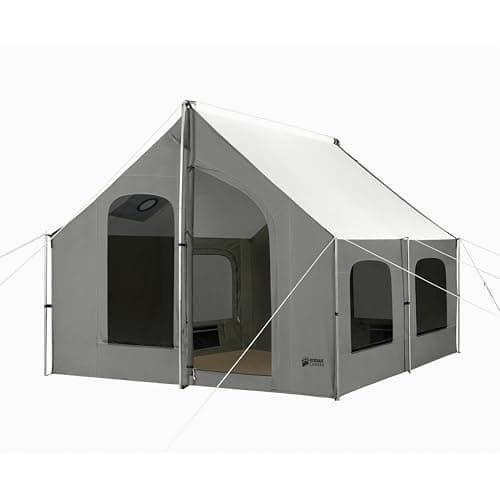
Kodiak Canvas 10 x 10 ft Cabin Lodge SR
Kodiak Canvas
10 oz Hydra-Shield canvas on steel tubing with a 7 ft 6 in peak, and a 5 in stove jack fitted from the factory.
Kodiak publishes a 10 by 10 ft floor, 10 oz Hydra-Shield canvas on the ceiling and 8.5 oz on the walls, a 13.5 oz welded-seam vinyl floor, a 7 ft 6 in peak with roughly 4 ft vertical side walls, 1 in galvanized steel tubing, a 5 in factory stove jack with a weather flap, a pack weight of about 75 lb, and a limited lifetime warranty.
The factory jack is the whole reason this is the canvas pick rather than a project. The alternative on a canvas tent is cutting a hole in a shelter that cost hundreds of dollars, or fitting an aftermarket kit, and a jack that arrives sewn in with a flap over it removes the one step most people are least willing to take.
Canvas is the traditional hot tent material for one reason that matters here: it chars rather than melting. An ember that would put a hole through nylon leaves a scorch mark on canvas. It is also breathable, which is why canvas tents condense far less.
The drawback
About 75 lb packed and the most expensive tent on this page by a wide margin. Kodiak also rates the 10 by 10 ft floor for six people but only two once a stove is inside, so the usable capacity is a third of the headline number.
Published specs
Floor
10 x 10 ft
Sleeps
6; 2 once a wood stove is inside
Ceiling canvas
10 oz Hydra-Shield
Wall canvas
8.5 oz Hydra-Shield
Floor material
13.5 oz vinyl, welded seams
Height
7 ft 6 in at the peak, with about 4 ft vertical walls at the sides
Frame
1 in galvanized steel tubing
Stove jack
5 in, fitted from the factory, with a weather flap
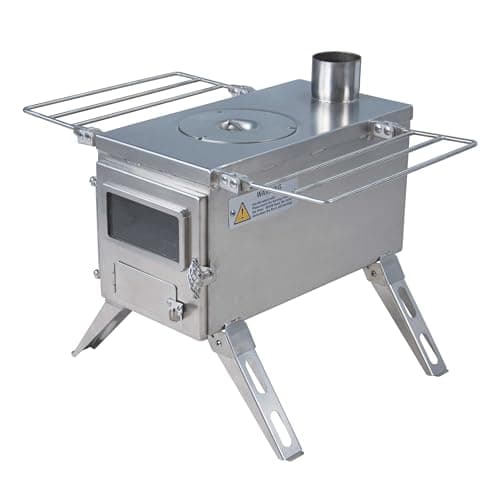
20 lb of 304 stainless with an 800 cubic inch firebox, a 2.5 in chimney in 5 sections, and a spark arrestor and ash scraper in the box.
Winnerwell publishes a total weight of 20 lb, 304 stainless steel construction, an 800 cubic inch firebox, a 2.5 in chimney in five sections, assembled dimensions of 15 by 20 in at 90 in of total height including the chimney, a packed size of 15 by 8 by 8 in, and a box containing the stove body, the five chimney sections, a spark arrestor and an ash scraper. The four legs nest flat under the stove, the pipe stows inside the body, and the side shelves fold together into a carry handle.
The spark arrestor is not an accessory. It is the part that stops burning embers leaving the chimney and landing on your tent, and on a nylon tent that is the difference between a scorch mark and a hole.
The drawback
Twenty pounds on top of the tent, and it assembles to 90 inches of total height once the chimney is up, which is taller than most hot tents. Check the geometry before you buy. No view window on this model either, and Winnerwell publishes no cooktop or body thickness for it.
Published specs
Weight
20 lb total
Material
304 stainless steel
Firebox
800 cubic inches
Chimney
2.5 in diameter, 5 sections
Assembled
15 x 20 in, 90 in total height including the chimney
Only with precautions. A wood stove consumes oxygen and produces carbon monoxide continuously, and a sealed tent is the enclosed space where that becomes lethal. Run a low-level CO detector at head height, keep low and high vents open, and use a spark arrestor and a fireproof mat.
QDoes a hot tent stay warm all night?
No. A tent stove burns down in two to four hours and nobody feeds it at 3am, so the tent returns to ambient by morning. Your sleeping bag and pad still have to handle the actual overnight low; the stove's real value is drying wet gear and making the evening usable.
QCanvas or nylon hot tent?
Canvas chars instead of melting, breathes so it condenses far less, and weighs six to seven times more. Coated nylon is light enough to carry and melts on contact with an ember. If the tent goes in a vehicle, choose canvas; if you carry it, choose synthetic and manage the spark risk.
QDo I need a spark arrestor on a tent stove?
Yes, every time. It stops burning embers leaving the chimney and landing on the tent, which on nylon is the difference between a scorch mark and a hole. Winnerwell includes one with the Nomad Medium; if yours did not come with one, buy it before you buy the stove.
How we picked
Everyone else in this category will tell you they tested twenty of these. We have not tested any of them, and we would rather say so than pretend. There is no gear closet here and no test lab.
What we did instead: pulled the published specifications from each manufacturer's own spec sheet or manual, named the standard behind every rating so you can check what it actually promises, did the arithmetic that turns a spec into a decision, and pulled today's real retail price rather than quoting one from memory. Every pick states a drawback, because a list where nothing is wrong with anything is an advert.
The limits of that method, stated plainly: published specs do not capture zipper quality, seam durability, or how a tent behaves at 2am in a storm. Where that matters, we say so on the pick. The full method is here.