The Best Sleeping Bags for Hot Weather, and When to Skip the Bag Entirely
Most people camping in summer are carrying a bag rated 20 degrees colder than the night. The fix is not a thinner version of the same thing; it is a different shape.
Above roughly 65 F, most people do not need a sleeping bag at all. A liner, or a rectangular bag used unzipped as a quilt, is more comfortable than any bag zipped shut. The two things that still matter in heat are the pad underneath you and the airflow through the tent.
This is the opposite of the advice people expect. Sleeping bags are sold on warmth, so the summer version is presented as the same product with less fill — but the actual problem in heat is that you need to dump heat, and a sewn tube is built to trap it.
A Reactor liner on its own weighs a few ounces, washes easily, and is what a great many summer campers actually sleep in. The full argument for liners is in do you need a sleeping bag liner.
Compared on published numbers
Bag
Rating
Shape
Weight
Dimensions
Fill
Coleman Kompact 40F
40 F
rectangular
not published (big and tall: 5.80 lb)
75 x 33 in (big and tall 84 x 39 in)
Coletherm Max synthetic
Kelty Galactic 30
30 F, maker's rating
hoodless rectangular
2 lb 10 oz regular
not published beyond length
550 fill power duck down
Figures as published by each manufacturer or its listing.
Two picks rather than three, because the summer bag category is mostly rebadged 40 F rectangles with no published weight, no published dimensions and no stated fill. A third pick chosen from those would add a name and no information.
Down is the wrong fill for hot, humid nights
This inverts the usual advice. Down wins on warmth for weight in cold, dry conditions, which is why it dominates the backpacking pages. In heat and humidity its weaknesses are the ones that bite.
Down in summer
Synthetic in summer
Body moisture
absorbs it, loses loft
keeps insulating damp
Drying
slow
fast
Washing
specialist wash, careful drying
machine washable in most cases
Cost
higher
lower
Packed size
smaller
larger, which rarely matters in a car
The trade reversed for warm and humid conditions. The cold-weather version is in our down vs synthetic page.
In a dry summer at altitude, down is still excellent. In a humid southeastern August, synthetic is the sane choice, and the general comparison is in down vs synthetic sleeping bags.
A 40 F bag is not comfortable at 40 F
A maker's temperature rating is usually closer to a survival limit than a comfort figure, and for bags rated by the ISO standard the comfort rating is typically about 10 to 15 F warmer than the limit. So a 40 F bag suits nights in the 50s, not nights at 40. Since you are buying for heat rather than cold, this works in your favor: a 40 F bag is a genuinely warm-night bag. The standard and what it measures are in sleeping bag temperature ratings explained.
The pad still matters in summer, for the opposite reason
In cold weather a pad's R-value stops the ground stealing your heat. On a hot night the ground is often the coolest surface available, and a high-R pad insulates you from that relief while an air pad with no insulation lets some of it through.
So the summer setup is the reverse of the winter one: a lower-R pad, or a cot that puts air under you entirely, is more comfortable in heat. Cots are the underrated hot-weather item for exactly this reason — best camping cots.
What actually cools a tent, since the bag cannot
No sleeping bag solves a hot tent. Three things help, in order of effect: pitch in shade that lasts into the evening, open every vent and both doors to get cross-flow, and move air across your skin with a fan. You cannot cool the air in a tent, only the person in it, which is the argument in best camping fans for tents and how to stay cool camping in hot weather.
A tent with a full mesh inner and the fly rolled back is dramatically cooler than the same tent flied, and is the single biggest change most people can make.
What the specifications do not tell you
Coleman does not publish a weight for the standard Kompact 40 rectangle on the listing we read, only for the big and tall version. Kelty does not publish a shoulder or hip girth for the Galactic. Both omissions matter for comfort, and we are not going to supply numbers neither maker states.
Neither bag here carries an ISO rating. Both figures are maker's ratings, which are not comparable between brands the way ISO comfort and limit figures are.
Which to buy
Buy the Coleman Kompact 40F if you car camp in summer and want one cheap bag that works as a quilt — and buy the big and tall version unless you are genuinely under 5 ft.
Buy the Kelty Galactic 30 if your summer nights are cool ones at altitude, you want the weight down, and the climate is dry.
Buy neither if the nights are genuinely hot. A light quilt or a liner plus a cot beats any bag above about 65 F, and the quilt case generally is in best camping quilts.
The picks in full
1. Best overall
Coleman Kompact 40F Rectangle
Coleman
A 40 F rectangular bag at 75 by 33 in that packs to 8.7 by 8.3 by 15.7 in, with a full-length zip.
Coleman publishes a 40 F rating, dimensions of 75 by 33 in fitting campers up to 5 ft, a packed size of 8.7 by 8.3 by 15.7 in, Coletherm Max synthetic fill, a Thermolock draft tube, a ZipPlow snag-free zipper and a Comfort Cuff. The big and tall version publishes 84 by 39 in, fitting to 6 ft 5 in, at 5.80 lb.
The rectangular shape is the reason this is the pick rather than a mummy bag of the same rating. Unzipped fully it becomes a quilt you can throw a leg out of, which is exactly how anyone sleeps in genuine heat, and a mummy bag cannot do it because the foot box is sewn closed.
Check the length figure carefully against your own height, because 75 in is genuinely short and the listing states it plainly.
The drawback
75 in of length fits campers up to about 5 ft, which rules out most adults. The big and tall version is 84 by 39 in and 5.80 lb, which is heavy for a summer bag.
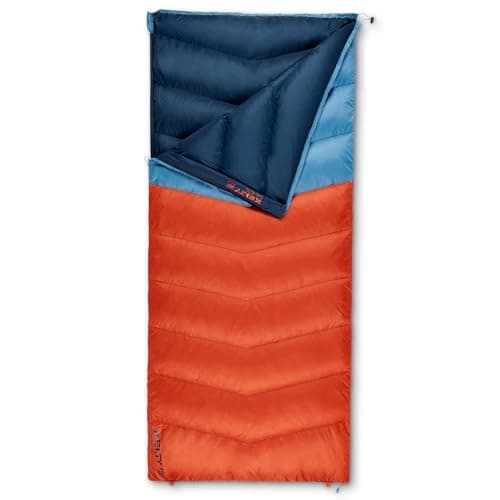
A hoodless 30 F down bag at 2 lb 10 oz, 550 fill power, that zips to a second bag.
Kelty publishes a 30 F maker's rating, 550-fill-power RDS-certified duck down with a 21.1 oz fill weight, a 2 lb 10 oz total weight for the regular, a 15 by 7.5 in stuffed size, 50D polyester taffeta shell and liner, and a hoodless design that zips to a second bag.
Hoodless is the underrated feature for warm weather. A hood is dead weight and trapped heat above about 50 F, and removing it makes a bag noticeably more comfortable in summer while saving weight.
QWhat temperature sleeping bag do I need for summer camping?
A 40 F bag suits most summer nights, because maker's ratings sit closer to a limit than a comfort figure, so a 40 F bag is comfortable in the 50s. Above about 65 F most people are better off with a liner or an unzipped rectangular bag used as a quilt.
QDo you need a sleeping bag in hot weather?
Often not. Above roughly 65 F a liner or a light quilt is more comfortable than any bag, because you can vent heat by moving a limb out. What still matters is the pad under you and the airflow through the tent.
QIs down or synthetic better for hot weather camping?
Synthetic, in humidity. Down absorbs body moisture, loses loft and dries slowly, which is exactly wrong for a humid August night. In dry summer heat at altitude down is still fine, and it packs smaller, which rarely matters when car camping.
QWhy am I hot in my sleeping bag even in a summer bag?
Because a sewn tube is designed to trap heat, and a mummy bag cannot vent. A rectangular bag unzipped as a quilt lets you put a leg out, which is how the body actually dumps heat. Pitching in shade, opening both doors and moving air with a fan matter more than the bag rating.
How we picked
Everyone else in this category will tell you they tested twenty of these. We have not tested any of them, and we would rather say so than pretend. There is no gear closet here and no test lab.
What we did instead: pulled the published specifications from each manufacturer's own spec sheet or manual, named the standard behind every rating so you can check what it actually promises, did the arithmetic that turns a spec into a decision, and pulled today's real retail price rather than quoting one from memory. Every pick states a drawback, because a list where nothing is wrong with anything is an advert.
The limits of that method, stated plainly: published specs do not capture zipper quality, seam durability, or how a tent behaves at 2am in a storm. Where that matters, we say so on the pick. The full method is here.