The Best Down Booties for Cold Nights, and Why Cold Feet Are a Sleeping-Bag Problem
Cold feet in a sleeping bag are almost never a sock problem. They are a circulation problem caused by a bag that fits too tight at the foot, and a bootie only helps once you understand which of the two you have.
Trail & Tarp earns a commission from qualifying purchases made through links on this page, at no extra cost to you. Full disclosure.
Quick picks
#
Product
Best for
Price
1
Best overall
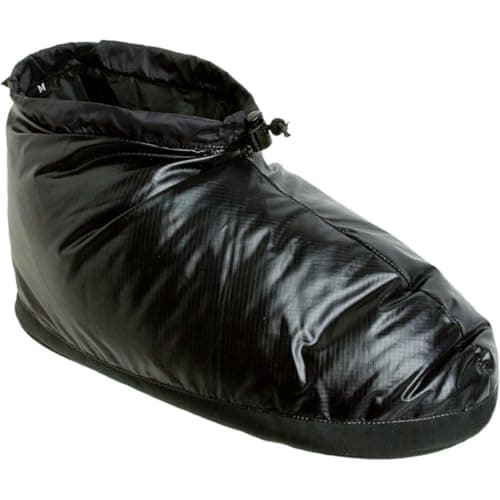
Western Mountaineering Flash Bootie
850-fill down in a ripstop nylon shell with a reinforced sole and rand and a foam insole, from the maker with the best down reputation in the business.
The most warmth for the least weight and bulk in a pack
Cold feet inside a sleeping bag are usually caused by compression, not by a lack of insulation. Thick socks or a tight bag foot squeeze the down flat and restrict circulation, and both make feet colder. The fix is a bag with room at the foot plus a thin, lofted layer — which is precisely what a down bootie is and what a heavy wool sock is not.
This is the most useful thing on this page, and it is counterintuitive enough that people reach for thicker socks for years. Insulation works by holding still air. A sock crushed flat against the inside of a mummy bag's footbox holds no air, and the pressure cuts the blood supply that was doing the heating in the first place.
A bootie is a tapered bag for your foot with loft of its own, worn inside a bag that has room for it. If your bag does not have that room, a bootie makes things worse and the real fix is a different bag — see mummy vs rectangular sleeping bags and the full diagnosis in why you get cold in a sleeping bag.
Compared on published numbers
Bootie
Insulation
Shell
Sole
Walkable?
Sizing
WM Flash Bootie
850-fill down
ripstop nylon
reinforced sole and rand
tent and vestibule only
shoe size
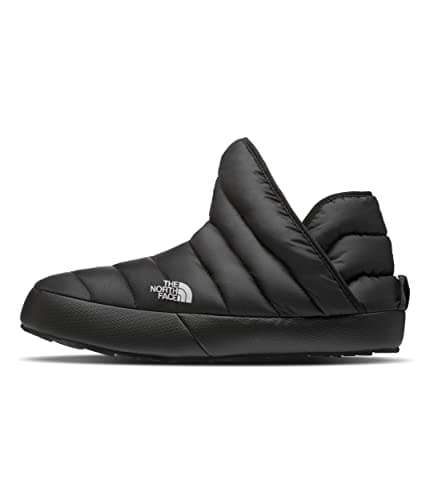
TNF ThermoBall Traction
ThermoBall Eco synthetic
recycled ripstop, non-PFC DWR
lugged rubber outsole
yes, on snow and ice
shoe size
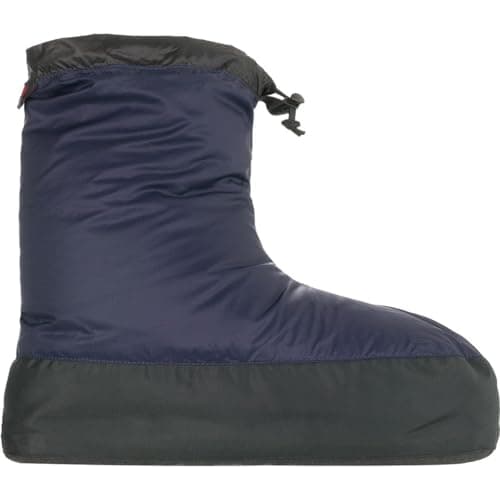
WM Standard Down Bootie
800-fill down
DWR-finished fabric
non-slip sole, foam insole
around camp, not distance
shoe size
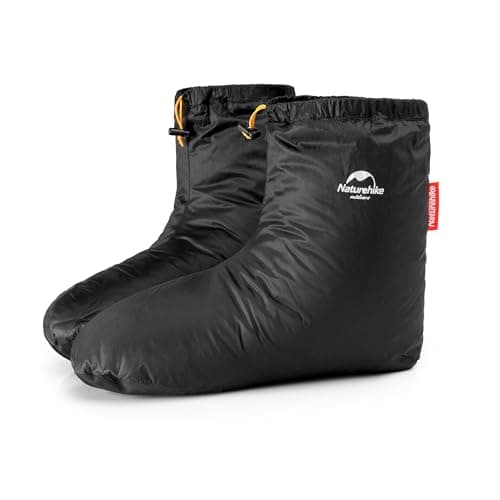
Naturehike Down Booties
700-fill down, 90% down
hydrophobic face and sole
hydrophobic fabric, no outsole
inside the tent
foot length in cm
Figures as published by each maker on 2026-10-17. None of the four publishes a temperature rating, and only Naturehike publishes a weight (40 g, without stating per sock or per pair).
The column that should decide your purchase is “walkable”. Three of these four are indoor footwear for a tent; one is a shoe. If the problem you are solving is the 3am walk to the toilet block, there is only one answer on this page.
Fill power is comparable; everything else here is not
Fill power is measured by a defined laboratory test: one ounce of down is compressed under a weight and the cubic inches it occupies is the figure. 850 fill means more loft per ounce than 700 fill, and that comparison holds across brands.
What is not comparable is how warm the finished bootie is, because warmth depends on total fill weight as much as on fill power, and not one of these four publishes a fill weight. A thin 850-fill bootie can easily be cooler than a thick 700-fill one. That is why the Western Mountaineering Standard, at a lower fill power than the Flash, is the warmer of the two — there is simply more down in it. The same arithmetic runs through down vs synthetic sleeping bags.
Never wear a bootie you have walked outside in, inside your sleeping bag
The sole of a camp bootie picks up grit, pine needles and moisture, and all three go straight into your bag's footbox, where grit abrades the inner fabric and moisture collapses the down. If you buy the walkable pick, treat it as outdoor footwear and keep a thin, dedicated sleeping layer for inside the bag. Keeping the bag clean is most of keeping it warm — how to wash a sleeping bag covers the rest.
Booties, camp shoes and sleeping socks are three different products
A down bootie is a lofted, soft-soled sleeve for warmth while stationary or sleeping. No support, no tread, no water resistance beyond a DWR finish.
A camp shoe is for getting your boots off at the end of the day in weather that is not freezing — a clog or a sandal, no insulation. Those are in best camp shoes and sandals.
A dedicated sleeping sock is a thin, clean, dry wool or synthetic sock that never touches the ground and never gets walked in. It costs very little and does most of what people buy booties for. Sock construction is in best hiking socks.
Only the ThermoBall Traction straddles the first two categories, which is why it is the pick for anyone who wants one object instead of two.
What to buy
Buy the Naturehike down booties first if you have never owned a pair. They cost a fraction of the others and will tell you in one trip whether this is a category you care about.
Buy the Western Mountaineering Flash Bootie if you are carrying it in a pack and want the best warmth-to-weight available. Buy the Western Mountaineering Standard if you sit outside in real cold and want the warmest thing here. Buy the North Face ThermoBall Traction if your feet are going to get wet or you want to walk in them — which, for most car campers, is the realistic answer.
And fix the underneath first. A bootie cannot out-insulate a cold sleeping pad, because the ground takes heat out of you faster than air ever will — sleeping pad R-value explained is the page to read before this one.
The picks in full
1. Best overall
Western Mountaineering Flash Bootie
Western Mountaineering
850-fill down in a ripstop nylon shell with a reinforced sole and rand and a foam insole, from the maker with the best down reputation in the business.
Published as 850-fill down in a ripstop nylon shell, with a reinforced sole and rand, a foam insole, and an intended use of backpacking and mountaineering.
850 fill power is the figure doing the work. Fill power measures loft per ounce — how many cubic inches one ounce of down occupies — so 850-fill down traps more air per gram than the 700-fill in the budget pick. That is the only spec here that is standardized and comparable, which is fortunate, because it is also the only one Western Mountaineering publishes.
The reinforced rand matters more than it sounds. A bootie whose sole wears through is finished, and the rand is the strip that takes the abrasion when you stand on gravel outside the tent for the thirty seconds nobody plans for.
The drawback
Western Mountaineering publishes no fill weight, no total weight and no temperature rating for this bootie, so the only hard number on it is the fill power. Down is also useless once wet, and these are not waterproof.
Published specs
Fill
850-fill down
Shell
ripstop nylon
Sole
reinforced sole and rand
Footbed
foam insole
Intended use
backpacking and mountaineering
Note
Western Mountaineering publishes no fill weight, total weight or temperature rating for either bootie
Synthetic ThermoBall Eco insulation under a DWR-treated recycled ripstop upper, on a lugged rubber outsole you can genuinely walk on.
The North Face publishes ThermoBall Eco insulation made from 100% recycled polyester, a 100% recycled polyester ripstop upper with a non-PFC DWR finish, a partly recycled rubber outsole, slip-on construction, and an intended use of base camp, snow, icy paths and winter errands.
Synthetic versus down is the real choice on this page, and it is a wetness choice rather than a warmth one. Down collapses when wet and stops insulating; synthetic fill keeps a usable fraction of its warmth. A camp bootie lives exactly where water lives — the tent doorway, wet grass, a snow-dusted vestibule — which is why the synthetic one is the safer pick for most campers, not the technically warmest one.
The outsole is the other reason to choose this. Western Mountaineering's booties have a “non-slip sole”, meaning you can cross a tent floor. This has a lugged rubber outsole, meaning you can walk to the privy at 3am without changing footwear. If you have ever done that in boots you put on in the dark, you know what that is worth.
The drawback
Synthetic insulation is heavier and bulkier than down for the same warmth, and a real rubber outsole adds weight again. The North Face publishes no weight or temperature rating.
Published specs
Fill
ThermoBall Eco, 100% recycled polyester (synthetic, not down)
800-fill down behind a DWR-finished shell, with a foam insole, a non-slip sole and a cuff you can cinch closed to trap heat.
Published as 800-fill down with a DWR-finished shell, a foam insole, a non-slip sole, and a cinchable elastic cuff, described by the maker for base camp and for relaxing in a yurt.
Note the lower fill power than the Flash bootie and the higher price. That combination tells you where the money went: this is a taller, more substantially built bootie with more down in it, where the Flash is the ultralight version. More total down at 800 fill beats less total down at 850 fill, which is why fill power alone never settles a comparison — it is warmth per ounce, not warmth.
The cinch cuff is the detail a cold sleeper should notice. Heat escapes up the leg out of an open-topped bootie, and closing that gap is worth more on a still evening than another 50 points of fill power.
The drawback
The most expensive bootie here and the least versatile: Western Mountaineering describes it for base camp and relaxing, not walking. Again no fill weight, weight or rating is published.
Published specs
Fill
800-fill down
Shell
DWR-finished fabric
Sole
non-slip sole with foam insole
Cuff
cinchable elastic
Intended use
base camp and standing around, not walking distance
Note
no fill weight, total weight or temperature rating is published
700 fill power at 90% down content, with hydrophobic face and sole fabric, a drawstring cuff and a stuff sack, published at 40 g.
Naturehike publishes 700 fill power down at 90% down content, a weight of 40 g, sizes by foot length (S 27 cm, M 29 cm, L 31 cm), hydrophobic face and sole fabric, an elastic drawstring cuff, and a stuff sack measuring 3.5 by 5.9 by 1.9 in. It also claims comfort from 32 down to 5 F.
Treat that temperature claim as advertising. No bootie standard exists — there is nothing equivalent to ISO 23537 for sleeping bags — so a figure like that has no test behind it and no way to compare it to anything. The honest reading is “warm, for a thin down sock”.
What is genuinely good here is the construction choice. A hydrophobic sole on a down bootie addresses the exact failure mode of down footwear: standing on something damp for ten seconds and wetting out the fill. At this price, that is a thoughtful decision rather than a corner cut.
The drawback
The 40 g figure does not say whether it is per sock or per pair, and the maker's 32 to 5 F claim is marketing rather than a tested standard. Sized by foot length in centimeters, which is an extra conversion step.
Published specs
Fill
700 fill power down, 90% down content
Weight
40 g as published; the listing does not say per sock or per pair
Sizes
S 27 cm, M 29 cm, L 31 cm (foot length)
Maker's comfort claim
32 to 5 F (0 to -15 C); a marketing figure, not a tested standard
QDo down booties actually keep your feet warm in a sleeping bag?
Yes, provided the bag has room at the foot. A bootie adds loft without the compression a thick sock creates. In a bag whose footbox is already tight, adding anything squeezes the insulation flat and restricts circulation, which makes feet colder rather than warmer.
QDown or synthetic camp booties?
Synthetic if your feet or your campsite are likely to be wet, down if weight and packed size matter most. Down loses nearly all its insulating value when wet and a camp bootie lives in the one damp spot in your kit, the tent doorway. Synthetic fill keeps a usable fraction of its warmth wet.
QCan you walk outside in down booties?
Briefly, on a reinforced sole, and only the North Face ThermoBall Traction here has a real lugged rubber outsole meant for snow and ice. The Western Mountaineering pair have non-slip soles for tent and camp use, and the Naturehike pair are indoor footwear. None is a substitute for boots.
QWhat fill power do camp booties need?
Fill power alone does not settle it, because warmth depends on total fill weight too and none of these makers publishes one. The 800-fill Western Mountaineering Standard is warmer than the 850-fill Flash because there is more down in it. Use fill power to compare warmth per ounce, not warmth.
QAre camp booties just expensive socks?
No, but a thin clean wool sleeping sock that never touches the ground does most of the same job for a fraction of the price, and is the right first purchase. A bootie adds real loft and a cuff you can close, which matters when you are sitting outside in the cold rather than lying in a bag.
How we picked
Everyone else in this category will tell you they tested twenty of these. We have not tested any of them, and we would rather say so than pretend. There is no gear closet here and no test lab.
What we did instead: pulled the published specifications from each manufacturer's own spec sheet or manual, named the standard behind every rating so you can check what it actually promises, did the arithmetic that turns a spec into a decision, and pulled today's real retail price rather than quoting one from memory. Every pick states a drawback, because a list where nothing is wrong with anything is an advert.
The limits of that method, stated plainly: published specs do not capture zipper quality, seam durability, or how a tent behaves at 2am in a storm. Where that matters, we say so on the pick. The full method is here.