Three things: a coated fabric with a stated waterhead, sealed seams, and a roll-top closed correctly — at least three tight rolls before the buckle clips. Two out of three leaks. The most common failure is not the bag; it is a roll-top rolled twice and clipped loosely. Roll the top down away from you, keeping the two edges aligned, then clip.
Bag
Fabric
Waterhead / rating
Seams
Weight
Best for
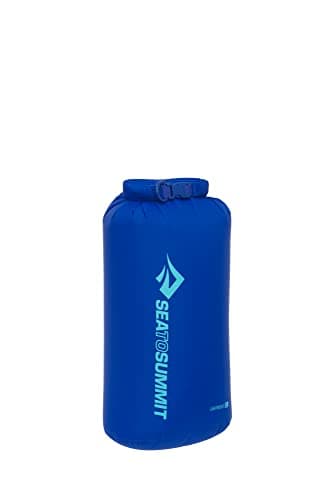
Sea to Summit Lightweight
Recycled 70D nylon
10,000 mm
Taped
2.8 oz at 8 L
Inside a pack
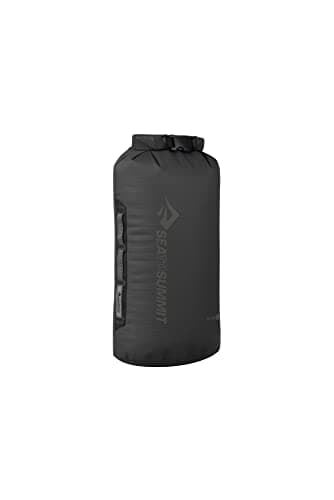
Sea to Summit Big River
TPU-coated 420D nylon
10,000 mm
Double-stitched and tape sealed
4.5 oz at 13 L
Outside a pack, on water
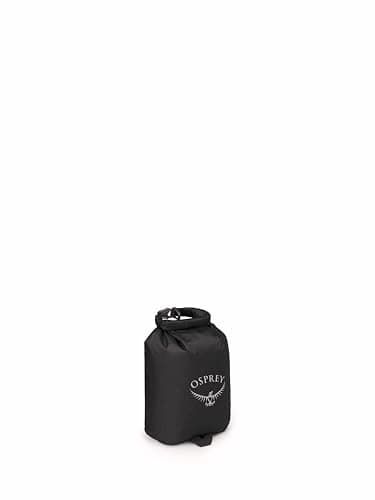
Osprey Ultralight Dry Sack
Recycled 40D nylon
IPX5, non-submersible
Hot-welded tape
0.101 lb at 12 L
Organising, minimum weight
All figures as published by the manufacturers. Note the two rating systems are not directly comparable.
Which sizes to actually buy
Most people buy one large dry bag and find it unwieldy. A set of three or four smaller ones is far more useful, because each becomes a labeled compartment.
3 to 5 L: electronics, first aid kit, documents, a phone and a power bank.
8 to 13 L: a change of clothes, or a down jacket. The workhorse size.
20 L: a sleeping bag, or a full clothing system for a weekend.
35 L and up: only for water sports and roof racks, where a single large bag is lashed rather than carried.
Color-coding them is the small habit that pays: one color for sleep, one for clothes, one for food, one for electronics. Finding the right bag by touch in an unlit tent is worth more than any feature on a spec sheet.
A dry bag is not a compression sack
They look similar and do opposite things. A dry bag keeps water out and traps air, so it resists being squashed. A compression sack squeezes air out to save volume and is not waterproof. Compression dry bags exist and combine the two with a purge valve, but a plain dry bag with a sleeping bag crammed in will fight you. Do not store a sleeping bag compressed in either — synthetic fill takes a permanent set, per how to wash a sleeping bag.
Why a rain cover is not enough
Pack rain covers are useful and widely misunderstood. A cover sheds rain off the outside of a pack, which is genuinely worth having, but water runs down your back and neck straight into the top of the pack under the cover, and a cover does nothing at all if the pack is set down in a puddle or dropped in a stream.
The reliable arrangement is both: a cover to stop the pack fabric soaking up several pounds of water, and dry bags inside for the things that must stay dry. An Osprey Rook 65 publishes an integrated rain cover, and the dry bags inside it are what protect the sleeping bag.
The things that must be dry
In priority order: the sleeping bag, the sleep clothes, the insulating layer, electronics and the first aid kit. A wet sleeping bag is a trip-ending problem, especially a down one, which is the argument in down vs synthetic sleeping bags.
Everything else can get damp without consequence. That is worth knowing because it stops you buying a dry bag for every item and carrying half a pound of nylon you did not need.
Care, and the one thing that kills them
Rinse after saltwater or mud, dry fully inside out, and store them loose and open. A dry bag put away damp and sealed grows mould inside, which is the same coating-destroying process that finishes tents — see how to clean and store a tent.
The other killer is folding the same crease repeatedly, which cracks the coating along a line. Roll them differently each time, and check the roll-top edge and the seam near the buckle first when a bag starts letting water in.
What we did not do
We have not submerged, loaded or weathered any of these. Every fabric, rating, seam construction and weight above is the manufacturer's published specification with a link. Note that Sea to Summit publishes a millimeter waterhead and Osprey publishes an IPX rating, which are different tests measuring different things — we have not converted between them, because there is no honest conversion. See how we research.
The picks in full
1. Best all-round dry bag
Sea to Summit Lightweight Dry Bag
Sea to Summit
Recycled 70D nylon with a 10,000 mm waterhead and taped seams, in seven sizes from 1.5 to 35 L, at 2.8 oz for the 8 L.
Sea to Summit publishes bluesign approved recycled 70D nylon with a C0 non-PFC DWR finish and a white interior polyurethane coating, a 10,000 mm waterhead with taped seams, a hypalon non-wicking roll-top closure with a D-ring, sizes of 1.5, 3, 5, 8, 13, 20 and 35 L, weights of 2.8 oz at 8 L and 5.8 oz at 35 L, an oval base that resists rolling away, and a replaceable 15 mm buckle.
Ten thousand millimeters of waterhead is a specific, comparable figure and it is the one to look for; plenty of dry bags publish nothing at all. It is the same hydrostatic head test used for tent fabric, so a 10,000 mm dry bag is rated several times higher than a typical 1,200 mm family tent fly.
The oval base is the kind of detail that reveals somebody thought about the product in use. A round-based dry bag left on a slope rolls away, usually into the water you were protecting it from. The replaceable buckle is the other one: the buckle is what fails, and on most bags that means the bag is finished.
The drawback
70D is a compromise denier: light enough to carry, thin enough that dragging it across gravel will eventually abrade it.
TPU-coated 420D nylon with a triple-coated base and double-stitched tape-sealed seams, at 4.5 oz for 13 L.
Sea to Summit publishes lightweight waterproof TPU-coated 420D nylon with a triple-coated base, a 10,000 mm waterhead, reinforced waterproof seams that are double-stitched and tape sealed, a secure hypalon roll-top closure with hypalon lash loops for attachment and stacking, weights of 4.5 oz at 13 L and 6.5 oz at 20 L, sizes from 3 L to 65 L, an oval base and a field-replaceable buckle.
Four hundred and twenty denier against 70 is the whole difference. This is the bag for gear that is not inside a pack: strapped into a canoe, lashed to a roof rack, thrown into the back of a truck, or dragged across a beach. The triple-coated base is where that abrasion lands.
The lash loops turn it into a system rather than a sack. You can strap it to a thwart, clip several together, or lash one to the outside of a pack, which is what makes heavy dry bags the standard for water-based camping. For a walk-in trip the weight penalty is real and the lightweight version is the better answer.
The drawback
Six times the denier means noticeably more weight and bulk than the lightweight version for the same volume.
Recycled 40D high-tenacity nylon with hot-welded tape seams, rated IPX5, in five sizes, at 0.101 lb for 12 L.
Osprey publishes bluesign approved 100% recycled 40D high-tenacity nylon, hot-welded tape seams, an IPX5 non-submersible waterproof rating, a roll-top closure with a D-ring, sizes of 3, 6, 12, 20 and 30 L with matching dimensions, weights of 0.062 lb at 3 L and 0.101 lb at 12 L, a rectangular shape for efficient packing, and PFAS-free DWR treatments.
A tenth of a pound for a 12 L bag is the number that makes this different. At that weight you stop rationing dry bags and start using three or four to organize a pack — sleep system in one, clothing in another, food in a third — which is a genuine improvement in how quickly you find things in the dark.
The rectangular shape is a deliberate choice for the same reason: rectangular bags stack inside a pack without leaving the wedge-shaped voids that cylindrical ones do. Read the IPX5 rating honestly, though. This is a rain-and-splash bag, and the 70D or 420D options above are the ones for genuine immersion.
The drawback
IPX5 is non-submersible: this keeps rain and splashes out, and is not the bag for something that might go in a river.
Roll the top down away from you at least three times, keeping the two edges aligned, then clip the buckle. The most common dry bag failure is not the bag - it is a roll-top rolled twice and clipped loosely.
QWhat size dry bags should I buy for camping?
Several small ones rather than one large. 3 to 5 L for electronics and a first aid kit, 8 to 13 L for clothing, 20 L for a sleeping bag, and 35 L and up only for water sports and roof racks. Color-code them so you can find the right one by touch.
QIs a pack rain cover as good as a dry bag?
No. A cover sheds rain off the outside of a pack, but water runs down your back into the top under the cover, and it does nothing if the pack is set in a puddle. Use both: a cover so the pack does not soak up water, and dry bags inside for what must stay dry.
QWhat is the difference between a dry bag and a compression sack?
They do opposite things. A dry bag keeps water out and traps air, so it resists being squashed. A compression sack squeezes air out to save volume and is not waterproof. Compression dry bags combine both with a purge valve.
How we picked
Everyone else in this category will tell you they tested twenty of these. We have not tested any of them, and we would rather say so than pretend. There is no gear closet here and no test lab.
What we did instead: pulled the published specifications from each manufacturer's own spec sheet or manual, named the standard behind every rating so you can check what it actually promises, did the arithmetic that turns a spec into a decision, and pulled today's real retail price rather than quoting one from memory. Every pick states a drawback, because a list where nothing is wrong with anything is an advert.
The limits of that method, stated plainly: published specs do not capture zipper quality, seam durability, or how a tent behaves at 2am in a storm. Where that matters, we say so on the pick. The full method is here.