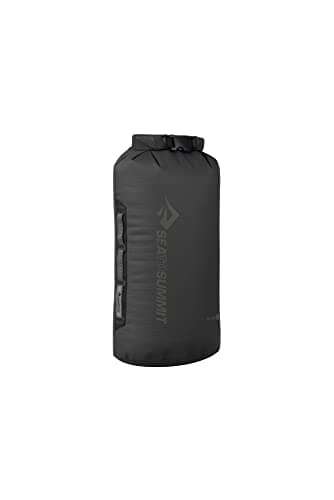
Sea to Summit Big River Dry Bag
Sea to Summit
420D TPU-coated at 10,000 mm with taped seams. The one that actually keeps water out.
$49.95 · Check price on Amazon
#ad how this is funded · price as of October 23, 2026
They look like the same product and do opposite jobs. One keeps water out. The other squeezes air out. Buying the wrong one is how sleeping bags get wet.

Trail & Tarp earns a commission from qualifying purchases made through links on this page, at no extra cost to you. Full disclosure.
The short answer
A dry bag is waterproof and does not shrink your load. A compression sack makes a bulky item small and is not waterproof. If your sleeping bag has to stay dry and pack small, you need a compression dry sack — a third product — or you need both.
The confusion is understandable: both are roll-top nylon sacks. The difference is that a compression sack has straps that pull the two ends together, and a dry bag has a taped, coated construction designed to hold out water.
| Sea to Summit Big River Dry Bag | Sea to Summit Ultra-Sil Compression Sack | |
|---|---|---|
| Job | keep water out | make a bulky item smaller |
| Fabric | TPU-coated 420D nylon, triple-coated base | 30D Ultra-Sil Cordura nylon |
| Waterhead | 10,000 mm | not waterproof; dry version rated 2,000 mm at the base |
| Seams | double-stitched and tape sealed | not sealed |
| Weight | 4.5 oz at 13 L, 6.5 oz at 20 L | 2.6 oz at 10 L |
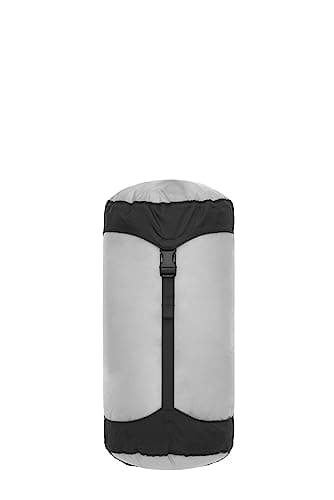
| Compression | none | 10 L down to about 3.3 L |
| Sizes | 3 L to 65 L | 5, 8, 13, 20 and 35 L |
The fabric row explains everything else. A 420D TPU-coated shell at 10,000 mm hydrostatic head is heavy-duty and genuinely waterproof. A 30D Ultra-Sil shell is a third of the thread weight, which is why the compression sack weighs 2.6 oz — and why it is not holding out a river.
Note that a roll-top is water-resistant, not submarine-proof, unless you roll it properly: three full turns and clip. The full range is in best dry bags for camping.
When something is light but enormous. A synthetic sleeping bag and a puffy jacket are the two classic cases: they weigh little and fill half a pack until you squeeze the air out. Sea to Summit publishes 10 L compressing to about 3.3 L, which is roughly a two-thirds reduction.
Compression does nothing for weight — it moves the same mass in a smaller space — and it does nothing for anything already dense. Compressing food, cookware or a tent body achieves almost nothing.
Do not store a sleeping bag compressed
Compression sacks are for carrying, never for storage. Leaving a bag squeezed between trips permanently flattens the loft, and loft is the entire mechanism by which a bag keeps you warm — a crushed bag is a colder bag forever. Store it loose in the large mesh sack it came with, and compress it only on the day you walk. The same logic applies to how you look after it in how to wash a sleeping bag and off-season storage.
Sea to Summit publishes a dry version of the compression sack with a 40D air-permeable waterproof base rated to 2,000 mm. The base has to let air escape while you compress, which is why it is a lower rating than a true dry bag — it is a compromise, and an honest one.
For a down sleeping bag on a wet multi-day trip, that compromise is usually the right buy. For a kayak, it is not; use a real dry bag. The roundup is in best compression sacks and stuff sacks.
| If this is you | Buy |
|---|---|
| Protecting a sleeping bag or down jacket from rain | a compression dry sack |
| Paddling, beach or river camping | a dry bag, 10,000 mm class |
| Fitting a bulky synthetic bag into a small pack | a compression sack |
| Organizing a pack into categories | plain stuff sacks, cheapest option |
| Separating wet and muddy gear | a dry bag |
| Car camping | neither, really; use bins |
For a first backpacking setup, the useful kit is one compression dry sack for the sleeping bag and one small dry bag for electronics and spare layers — everything else can live in cheap stuff sacks. Packing order matters as much as the bags do: how to pack a backpacking backpack.
Sea to Summit
420D TPU-coated at 10,000 mm with taped seams. The one that actually keeps water out.
#ad how this is funded · price as of October 23, 2026
Sea to Summit
10 L down to about 3.3 L at 2.6 oz. The one that makes a bulky bag small.
#ad how this is funded · price as of October 23, 2026
Sea to Summit
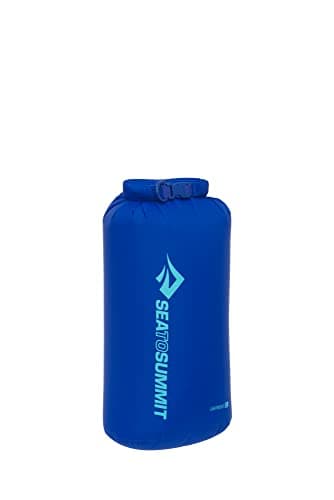
A lighter dry bag for electronics and spare layers inside the pack.
#ad how this is funded · price as of October 23, 2026
A dry bag keeps water out and does not reduce volume; a compression sack squeezes air out of a bulky item and is not waterproof. Sea to Summit publishes a 10,000 mm waterhead and taped seams on the Big River dry bag, against 30D unsealed fabric on the Ultra-Sil compression sack.
Not a standard one. The fabric is thin and the seams are unsealed, so it will shed a shower and nothing more. Sea to Summit makes a dry version with a 40D air-permeable base rated to 2,000 mm, which is the compromise product for keeping a sleeping bag dry while compressing it.
No. It moves the same weight into a smaller space. It also does nothing useful for anything already dense, like food or cookware. Compression pays off on light, bulky items: synthetic sleeping bags and puffy jackets.
Never. Long-term compression permanently flattens the loft that keeps you warm. Store the bag loose in the large mesh sack it came with, and only compress it on the day you carry it.
Every figure on this page comes from a published source. We have not tested this gear, so the numbers are the manufacturer's or the standard body's, not ours. How we research.