The Best Camping Mess Kits, Counted by the Number of People Eating
A mess kit is what you eat off. A cookware set is what you cook in. Buying one expecting the other is the single most common camp-kitchen mistake, and it is why people end up eating dinner out of a saucepan.
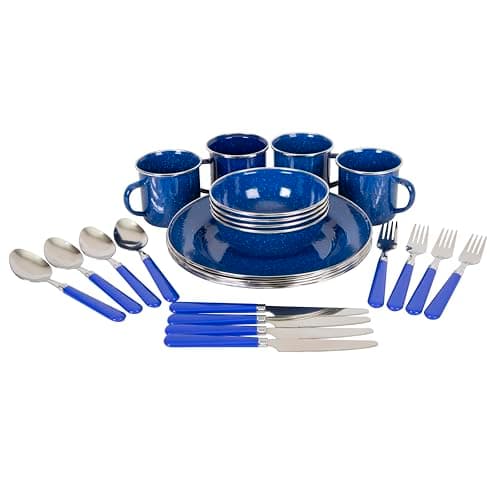
Twenty-four pieces for four people — four 10.5 in plates, four 6 in bowls, four 12 oz mugs and four flatware sets — in double-coated enamel over steel with stainless rims.
A car-camping household that wants crockery rather than camping gear
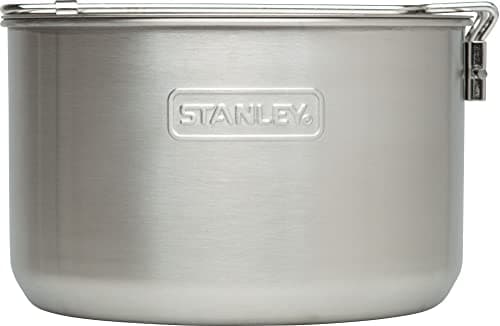
Eight pieces in 18/8 stainless: a 1.58 qt pot with a vented lid, two 20 oz bowls with lids, a folding cutting board, and an extending spatula and ladle, all nesting inside the pot.
Two people who want one object that both cooks the meal and serves it
A mess kit is per-person tableware: a plate, a bowl, a cup and cutlery that nest together. A cookware set is pots and pans you cook in. You need both, they are sold in different aisles, and a cookware set is not something you can comfortably eat four dinners a day out of. The exception is a cook-and-eat kit like the Stanley here, which is a small pot plus bowls.
If you are outfitting from nothing, buy the cookware first — you cannot cook on a plate — then one mess kit per person. The whole-kitchen order of operations is in the camp kitchen setup guide.
Figures as published by each maker on 2026-10-17. Only GSI publishes a weight for its set; the other cells say so rather than carrying an estimate.
That table has an obvious hole in it, and it is not ours. Five of these six makers do not publish a weight for a product whose entire selling point is that it packs small. GSI is the only one you can compare on paper, which is one of the reasons it is the overall pick.
The four materials, and what each one costs you
Polypropylene (GSI). Lightest, cheapest, dishwasher safe, and it stains permanently from anything with turmeric or tomato in it. It will also deform against a hot pan.
Reinforced glass nylon (UCO). Stiffer and more heat-tolerant than polypropylene, which is why UCO can claim microwave safety. Heavier, and the same staining applies.
Enamel over steel (Stansport, Coleman). Takes heat, washes clean in cold water, does not stain, and chips when dropped on stone — after which the exposed steel rusts. Heaviest by a wide margin.
Stainless steel (Stanley). Indestructible, no staining, no flavor retention, and it will burn your hand when hot food goes in it. Also the only material here you can put directly on a camp stove.
Count the cups, not the pieces
“24 pieces” sounds generous until you divide it: four people, three flatware pieces each, is twelve of the twenty-four. Piece counts are marketing arithmetic. The number that tells you whether a set works for your household is how many people can eat and drink simultaneously, which is why the comparison table above has a “serves” column before it has a “pieces” one.
Washing it, which is where cheap kits get thrown away
Camp dishes are not thrown away because they break. They are thrown away because something soured in a closed bag and nobody wanted to deal with it. Three habits prevent that completely:
Wash before the food dries, store in mesh rather than sealed plastic, and never pack a kit that is still damp into a bin that will sit in a garage until spring. The campsite procedure is in how to wash dishes at a campsite, including where the water goes, and the off-season side is in how to store camping gear in the off-season.
What to buy
For a family that drives to the campsite, buy the Stansport Deluxe enamel set. It is the one that makes camp food feel like dinner rather than like rations, it survives children, and the weight does not matter in a car.
For one person, or per person in a group that walks in, buy the GSI Cascadian Table Set — 7.5 oz for a complete setting, and the only kit here with published numbers to check. Buy the UCO 6-Piece instead if the seal-and-carry trick appeals. Buy the Stanley All-in-One if there are two of you and you would rather own one object than two. Buy the UCO 4-Piece as a child's kit and add a real mug.
The picks in full
1. Best overall, per person
GSI Outdoors Cascadian Table Set, 1 Person
GSI Outdoors
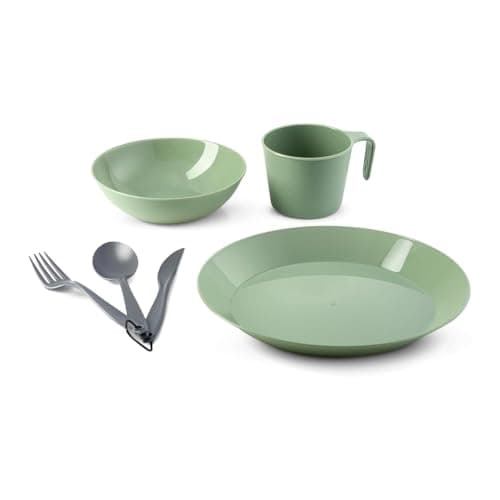
Six pieces — plate, bowl, cup, fork, knife, spoon — at 7.5 oz in a 9.7 by 9.7 by 3.2 in stack, with a mesh sack and a lifetime warranty.
GSI publishes a six-piece set — plate, bowl, cup, fork, knife and spoon — a weight of 7.5 oz, a packed size of 9.7 by 9.7 by 3.2 in, BPA-free recyclable polypropylene construction, a mesh storage sack, and GSI's lifetime warranty against defects.
This is the set we would buy one of per family member, and the reason is the published weight. Two complete place settings for under a pound is not a compromise against real crockery, it is a different category of object, and at this price you can buy four without thinking about it.
The mesh sack is not packaging, it is the feature. A mess kit washed at a dish station goes back into the sack wet, drains, and dries hanging off a tree instead of souring inside a dry bag. Kits sold in a zip pouch do the opposite.
The drawback
Polypropylene stains with tomato and curry, the cup is small by any coffee-drinker's standard, and a rigid plate does not nest into a pot the way a bowl-only kit does.
Twenty-four pieces for four people — four 10.5 in plates, four 6 in bowls, four 12 oz mugs and four flatware sets — in double-coated enamel over steel with stainless rims.
Published as 24 pieces serving four: four 10.5 in plates, four 6 in bowls, four 12 oz mugs, and four three-piece flatware sets, in double-coated enamel over steel with stainless steel rim edging.
The stainless rim is the specification to care about. The classic enamelware failure is a chipped edge that rusts, and a stainless band around the rim removes the most vulnerable millimeter of the plate. It is the difference between a set that lasts a decade and one that looks sad after two seasons.
It also handles heat, which no polypropylene kit does. Enamel over steel can take food straight off a griddle or out of a dutch oven without warping or absorbing flavor, and it washes clean in cold water, which plastic resists. For the household this site is written for, this is the honest answer: real plates, in a box, that live in the car.
The drawback
Enamel chips if you drop it on concrete, and the chip rusts. Stansport publishes neither a set weight nor a packed size, and this is heavy and bulky next to any plastic kit. Not for backpacking at any price.
Published specs
Serves
4
Pieces
24: four 10.5 in plates, four 6 in bowls, four 12 oz mugs, four 3-piece flatware sets
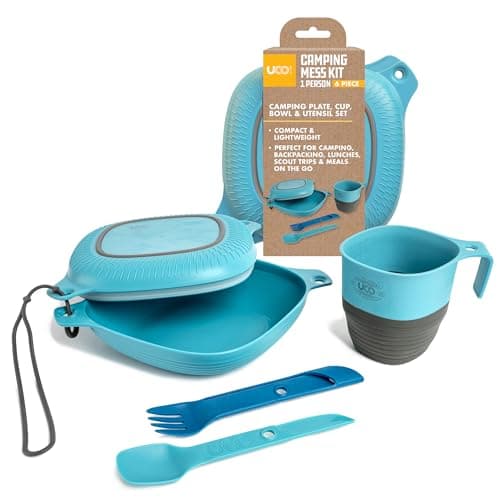
Plate and bowl that clamp into an airtight seal with a collapsible cup inside and a three-piece Switch Spork set, packed at 8 by 8 by 3 in.
UCO publishes a six-piece set — plate, bowl, collapsible cup, a two-piece Switch Spork utensil set and a tether — a packed size of 8 by 8 by 3 in, rubberized bases on the plate and bowl, reinforced glass nylon construction, phthalate-free material, and dishwasher and microwave safety.
The airtight seal between plate and bowl is the genuine innovation here. It makes the kit a container: leftovers go in the bowl, the plate clamps on, and the whole thing goes in a cooler without decanting into anything. Nothing else on this page does that.
The rubberized bases are the other quietly good detail, and anyone who has watched a plastic bowl slide off a sloping picnic table in the wind will understand why UCO bothered.
The drawback
UCO publishes no weight for this set, the collapsible cup is the first thing in any kit to perish, and the joined-spork trick is more charming than useful.
Eight pieces in 18/8 stainless: a 1.58 qt pot with a vented lid, two 20 oz bowls with lids, a folding cutting board, and an extending spatula and ladle, all nesting inside the pot.
Stanley publishes eight pieces: a 1.58 qt pot, a vented pot lid, two 20 oz bowls, two bowl lids, a folding cutting board, a spatula with an extending handle and a ladle with an extending handle. Construction is BPA-free 18/8 stainless steel, everything nests inside the pot, the pot's locking handle holds the stack shut, it is dishwasher safe and it carries Stanley's lifetime warranty.
We are including this because it answers the question most people are actually asking when they search for a mess kit for two. The complete picture — cook it, serve it, eat it, lid the leftovers, pack it into one pot — is more useful to a couple than a plate and a cup each.
The cutting board inside the pot is the detail that shows somebody thought about it. The thing you need before cooking is a flat surface, and it is the thing a campsite never has. If you want cookware rather than tableware, the proper comparison is in best camping cookware sets.
The drawback
This is a cookware set with bowls, not a mess kit — no plates, no cups. Stainless is heavy, Stanley publishes no set weight, and the extending handles are the part most likely to annoy you.
Published specs
Serves
2
Pieces
8: 1.58 qt pot, vented lid, two 20 oz bowls, two bowl lids, folding cutting board, extending spatula, extending ladle
Material
BPA-free 18/8 stainless steel
Packing
everything nests; the pot's locking handle holds it shut
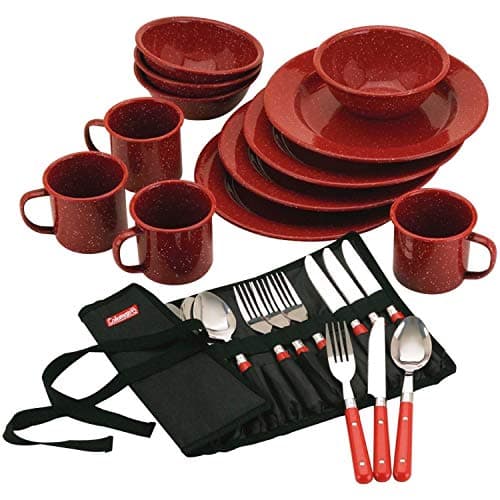
Twenty-four pieces for four in double-fired speckled enamelware, with the flatware in a roll-up pouch and a published dishwasher-safe claim.
Coleman publishes 24 pieces serving four: four 10 in dinner plates, four bowls, four mugs and twelve flatware pieces in a roll-up pouch, in double-fired enamelware with a speckled finish, and it is published as dishwasher safe.
Set side by side with the Stansport, the comparison is unusually clean — same piece count, same material, same four settings — and it comes down to two published differences. Coleman publishes a dishwasher claim and Stansport does not. Stansport publishes stainless rim edging and Coleman does not.
We would take the rim. A chipped enamel edge rusts, and that is how enamelware actually dies; a dishwasher is a convenience you can replace with a sink. The roll-up flatware pouch is a genuinely nice touch though, and if you already run a Coleman stove and like the look matching, that is a reasonable thing to buy on.
The drawback
No stainless rim edging, which is the Stansport's one real advantage and the exact place enamel fails. Costs more than the Stansport for a set with one fewer protection, and Coleman publishes no weight or packed size either.
Published specs
Serves
4
Pieces
24: four 10 in plates, four bowls, four mugs, 12 flatware pieces in a roll-up pouch
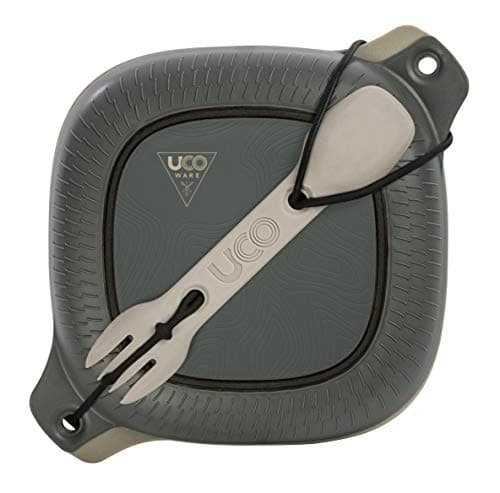
A plate, a bowl that seals to it, and a 3-in-1 Spork with a serrated edge, tethered together so nothing walks off.
Published as four pieces: plate, bowl, 3-in-1 Spork and tether, with an airtight seal between plate and bowl, rubberized non-slip bases, reinforced glass nylon construction, phthalate-free material, and dishwasher and microwave safety.
The tether is the reason this is the one to buy for a child. Camp cutlery disappears — into long grass, into the washing-up bowl, into a pocket — and a utensil physically attached to the plate does not. For a family kit, that is worth more than any spec.
Buy a proper insulated mug alongside it rather than paying up for the six-piece set with the collapsible cup. A real mug keeps coffee hot for an hour; a folding plastic cup keeps it hot for four minutes.
The drawback
No cup, which means you still need a mug. No published weight. A spork is a compromise at both ends, and the serrated 'knife' edge will not cut a steak.
Published specs
Serves
1
Pieces
4: plate, bowl, 3-in-1 Spork, tether
Closure
plate and bowl seal together airtight
Utensil
spoon one end, fork with a serrated edge the other
Grip
rubberized bases, so the bowl stays on a picnic table
QWhat is the difference between a mess kit and a camping cookware set?
A mess kit is per-person tableware: a plate, a bowl, a cup and cutlery that nest together. A cookware set is pots and pans for cooking over heat. You need both. A few products straddle the line, like the Stanley All-in-One, which is a small pot with two lidded bowls.
QWhat should a camping mess kit include?
One plate, one bowl, one cup and three utensils per person, which is exactly the six-piece configuration GSI and UCO both sell. Anything less and you are eating off a lid; anything more is usually flatware count padding the piece total.
QIs enamel or plastic better for camp dishes?
Enamel over steel if you drive to the campsite: it takes heat, washes clean in cold water and does not stain, at the cost of weight and the risk of chipping. Polypropylene or glass nylon if you carry your kit: a complete GSI setting is 7.5 oz, where four enamel plates alone are heavier than that several times over.
QCan you put a camping mess kit in the dishwasher?
The UCO and GSI plastic kits are published as dishwasher safe, and UCO also publishes microwave safety for its glass nylon. The Stanley stainless set is dishwasher safe. Enamel sets are generally fine but Stansport does not publish a dishwasher claim, so hand wash that one.
QHow much does a camping mess kit weigh?
GSI publishes 7.5 oz for its complete one-person, six-piece set, and it is the only maker on this page that publishes a weight at all. For a product sold on packing small, that absence is worth noting rather than filling in with an estimate.
How we picked
Everyone else in this category will tell you they tested twenty of these. We have not tested any of them, and we would rather say so than pretend. There is no gear closet here and no test lab.
What we did instead: pulled the published specifications from each manufacturer's own spec sheet or manual, named the standard behind every rating so you can check what it actually promises, did the arithmetic that turns a spec into a decision, and pulled today's real retail price rather than quoting one from memory. Every pick states a drawback, because a list where nothing is wrong with anything is an advert.
The limits of that method, stated plainly: published specs do not capture zipper quality, seam durability, or how a tent behaves at 2am in a storm. Where that matters, we say so on the pick. The full method is here.