The Best Backpack Coolers, Where Hands-Free Costs You Ice Hours
A backpack cooler exists for one reason: the pitch is further from the car than you want to carry a cooler. That reason is worth more than any ice-retention figure on this page.
A backpack cooler is the right purchase when the distance from the car to the pitch is more than you want to carry a hard cooler - a walk-in site, a beach, a hike-in picnic spot, a canoe portage. If you can park next to the tent, a hard cooler holds more, keeps ice for days rather than hours, and costs less. Buy a backpack cooler for the carry, and nothing else on this page will disappoint you.
That sounds obvious and it is the most commonly skipped step. The published retention figures here are 24 and 36 hours; a rotomolded hard cooler is measured in days. Any soft cooler is a significant insulation downgrade, accepted deliberately in exchange for being wearable. If the carry is not the problem, you are paying for a solution to a problem you do not have - the comparison is in best coolers for camping.
It is also worth being clear what a backpack cooler is not. The site's soft cooler picks are cube and tote styles carried by a handle or a shoulder strap, which is a different job: hands-free over a quarter mile is the only thing a harness buys you, and it costs about a pound of weight and some capacity against a tote of the same volume.
What to look for
Specification
What to want
Why
Empty weight
under 4 lb
it is the only number you carry before adding ice, which is most of the load
Closure
magnetic or welded watertight zipper
the closure is what fails first on every soft cooler
Seams
welded, not stitched
stitch holes are where meltwater leaves and warm air arrives
Capacity
15 to 20 cans for a day, more only if someone else carries
a 36-can cooler fully loaded is heavier than you think on a trail
Structure
semi-rigid, stands upright
a slumping cooler presses its contents into your back
Back panel
padded with adjustable straps
the difference between a pack and a sack with straps
What decides whether a backpack cooler suits the walk, rather than how cold it claims to stay.
Empty weight is deliberately first. Ice is the heavy part of a loaded cooler, and the only way to carry more ice is to start with less cooler. Two and a half pounds of difference between the lightest and heaviest here is five or six cans' worth of payload.
Compared on published numbers
Cooler
Capacity
Cold retention
Empty weight
Closure
Shell
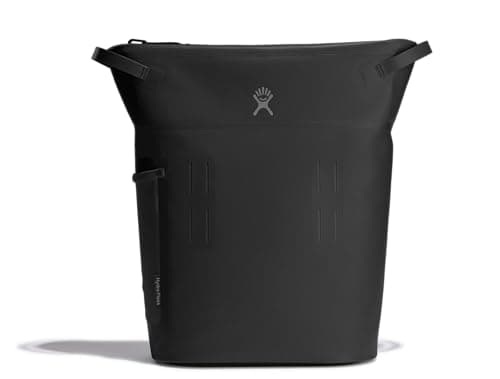
Hydro Flask 20 L Day Escape
20 L, 36 cans no ice
36 hours
3 lb
watertight zipper, welded seams
600D polyester
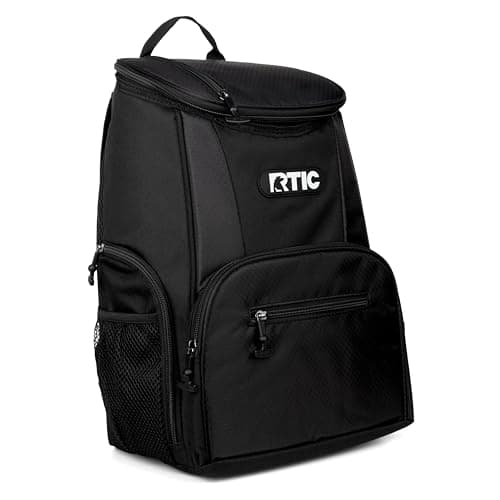
RTIC Lightweight Backpack
15 cans
up to 24 hours
not published
zipper
heavy-duty polyester
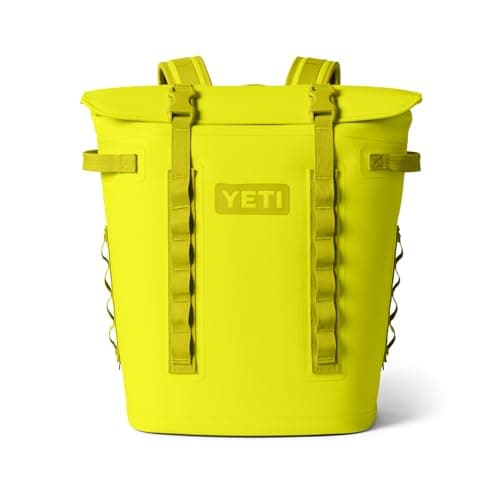
YETI Hopper M20
18 cans at 2:1 ice
not published as hours
5.6 lb
MagShield magnetic
DryHide
Figures as published by each manufacturer, and not directly comparable - see the note below.
The two blank cells are the honest state of this category. RTIC does not publish a weight for this model and YETI does not publish an hour figure, so neither cell can be filled without inventing a number. YETI's choice is arguably the better one: an hour claim with no stated ice ratio is almost meaningless, because a cooler packed 2:1 with ice behaves nothing like one with a single ice pack in it.
Ice ratio is the number that actually decides it
Retention claims assume a cooler packed properly, which means roughly two parts ice to one part contents by volume, pre-chilled, and opened as little as possible. Load one of these with warm cans and one small ice pack and none of the figures above apply.
What you do
Effect on cold
Pre-chill the cooler and the drinks overnight
largest single gain - you are not spending ice cooling the cans
Pack 2 parts ice to 1 part contents
what the published figures assume
Use block ice or hard ice packs instead of cubes
less surface area, slower melt
Leave the meltwater in
cold water is still cold; draining it makes things worse
Open it four times an hour
the fastest way to lose a published figure
Leave it in direct sun on the sand
a soft shell has far less insulation than a hard cooler to resist this
Technique changes retention more than the choice between these three coolers does.
That last row is the one specific to this category. A soft cooler's walls are thin by design, so sun on a dark shell matters in a way it does not on a rotomolded box. Put it in the shade or under a tarp and you will get closer to the claimed hours than any purchase decision will take you.
A loaded 36-can cooler is not a day pack
Twenty liters packed 2:1 with ice is roughly 30 to 35 lb on your back, carried in a bag with no frame, no load lifters and no hipbelt worth the name. That is fine for a quarter mile across a beach and unpleasant for two miles uphill. If the walk is long, carry less ice and fewer cans rather than buying a bigger cooler, and read how to fit a backpack for why a frameless load sits so differently from a hiking pack.
Which to buy
Buy the Hydro Flask 20 L Day Escape Soft Cooler Pack if you want one backpack cooler to cover walk-in campsites and beach days. Thirty-six hours of published retention at 3 lb empty is the best pairing of the two numbers that matter here, and the welded seams are what keep meltwater inside on the walk back.
Buy the RTIC Lightweight Backpack Cooler if the trip is a day out and back. Twenty-four hours is more cold than a dawn-to-dusk trip needs, the semi-rigid body keeps the contents off your spine, and the price difference against the YETI is enough to buy a season of ice packs and a bottle as well.
Buy the YETI Hopper M20 if you have already worn out a soft cooler's zipper, or if the thing gets loaded and unloaded hard several times a month. MagShield removes the component that fails and lets you pack it one-handed, and DryHide is the shell that survives being dragged. Accept the 5.6 lb and the price as what those two things cost. If the carry is not actually the problem, go back to best coolers for camping and buy more insulation for less money.
The picks in full
1. Best overall
Hydro Flask 20 L Day Escape Soft Cooler Pack
Hydro Flask
20 L and 36 cans without ice, 36 hours of cold retention, 3 lb empty, with a watertight zipper and welded seams.
Hydro Flask publishes a 20 L capacity, 36 cans without ice, 36 hours of cold retention, a 3 lb empty weight, a 17.70 by 13.00 by 7.80 in body, a waterproof 600D polyester shell, a watertight zipper with welded seams, an FDA food-grade BPA-free liner, and shoulder straps plus a removable cross-body strap.
Thirty-six hours against the RTIC's 24 is the headline, and 3 lb empty against the YETI's 5.6 is the one that decides the walk. Those two numbers together are why this wins: it is the only pick here that is both the lightest-but-one and the coldest, which in a category built on a weight-versus-insulation trade is unusual.
The welded seams and watertight zipper are the practical difference from a cheap insulated bag. A soft cooler that leaks is a soft cooler you carry on your back down a trail, and melted ice finds any stitched seam. Welded means there are no stitch holes to find. The cross-body strap also matters more than it sounds - 20 L of ice and cans is heavy enough that you will want to swing it onto one shoulder for the last hundred yards.
The drawback
A watertight zipper is stiff and has to be worked rather than pulled, and it is the component that will eventually fail. Thirty-six cans of capacity also means you can load it past what you want on your back.
15 cans and up to 24 hours of cold from high-density foam, in a semi-rigid body that stands up on its own, for a quarter of the YETI's price.
RTIC publishes a 15-can capacity, cold retention up to 24 hours, high-density foam insulation, a heavy-duty polyester shell, an FDA food-contact-approved antimicrobial liner that resists odor, mold and mildew, a semi-rigid structure that stands upright, two mesh side pockets, an interior mesh pocket in the lid, and a padded back panel with adjustable straps.
The semi-rigid structure is the underrated feature. A soft cooler that slumps has to be packed standing in something; one that holds its own shape can be loaded on the ground at the car and set down at the pitch without everything inside rearranging itself. That is also what stops the contents pressing into your back on the walk.
Twenty-four hours is honest for what most people do with one of these. If the cooler goes out in the morning and comes back at dusk, the difference between 24 and 36 hours is theoretical, and the money is better spent on the ice packs that actually determine how long it lasts.
The drawback
RTIC does not publish a weight or dimensions for this model, and 24 hours is the shortest retention here. Fifteen cans is a day out, not a weekend.
18 cans at a 2:1 ice ratio in a ColdCell closed-cell foam body, with a magnetic wide mouth instead of a zipper.
YETI publishes a capacity of 18 cans at a 2:1 ice ratio by volume, exterior dimensions of 15.3 by 9.9 by 18.1 in, interior dimensions of 11.6 by 8.9 by 14 in, a 5.6 lb empty weight, ColdCell closed-cell foam insulation, MagShield magnetic wide-mouth access that is leak resistant, a DryHide high-density shell resistant to punctures and UV, and a HitchPoint grid for accessories.
MagShield is the reason to consider this. On every soft cooler, the closure is the part that fails: a watertight zipper is a wear item, it needs lubricating, and when it goes the cooler is finished. Magnets have nothing to wear out and they let you load the thing one-handed, because the mouth stays open by itself.
Note what YETI publishes and what it does not. A can count at a 2:1 ice ratio is a genuinely more useful number than a bare hour figure, because retention depends entirely on how much ice you put in - but it is not comparable to the other two coolers' hour claims, and nobody should pretend otherwise. The physics behind that is in how long does ice last in a cooler.
The drawback
5.6 lb empty is nearly double the Hydro Flask, before any ice goes in, and YETI publishes no hour figure for cold retention - only a can count at a stated ice ratio. It is also by far the most expensive thing here.
Published specs
Capacity
18 cans at a 2:1 ice ratio by volume
Exterior
15.3 x 9.9 x 18.1 in
Interior
11.6 x 8.9 x 14 in
Empty weight
5.6 lb
Insulation
ColdCell closed-cell foam
Closure
MagShield magnetic wide mouth, leak resistant
Shell
DryHide high-density fabric, puncture and UV resistant
Only for the carry. A hard cooler holds more and keeps ice for days rather than the 24 to 36 hours these publish, and it costs less. A backpack cooler is worth it when the pitch is a walk from the car - a walk-in site, a beach, a portage - because hands-free over a few hundred yards is a real benefit that no amount of insulation substitutes for.
QHow long do backpack coolers keep ice?
The published figures here are up to 24 hours for the RTIC and 36 hours for the Hydro Flask, both assuming a cooler packed roughly two parts ice to one part contents, pre-chilled and kept shut. YETI publishes a can count at a 2:1 ice ratio rather than an hour figure, which is arguably more honest since retention depends entirely on how much ice goes in.
QWhat size backpack cooler do I need?
Fifteen to twenty cans for a day trip. Capacity is tempting to over-buy because the empty bag feels light: twenty liters packed 2:1 with ice is roughly 30 to 35 lb on a frameless harness, which is fine across a beach and unpleasant for two miles uphill. If the walk is long, carry less rather than buying bigger.
QIs a magnetic closure better than a zipper on a soft cooler?
It removes the part that normally fails. A watertight zipper on a soft cooler is a wear item that needs lubricating and ends the cooler's life when it goes; YETI's MagShield has nothing to wear out and stays open by itself for one-handed loading. A welded watertight zipper, like the Hydro Flask's, seals better while it lasts.
QWhat is the difference between a backpack cooler and a soft cooler?
The harness, and about a pound. A soft cooler is a cube or tote carried by a handle or shoulder strap and gives you more capacity per pound; a backpack cooler trades some of that for shoulder straps, a padded back panel and hands-free carrying. If you never walk more than a few steps with it, the tote is the better buy.
How we picked
Everyone else in this category will tell you they tested twenty of these. We have not tested any of them, and we would rather say so than pretend. There is no gear closet here and no test lab.
What we did instead: pulled the published specifications from each manufacturer's own spec sheet or manual, named the standard behind every rating so you can check what it actually promises, did the arithmetic that turns a spec into a decision, and pulled today's real retail price rather than quoting one from memory. Every pick states a drawback, because a list where nothing is wrong with anything is an advert.
The limits of that method, stated plainly: published specs do not capture zipper quality, seam durability, or how a tent behaves at 2am in a storm. Where that matters, we say so on the pick. The full method is here.