The Best Bluetooth Speakers for Camping, and How Loud Is Too Loud at a Campground
The right campsite speaker is smaller than the one you want. Sound carries further outdoors than it does in a room, your neighbors are thirty feet away, and the loudest speaker on this page is the one most likely to be asked to turn it off.
The working rule at any developed campground is that your music should not be audible at the next site. Most campgrounds also enforce quiet hours, commonly from around 10pm to 6am, during which amplified sound is not permitted at all. Those two rules together mean a small speaker played quietly is not a compromise — it is the only configuration that complies. Each campground publishes its own hours, and the posted rule at the site you are visiting is the one that applies.
Sound also behaves differently outdoors than it does in a living room. Indoors, walls reflect sound back at you and it dies quickly beyond them. Outdoors there is nothing to absorb it, so a speaker that sounds moderate at your picnic table is clearly audible several sites away — and across water or a canyon, much further. This is the mechanism behind almost every campground noise complaint, and it is why we have made the smallest speaker here the overall pick.
Compared on published numbers
Speaker
Output
Playtime
Rating
Power bank
Carry
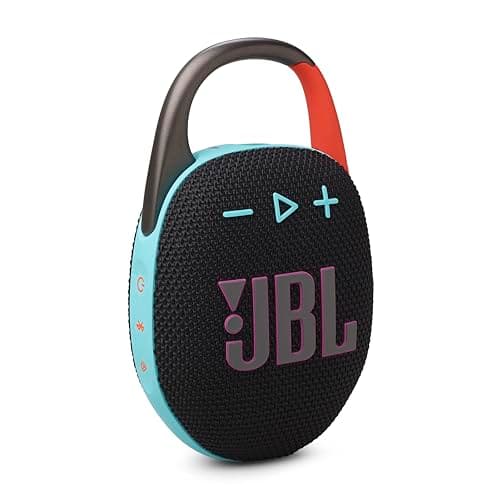
JBL Clip 5
not published
12 h, +3 h Boost
IP67 (dust-tight)
no
integrated carabiner
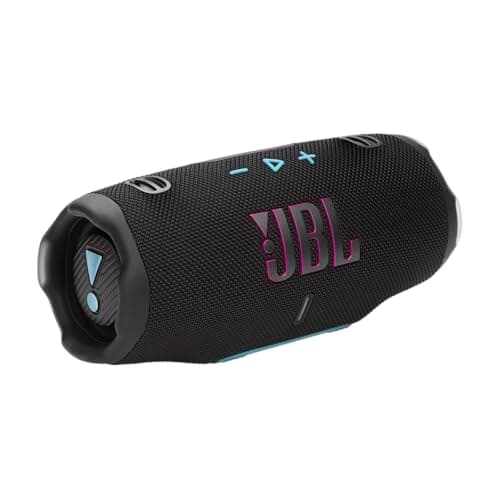
JBL Charge 6
not published
24 h, +4 h Boost
IP68, drop-proof 1 m
yes, phones only
removable handle strap
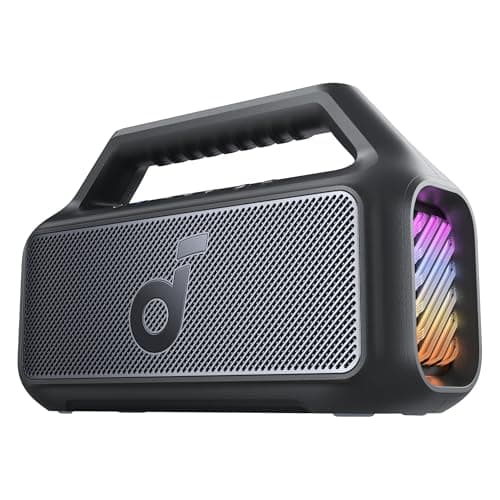
Soundcore Boom 2
80 W
up to 24 h
IPX7, floats
yes
handle
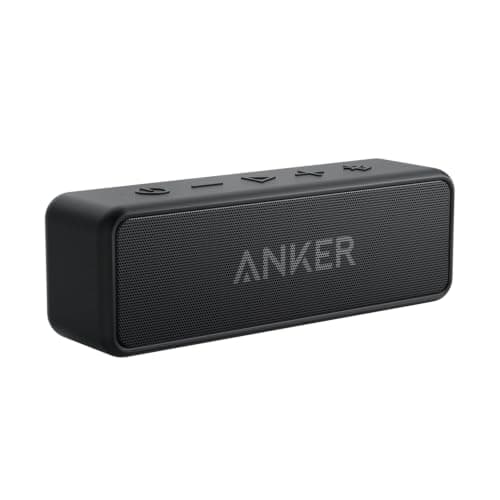
Anker Soundcore 2
12 W
up to 24 h
IPX7
no
none
Figures as published by each maker on 2026-10-17. JBL publishes no output wattage for either of its speakers, so the two brands cannot be compared on loudness; those cells say so rather than carrying an estimate.
The useful finding in that table is the ingress column. IP67 and IP68 both carry a tested dust rating; IPX7 does not, because the X means dust was never tested. At a dry, dusty site — which is most dispersed camping in summer — dust ingress is the more likely failure, and only the two JBLs are rated for it.
What IP67, IP68 and IPX7 actually promise
IP ratings are two digits. The first is solid particles and runs 0 to 6, where 6 means dust-tight. The second is water and runs 0 to 9, where 7 means 30 minutes submerged at 1 m and 8 means a deeper or longer immersion that the maker has to state — which is why JBL specifies 1.5 m for 30 minutes for the Charge 6.
An X in either position means that property was not tested, not that it failed. So IPX7 is a genuine waterproof claim with no dust claim beside it. None of these ratings covers water jets at pressure, and none of them is a promise about salt water — rinse any speaker that has been near the sea.
A speaker is not a lantern, and a lantern is not a speaker
Combination lantern-speakers exist and are a poor version of both: too dim to light a picnic table, too tinny to enjoy, and the battery drains twice as fast because it is doing two jobs. Buy a lantern for light and a speaker for sound. The exception worth considering is the Boom 2's RGB lights, which are decoration rather than illumination — and at a campsite trying to keep its lighting under control, they are a feature to switch off.
Charging it at a campsite
All four speakers here charge over USB, and none of them is a meaningful load. A 5,200 mAh speaker battery is roughly a single phone charge, so a mid-size power bank refills one several times and a power station will do it dozens of times over. The watt-hour arithmetic is worth running once for your whole kit, because a speaker is the smallest line on it.
The practical note is the one JBL buries: there is no USB-C cable in the Charge 6 box. Check what you own before you leave, because a speaker with a 28-hour battery and no way to refill it is a 28-hour speaker.
What to buy
Buy the JBL Clip 5. It is loud enough for your own site and not loud enough for anyone else's, it is the only pick here with a tested dust rating and a built-in way to hang it up, and twelve hours covers an evening and the next day.
Buy the JBL Charge 6 if your trips are long and unpowered and you want the speaker to charge phones too. Buy the Soundcore Boom 2 only if volume is genuinely the point and you are not at a developed campground. Buy the Anker Soundcore 2 if you want to spend the least and find out whether you use it.
Then play it quietly. The reason most people camp is more or less the opposite of the reason most people buy speakers, and the gear that makes a campsite better is mostly the gear that nobody else notices — how to set up a comfortable campsite covers the rest of it.
The picks in full
1. Best overall for a campsite
JBL Clip 5
JBL
Up to 12 hours of playtime plus 3 with Playtime Boost, an IP67 rating, and a built-in carabiner that means it hangs instead of sitting in the dirt.
JBL publishes up to 12 hours of playtime plus up to 3 more with Playtime Boost, an IP67 rating (dust-tight and good for 30 minutes at 1 m of water), a redesigned fully integrated carabiner with a wide opening, and Auracast multi-speaker pairing including stereo-pairing two Clip 5s.
The carabiner is the reason this is the pick, which sounds like faint praise until you have camped with a speaker that has nowhere to live. Clipped to a tent loop or the frame of a canopy, it is off the ground, out of the spilled drinks, at head height where you can hear it quietly, and impossible to leave behind when you pack up.
IP67 is the other reason. The first digit is dust and the second is water, so a 6 means dust-tight — which matters more at a dry dispersed site than waterproofing does. Every other speaker here is IPX7, where the X means no dust rating was tested at all.
The drawback
JBL publishes no output wattage for the Clip 5, so you cannot compare its loudness on paper to the Boom 2's 80 W. It also has no power-bank output, so it is one more thing to charge rather than a thing that charges others.
2. Best battery, and the one that earns its place twice
JBL Charge 6
JBL
Up to 28 hours of playtime, IP68 and drop-proof from 1 m, a built-in power bank for phones, and 150 minutes of playtime from a 10-minute charge.
JBL publishes up to 28 hours of playtime (24 hours plus 4 with Playtime Boost), fast charging that gives up to 150 minutes of playtime from 10 minutes on the charger, an IP68 rating with drop-proofing from 1 m and lab submersion testing to 1.5 m for 30 minutes, Auracast pairing, a removable handle strap, and a built-in power bank that charges mobile devices but not laptops. There is no USB-C cable in the box.
Twenty-eight hours is the figure that changes how you pack. A speaker that lasts a long weekend is a speaker you never think about, and that is worth more at a campsite than any sound-quality difference you will notice over a fire.
The power bank makes it a dual-purpose object, which is how it justifies its size. It is not a replacement for a proper power bank — running the speaker and charging a phone from the same cell is a zero-sum game — but as an emergency top-up on day three it is genuinely useful.
The drawback
The most expensive speaker here, big enough to be a packing decision, and JBL ships no USB-C cable in the box. The power bank will not charge a laptop.
Published specs
Battery
up to 28 h: 24 h plus 4 h with Playtime Boost
Fast charge
10 min gives up to 150 min of playtime
Ingress rating
IP68 and drop-proof from 1 m; JBL tests submersion to 1.5 m for 30 min
Power bank
built in, phones only; it will not charge a laptop
80 W with a dedicated subwoofer and BassUp 2.0, up to 24 hours of playtime, IPX7, floatable, with a built-in power bank and app EQ.
Soundcore publishes 80 W of output, a dedicated subwoofer with BassUp 2.0, up to 24 hours of playtime (volume dependent), an IPX7 rating, a floatable design, a built-in power bank, customizable EQ through the app, and RGB lights.
This is here because it is the honest answer to “I want it loud”, and because 80 W is the only published output figure on this page — JBL publishes none for either of its speakers, which makes a like-for-like loudness comparison impossible.
It floats, which is a real feature if your camping involves a lake or a kayak. And it is the one we would push hardest on etiquette: at a campground with sites thirty feet apart, 80 W used anywhere near its capability is a complaint. Buy it for a group site, a private property or a beach — see the beach camping guide.
The drawback
80 W is more speaker than a campground should hear and this is the one most likely to make you unpopular. IPX7 carries no dust rating, and the RGB lights are the opposite of what you want at a dark site.
12 W from dual neodymium drivers, a 5,200 mAh battery published at up to 24 hours, IPX7, and stereo pairing with a second unit.
Anker publishes 12 W of output from dual neodymium drivers, a 5,200 mAh lithium-ion battery good for up to 24 hours, an IPX7 rating, BassUp processing with a spiral bass port, and wireless stereo pairing with a second unit. It has no power-bank output.
Twelve watts and twenty-four hours is the combination that makes this a good campsite speaker rather than a cheap one. Low output is not a flaw at a campground — it is the correct specification — and a small amplifier draining a 5,200 mAh cell slowly is why the runtime matches speakers several times the price.
Buy this one if you are not sure you want a camp speaker at all. It is the cheapest way to find out, and if it ends up living in the gear bin permanently, nothing has been wasted.
The drawback
No power-bank output, no carabiner or strap, no dust rating, and 12 W is quiet enough that a windy site will drown it. An older design than everything else here.
For a developed campground, the smallest one that still sounds good, because sound carries much further outdoors than indoors. The JBL Clip 5 is our pick: 12 hours of playtime plus 3 with Boost, an IP67 dust-tight and waterproof rating, and an integrated carabiner so it hangs off a tent loop instead of sitting in the dirt.
QHow loud can you play music at a campground?
The working rule is that it should not be audible at the next site, and most campgrounds also enforce quiet hours when amplified sound is not permitted at all, commonly around 10pm to 6am. Posted hours vary by campground, so the rule at the site you are visiting is the one that applies.
QWhat does IPX7 mean on a camping speaker?
IPX7 means tested to 30 minutes submerged in 1 m of water, with no dust rating tested at all: the X is an untested property, not a failed one. IP67 adds a 6 for dust-tight, and IP68 is a deeper or longer immersion the maker must state. For dusty dispersed camping the dust digit matters more than the water one.
QCan a camping speaker charge your phone?
The JBL Charge 6 and Soundcore Boom 2 both publish a built-in power bank, phones only in the Charge 6's case. The JBL Clip 5 and Anker Soundcore 2 do not. Running a speaker and charging a phone from the same cell is zero-sum, so a speaker power bank is an emergency top-up rather than a reason to leave the real one at home.
QHow long do camping speaker batteries last?
On published figures, 12 hours for the JBL Clip 5 (plus 3 with Playtime Boost) and up to 24 hours for the Charge 6, Boom 2 and Soundcore 2. All of these are maximums at moderate volume, and Soundcore states explicitly that its figure varies with volume and content.
How we picked
Everyone else in this category will tell you they tested twenty of these. We have not tested any of them, and we would rather say so than pretend. There is no gear closet here and no test lab.
What we did instead: pulled the published specifications from each manufacturer's own spec sheet or manual, named the standard behind every rating so you can check what it actually promises, did the arithmetic that turns a spec into a decision, and pulled today's real retail price rather than quoting one from memory. Every pick states a drawback, because a list where nothing is wrong with anything is an advert.
The limits of that method, stated plainly: published specs do not capture zipper quality, seam durability, or how a tent behaves at 2am in a storm. Where that matters, we say so on the pick. The full method is here.