The Best Rechargeable Batteries for Camping, and the 1.2 Volt Catch
A rechargeable AA is 1.2 volts where an alkaline is 1.5. That gap explains almost every complaint about rechargeables in camping gear, and it is not a fault.
A rechargeable NiMH AA is 1.2 V nominal. A disposable alkaline AA is 1.5 V. Most camping gear runs fine on 1.2 V, but devices with a battery meter calibrated for alkalines will read a fully charged rechargeable as part-empty, and a few badly designed ones refuse to start. That is the voltage difference, not a faulty cell. The upside of the same chemistry is that NiMH holds its voltage almost flat until it is nearly done, where an alkaline sags steadily — so a rechargeable headlamp stays bright and then stops, rather than dimming for an hour.
Almost every complaint about rechargeables in camping gear traces back to those two sentences. A lantern that shows one bar on fresh eneloops is not broken and the cells are not duds; the meter is reading 1.2 V against a scale that assumes 1.5. Learn to ignore the meter on that device and use runtime instead.
The flat discharge curve is the part nobody mentions and it is a real advantage outdoors. An alkaline headlamp spends its last two hours getting gradually useless, which is why people carry spares they never quite need. A NiMH headlamp is at full brightness and then it is not, which is more abrupt and much easier to plan around.
What to look for
Specification
What to want
Why
Low self-discharge
a published multi-year retention figure
camping gear sits unused for months; a cell that leaks charge is useless for it
Cycle life
1,000+, published
it is the entire cost argument against disposables
Cold performance
a published low-temperature figure
cold is where alkalines fail and where you most need the light
Independent charge channels
one per cell, not wired in pairs
paired channels overcharge the weaker cell of the two
Temperature cut-off
yes
heat near full charge is what shortens a cell's life
Capacity
about 2,000 mAh for AA
higher-capacity cells usually trade away self-discharge performance
What decides whether rechargeables work for camping, rather than which pack has the biggest mAh number.
Note the last row, because it is the trap. There are AA cells advertised at 2,800 mAh and more, and they buy that number by giving up the low self-discharge that makes a cell suitable for gear you use three times a year. For camping, the 2,000 mAh cell that is still charged in March beats the 2,800 mAh cell that is not.
Compared on published numbers
Option
Cells included
Charge time
Channels
Input
Cycle life
eneloop Charger Pack (BQ-CC17 + 4 AA)
4 AA
about 7 h AA, 6 h AAA
4, independent
110 to 240 V, foldaway plug
up to 2,100
eneloop BQ-CC17 charger
none
about 7 h for a 2,000 mAh AA
4, independent
100 to 240 V, 5 W
n/a (charger only)
eneloop Power Pack (BQ-CC55 + 8 AA + 4 AAA)
8 AA, 4 AAA
about 3 h for 4 AA
4, independent
not published here
up to 2,100
Figures as published by Panasonic and its retail listings. Prices on this page carry their own as-of date.
All three share the same cell specification, because they are the same cell: 2,000 mAh minimum at 1.2 V, up to 2,100 charges, about 70 percent of charge after ten years in storage, and usable performance to -20 C. The choice between them is how many cells you need and how fast you want them back.
Cold is the reason this matters in winter
Alkaline cells lose capacity sharply below freezing, which is exactly when a camper most wants a working headlamp — a long December night with a 4 pm sunset. Panasonic publishes usable eneloop performance down to -20 C, which is a meaningful claim for anyone camping in real cold.
The practical habit is the same one that applies to any battery chemistry: keep spare cells in an inside pocket rather than in the pack, because a warm cell delivers more than a cold one regardless of what it is made of. Lithium-ion behaves the same way, which is covered in best power banks for camping.
This page is about the cells, not about which light to buy
The separate and more important question — whether to buy lights with built-in rechargeable batteries or lights that take AA and AAA cells — is argued out in rechargeable vs battery camping lights. The short version is that built-in is lighter and simpler until the battery dies with the light attached to it, and replaceable cells are heavier and outlive the device. This page is for people who have chosen the replaceable-cell route, or who own a mix and need the cells anyway.
How many cells a campsite actually needs
Device
Typical cells
Four people
Headlamp
3 x AAA each
12 AAA
Child's headlamp or lantern
3 x AAA or 3 x AA
3 to 6 more
AA lantern
3 to 4 x AA
4 AA
Two-way radios
3 x AA each
6 AA per pair
GPS or weather radio
2 to 3 x AA
3 AA
Cell counts are the common configurations across the devices this site recommends; check your own gear.
Add that up for a family and the answer is a dozen cells minimum if you want one set in the device and one set charged. That arithmetic is the honest case for the Power Pack over the four-cell kit, and it is why people who buy four end up buying four again.
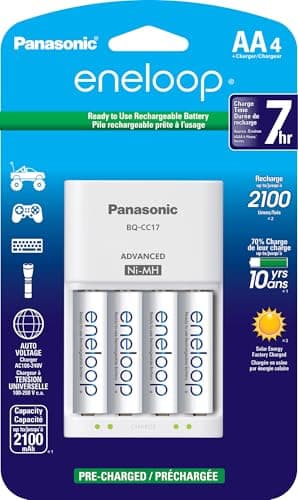
Buy the eneloop Charger Pack with four AA if this is your first set. It is the complete answer for two or three devices, the cells hold charge through a winter in storage, and seven hours overnight is not a real constraint between trips. This is the one most people should stop reading at.
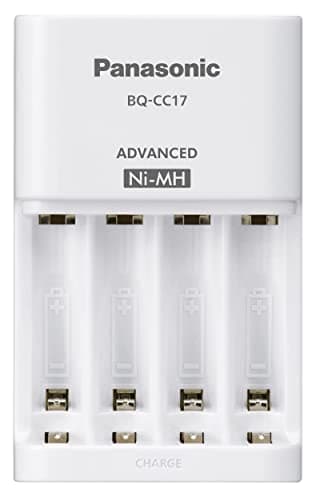
Buy the BQ-CC17 charger on its own only if you already own cells. Four independent channels with a temperature cut-off is what makes cells last, and at 5 W it is the gentlest option here — but with no cells in the box it is half a purchase for most readers.
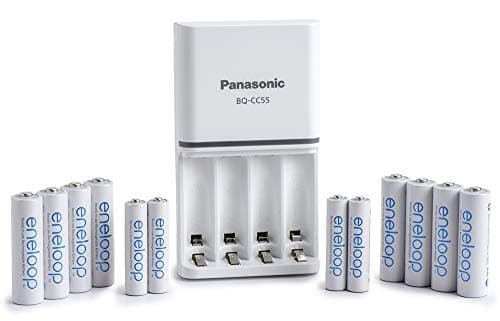
Buy the eneloop Power Pack if there are four of you. Twelve cells covers a family's headlamps and lantern with a spare set, and three hours to recharge four AA means you can turn cells around during a trip rather than only between them. It is the most expensive option and the only one that matches what a family actually gets through.
The picks in full
1. Best overall, and the right first purchase
Panasonic eneloop Charger Pack with 4 AA
Panasonic
Four 2,000 mAh eneloop AA cells and a four-position charger, rated for up to 2,100 charges and holding about 70 percent of charge after ten years.
Panasonic publishes a bundle of a BQ-CC17 four-position charger with four AA eneloop cells, a minimum capacity of 2,000 mAh at 1.2 V, a cycle life of up to 2,100 charges, about 70 percent of charge retained after ten years of storage, usable performance down to -20 C, a charge time of about seven hours for AA and six for AAA, charge currents of 300 mA per AA slot and 150 mA per AAA, and 110 to 240 V input on a foldaway plug.
The ten-year figure is why eneloop specifically suit camping rather than rechargeables in general. Older NiMH cells self-discharged fast enough that a set left in a drawer for six months was flat when you needed it — which for gear used three weekends a year is the whole problem. A cell that still holds most of its charge after a decade is a cell you can leave in the camping bin.
Two thousand one hundred cycles is the cost argument, and it is not close. At three sets of alkalines a season, one pack of four eneloops replaces a shelf of disposables and keeps the dead ones out of your pack and out of the ground. The foldaway plug and 110 to 240 V input also mean it travels.
The drawback
About seven hours to charge a set of AA, which means overnight rather than before you leave. Four cells is one headlamp and one lantern, not a family's worth, and the charger needs mains power so it is a between-trips device.
Published specs
Included
BQ-CC17 4-position charger plus 4 AA eneloop cells
Four independently charged channels on 100 to 240 V at 5 W, with a safety timer and a temperature cut-off, and an LED per channel.
Panasonic publishes four independently charged channels taking one, two, three or four cells at a time in AA or AAA, AC input of 100 to 240 V at 50/60 Hz drawing 5 W, a charge time of about seven hours for a 2,000 mAh AA, a safety timer, a temperature cut-off, and four LED charge indicators, one per channel.
Independent channels are the specification that matters and the one cheap chargers skip. A charger wired in pairs charges two cells as one unit, which means a strong cell and a tired cell get the same current and the tired one is overcharged. Four separate channels treat each cell on its own, which is most of why a good charger makes cells last.
The temperature cut-off is the safety half. NiMH cells warm as they approach full, and heat is what kills them; a charger that watches cell temperature and stops is a charger that is still giving you 2,000 mAh in year five. Slow charging at 300 mA is part of the same philosophy — it is gentler than a fast charger, and seven hours overnight costs you nothing.
The drawback
No cells included, so it is only the right purchase if you already have some. Seven hours for a 2,000 mAh AA is slow, and there is no fast mode to switch to.
Panasonic eneloop Power Pack, 8 AA + 4 AAA with BQ-CC55 Charger
Panasonic
Eight AA and four AAA eneloop cells with a BQ-CC55 charger that does a discharged set of four AA in about three hours.
Panasonic publishes eight AA and four AAA eneloop cells with a BQ-CC55 charger, a minimum AA capacity of 2,000 mAh at 1.2 V, a cycle life of up to 2,100 charges, a charge time of about three hours for a fully discharged set of four AA, and four independent channels with an LED for each.
Twelve cells is the number that makes a family work. Four headlamps at three AAA each is twelve AAA on its own, and the realistic pattern at a campsite is one set in the device and one set charged in the bag. Buying cells in fours and then discovering you need sixteen is the expensive route to the same place.
Three hours against seven is the other half, and it is genuinely useful on a trip rather than between trips: a set charged over dinner from a power station is a set you can use that night. Accept that fast charging is slightly harder on cells — with 2,100 cycles available, that is a trade most families should take.
The drawback
Twelve cells is more than a solo camper will ever cycle, and faster charging is harder on cells than the slow BQ-CC17 is. It is also the most expensive option here by a clear margin.
Published specs
Included
8 AA and 4 AAA eneloop cells plus a BQ-CC55 charger
QWhy do rechargeable batteries show as low in my camping lantern?
Because a NiMH rechargeable is 1.2 V nominal where a disposable alkaline is 1.5 V, and a battery meter calibrated for alkalines reads that as part-empty. The cells are fine and the device is not broken. Judge by runtime instead of by the meter on that particular device.
QAre rechargeable batteries good for camping gear that sits unused?
Modern low self-discharge cells are, and that is the whole reason to buy eneloop specifically. Panasonic publishes about 70 percent of charge retained after ten years in storage, which is what makes them suitable for gear used three weekends a year. Older NiMH cells went flat in a drawer within months.
QDo rechargeable batteries work in the cold?
Better than alkalines do. Panasonic publishes usable eneloop performance down to -20 C, while alkaline capacity falls off sharply below freezing - which matters because winter is when you need a headlamp most. Keep spares in an inside pocket rather than the pack, since a warm cell outperforms a cold one whatever the chemistry.
QIs a higher mAh rechargeable battery better for camping?
Usually not. Cells advertised at 2,800 mAh and above tend to buy that capacity by giving up the low self-discharge that makes a cell usable after months in storage. For camping, a 2,000 mAh cell that is still charged in spring beats a 2,800 mAh cell that is not.
QHow many rechargeable batteries do I need for a family camping trip?
About a dozen. Four headlamps at three AAA each is twelve AAA before you count a lantern, radios or a weather radio, and the workable pattern is one set in the device and one set charged in the bag. Families who buy a four-cell pack generally buy a second one.
How we picked
Everyone else in this category will tell you they tested twenty of these. We have not tested any of them, and we would rather say so than pretend. There is no gear closet here and no test lab.
What we did instead: pulled the published specifications from each manufacturer's own spec sheet or manual, named the standard behind every rating so you can check what it actually promises, did the arithmetic that turns a spec into a decision, and pulled today's real retail price rather than quoting one from memory. Every pick states a drawback, because a list where nothing is wrong with anything is an advert.
The limits of that method, stated plainly: published specs do not capture zipper quality, seam durability, or how a tent behaves at 2am in a storm. Where that matters, we say so on the pick. The full method is here.