No photo
Exped MegaMat 10
Exped
R 8.1 and 3.9 in thick. The clearest case on this page of money buying a measured number rather than a finish.
The answer is different in every category, and in a couple of them the expensive version is measurably worse for a beginner. Here is where the money lands.
Trail & Tarp earns a commission from qualifying purchases made through links on this page, at no extra cost to you. Full disclosure.
The short answer
Spend disproportionately on the sleeping pad, the sleeping bag and the cooler. Take the middle option on the tent, the pack and the boots. Buy the cheapest acceptable chair, table, cookware and lantern. The test throughout is whether the extra money changes a published, measured number — R-value, an ISO temperature rating, insulation thickness — or whether it buys weight savings and finish you will not notice from a car.
| Category | Does more money help? | What it buys | What it does not |
|---|---|---|---|
| Sleeping pad | Yes, a lot | Measured R-value and thickness | Nothing, until you get to ultralight weight |
| Sleeping bag | Yes, to a point | Down fill power: less weight and bulk at the same ISO rating | A warmer bag; warmth is the rating, not the price |
| Cooler | Yes, for long trips | Insulation thickness, gasket seal, latch quality | Anything, on a one-night trip |
| Tent | Some | Fly coverage, aluminum poles, taped seams, lighter fabric | Floor area; capacity is cheap |
| Backpack | Some | Suspension quality and adjustability | Volume |
| Boots | Some | Outsole rubber, midsole durability, membrane quality | Fit, which is free and matters more |
| Headlamp | A little | Regulated output, better runtime, water rating | Peak lumens you will never use |
| Camp chair | Barely | Weight and stitching | Comfort |
| Cookware | Barely | Weight and non-stick coating | Cooking performance on a two-burner stove |
| Camp table | No | Nothing meaningful | Anything at all |
Sleeping pads are the clearest case on this page, because R-value is measured to a common standard, ASTM F3340, and it tracks price closely. A Klymit Static V Base publishes R 1.3 at 18.7 oz. An Exped MegaMat 10 publishes R 8.1 at 3.9 in thick. That is a six-fold difference in a number that directly determines whether you are warm, and no amount of clever packing substitutes for it.
Sleeping bags are the second case, with a caveat that catches beginners out. More money does not buy a warmer bag — the ISO rating tells you the warmth and a cheap bag rated to 20 F is as warm as an expensive one rated to 20 F. What money buys is that warmth in less weight and bulk: a Kelty Cosmic Down 20 publishes ISO comfort 31 F at 2 lb 7 oz on 550-fill down, while synthetic bags at the same rating are a pound heavier. Whether that pound is worth anything depends entirely on whether you are carrying it, which is the argument in down vs synthetic.
Cooler prices span an enormous range and the performance difference is real but conditional. A Coleman Classic 70-Quart publishes a claim of up to 3 days at 90 F. A YETI Tundra 45 is rotomolded with far thicker walls and a full-perimeter gasket, and holds ice substantially longer.
On a two-night trip, both work and the difference is invisible. On a five-day trip with no shop, the difference decides whether your food is safe. Buy for your longest realistic trip, not your average one, and note that no cooler claim survives being opened twenty times a day — the arithmetic is in how long does ice last in a cooler.
Two categories where expensive can be actively worse
Tents. Premium backpacking tents save weight with 15D and 20D fabrics that are far easier for a beginner to damage than the 68D and 75D used on entry-level models. A Kelty Late Start 2P at 68D/1200 mm is more forgiving than a lighter, more expensive tent, and that matters more in a first season than a pound does.
Boots. A stiff, expensive mountaineering-style boot is worse than a flexible mid for someone walking three miles on a trail. Fit and flexibility beat price outright here, and fit costs nothing — see how to break in hiking boots.
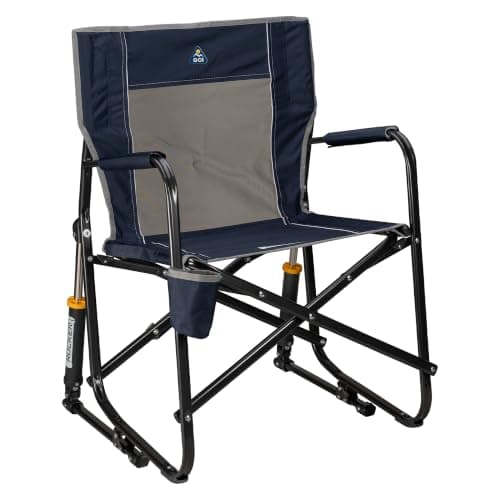
Camp chairs. A GCI Freestyle Rocker publishes a 250 lb capacity, a 19.7 in seat height and 11.8 lb on a powder-coated steel frame. A chair several times the price is lighter and better stitched. It is not more comfortable, because seat height and back angle are what comfort is, and those are free.
Camp tables. A folding table is a flat surface at a height with a load rating. There is no premium version of that idea.
Cookware. On a two-burner stove, a cheap aluminum pot boils water exactly as fast as an expensive one. What money buys in cookware is weight and coating quality, both of which matter for backpacking and neither of which matters at a picnic table. A GSI Pinnacle Ceramic Camper at 3 lb 10.1 oz for four people is the right tier for car camping.
Lanterns. Beyond a certain point you are paying for lumens nobody uses. A Streamlight Siege AA publishes 200 lm high and 50 lm low, and the 50 lm setting is the one that lights a table for 37 hours.
A rough division that reflects everything above, for someone outfitting from nothing for car camping:
The sequencing version of this — what to buy first, second and third rather than how to divide a total — is in start here.
Two moves that beat spending more on anything on this page. First, buy the expensive categories secondhand, which is exactly where the used market is strongest — see how to buy used camping gear. Second, maintain what you own: a reproofed rain jacket, a properly stored tent and a washed sleeping bag all outperform a neglected replacement that cost more.
And the free upgrades, which are the real answer to this question. Sock choice prevents more misery than boot price. Pitching on flat, cleared ground beats a better tent. Head uphill, clear the site, tension the fly, change into dry clothes at bedtime. None of it costs anything and all of it does more than the next price tier.
Exped
R 8.1 and 3.9 in thick. The clearest case on this page of money buying a measured number rather than a finish.
Klymit
R 1.3 at 18.7 oz. The other end of the same category, and a genuinely correct choice for hot weather or a tight pack.
GCI Outdoor
250 lb capacity, 19.7 in seat height, 11.8 lb. A chair several times the price is lighter, not more comfortable.
#ad how this is funded · price as of October 23, 2026
Kelty
68D at 1200 mm rather than fragile 20D. An example of the cheaper tent being the better first tent.
In some categories. Sleeping pads, sleeping bags and coolers reward spending more because the extra money changes a measured number such as R-value, ISO temperature rating or insulation thickness. Chairs, tables, cookware and lanterns flatten out almost immediately.
The sleep system. About a third of a first-time budget belongs in the sleeping pad and bag, because sleep quality is what decides whether anyone wants to go camping again. The pad matters more than the bag, because body weight crushes the insulation underneath you flat.
Often it is better. Premium backpacking tents save weight with 15D and 20D fabrics that are much easier to damage, while entry-level tents use 68D and 75D and forgive the mistakes a beginner makes. Buy mid-tier, sized one person larger than your headcount, with a full fly.
No. Warmth is the ISO rating, and a cheap bag rated to 20 F is as warm as an expensive one rated to 20 F. What the money buys is the same warmth in less weight and bulk, which matters only if you are carrying it.
Every figure on this page comes from a published source. We have not tested this gear, so the numbers are the manufacturer's or the standard body's, not ours. How we research.