Why a sleeping bag alone does not work in a hammock
The short answer
Your body weight compresses the insulation underneath you flat, and in a hammock the fabric wraps around you so the compression is total. A sleeping bag in a hammock has no loft on the underside at all, and moving air passes freely beneath it. That effect is called cold butt syndrome, and it catches people out at temperatures they would sleep through comfortably on the ground.
There are two solutions. An underquilt hangs on the outside of the hammock, so nothing compresses it and it insulates the full length of your body. A sleeping pad goes inside the hammock, which works and slides around all night as the fabric curves under you.
An underquilt is the better answer and costs more. A pad is the answer people already own, and a wide car camping pad works better in a hammock than a narrow backpacking one because it resists the fabric folding around it.
Compared on published numbers
Item
Key figures
Weight
Material
Packed size
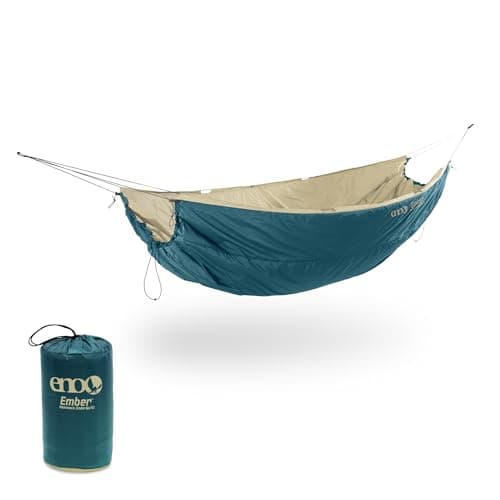
ENO Ember UnderQuilt
40-60 F, 6 ft 10 in x 4 ft
1.66 lb
160 g recycled synthetic, 40D shell
12 x 7 x 7 in
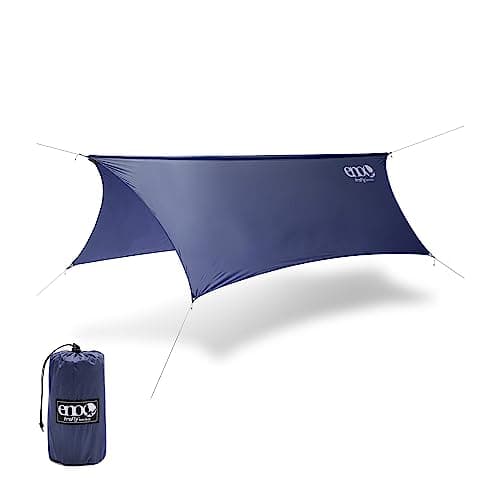
ENO ProFly Rain Tarp
10 ft 6 in x 6 ft 4 in, 1,000 mm
22 oz
70D ripstop nylon, PU coated
8 x 4.5 x 4.5 in
ENO Atlas Straps
9 ft each, 400 lb, 30 points
9 oz
1000D polyfilament webbing
6.25 x 3.25 x 2.5 in
Figures as published by ENO.
Add those together and a complete hammock sleep system, before the hammock itself, is about 3 lb 3 oz. That is a useful number to hold against a tent, because a hammock alone at 19 oz looks lighter than a tent right up until you add the parts that make it work overnight.
Tarp coverage is a shape question, not an area one
A hammock hangs in a curve, and rain arrives at an angle. A rectangular tarp like the ProFly covers the middle well and leaves the ends exposed, which is fine in vertical rain and not fine in wind. The larger ENO tarps are wider for exactly this reason.
A rectangular tarp is lighter, simpler and enough for most three-season nights. Pitch it low in weather and high in heat.
A wider or hex-cut tarp with doors closes the ends and handles wind-driven rain, at more weight and more setup.
Whichever you use, the ridgeline should be taut and above the hammock rather than resting on it, and the tarp corners should be pulled out and down. The general principles carry over directly from how to use a tarp at a campsite.
Wide straps are a rule, not a courtesy
Many state parks, national forests and private campgrounds now require tree straps of a minimum width, commonly 0.75 to 1 inch, and prohibit rope, cord or anything that cuts into bark. Narrow suspension damages the cambium layer under the bark, and repeated damage in a popular spot can kill the tree. ENO publishes 1.5 in tapering to 0.75 in on the Atlas, which meets the usual requirement. Check the specific site before you rely on it, and never hang from a dead or damaged tree.
Getting the hang right
Two numbers make the difference between a hammock that sleeps well and one that folds you in half. Aim for straps at about 30 degrees from horizontal, and a deep enough sag that the fabric is not taut. A tight hammock squeezes your shoulders; a saggy one lets you lie flat.
Then lie diagonally rather than along the centerline. That is the single technique that turns a banana-shaped hammock into a flat bed, and it is the thing most first-time hammock campers do not know. The rest of the setup is in hammock camping for beginners.
What else the system needs
A bug net, if you are anywhere with mosquitoes, because a hammock exposes far more of you than a tent does. Some hammocks integrate one; most do not, and a separate net that covers the whole hammock is the usual answer. The chemical side is in best bug protection for camping.
Drip lines are the other detail nobody mentions. Rain runs along the suspension straps and into the hammock with you; tying a short length of cord around each strap so water drips off before it reaches the fabric costs nothing and fixes it. A ridgeline and guy line kit usually includes enough cord for both jobs.
Which to buy
Buy the ENO Ember UnderQuilt if you are hammock camping below about 60 F, which is most nights that are not high summer. Buy the ProFly if there is any chance of rain, which is most trips. Buy the Atlas straps if your hammock did not come with compliant ones, and check the site rules before you go.
If you have not chosen the hammock itself yet, start at best camping hammocks, which is honest about which ones are for lying around and which are for sleeping.
The picks in full
1. Best underquilt
ENO Ember UnderQuilt
ENO
A 40 to 60 F range from two layers of 160 g recycled synthetic insulation, at 1.66 lb, with fully adjustable suspension.
ENO publishes a temperature range of 40 to 60 F, a weight of 1.66 lb, dimensions of 6 ft 10 in by 4 ft, a packed size of 12 by 7 by 7 in, insulation of 160 g in two layers of 100 percent recycled polyester, a 40D ripstop nylon shell, a 30D nylon lining, and fully adjustable suspension compatible with all ENO hammocks.
Synthetic rather than down is the right call for an underquilt specifically, because an underquilt hangs on the outside of the hammock where it collects dew, rain blown under the tarp and condensation. Down in that position is a bad idea in a way that down inside a tent is not.
The drawback
40 F is the bottom of its published range, which makes it a three-season quilt at best. Below that you are stacking a pad inside the hammock as well.
10 ft 6 in by 6 ft 4 in of 70D ripstop at 1,000 mm, with LineLoc tensioners and aluminum ridgeline hooks, at 22 oz.
ENO publishes dimensions of 10 ft 6 in by 6 ft 4 in, a weight of 22 oz / 640 g, a packed size of 8 by 4.5 by 4.5 in, 70D ripstop nylon with a 1,000 mm PU coating, double-stitched waterproof seams, and integrated LineLoc tensioners with aluminum ridgeline hooks.
The 1,000 mm hydrostatic head figure is modest and it is adequate here for a specific reason: a tarp is never under the pressure a tent floor is, because nothing kneels on it. Read the coverage dimensions first and the millimeters second.
The drawback
22 oz is heavy against the silnylon version at 18 oz, and 6 ft 4 in of width is coverage for rain falling vertically rather than blowing sideways.
9 ft straps rated to 400 lb with 30 attachment points, in 1000D polyfilament webbing at 9 oz.
ENO publishes a weight of 9 oz / 255 g, a length of 9 ft each tapering from 1.5 in to 0.75 in, a capacity of 400 lb / 181 kg, 30 total attachment points, 1000D polyfilament webbing, and a packed size of 6.25 by 3.25 by 2.5 in.
Thirty attachment points is what removes knots from the process, and the 1.5 in width is what protects the tree. Narrow cord or rope cuts into bark and can girdle a tree, which is why most managed sites now require wide webbing straps specifically.
The drawback
9 oz for a pair of straps is not nothing, and 9 ft limits how far apart the trees can be. A wide gap needs the extra-long version.
Below about 60 F, yes. Your body weight compresses a sleeping bag flat underneath you and the hammock fabric wraps around you, so there is no loft under you at all. An underquilt hangs outside the hammock where nothing compresses it.
QCan I use a sleeping pad instead of an underquilt?
Yes, and it works less well. A pad inside the hammock slides around as the fabric curves under you all night. A wide pad resists this better than a narrow backpacking one. An underquilt is the better answer and costs more.
QWhat size tarp do I need for a hammock?
Coverage shape matters more than area. A rectangular tarp around 10 ft 6 in by 6 ft 4 in handles vertical rain and leaves the ends exposed in wind. A wider or hex-cut tarp with doors closes the ends, at more weight and setup time.
QWhy do campgrounds require wide hammock straps?
Narrow rope or cord cuts into bark and damages the cambium layer underneath, and repeated damage in a popular spot can kill the tree. Many sites now require webbing of a minimum width, commonly 0.75 to 1 inch, and prohibit rope entirely.
How we picked
Everyone else in this category will tell you they tested twenty of these. We have not tested any of them, and we would rather say so than pretend. There is no gear closet here and no test lab.
What we did instead: pulled the published specifications from each manufacturer's own spec sheet or manual, named the standard behind every rating so you can check what it actually promises, did the arithmetic that turns a spec into a decision, and pulled today's real retail price rather than quoting one from memory. Every pick states a drawback, because a list where nothing is wrong with anything is an advert.
The limits of that method, stated plainly: published specs do not capture zipper quality, seam durability, or how a tent behaves at 2am in a storm. Where that matters, we say so on the pick. The full method is here.