A dog that sleeps badly outdoors is usually cold from underneath, not from the air. Insulation between the dog and the ground fixes more than a coat does. The second thing is containment: most campgrounds require dogs leashed at all times and on a lead no longer than six feet. Get those two right and almost everything else is optional.
The ground-insulation point surprises people because dogs look well-insulated. They are, on the side that is not compressed. Body weight flattens fur exactly the way it flattens a sleeping bag, and a short-coated or thin dog on cold earth in October is losing heat steadily all night.
The leash rules are worth checking rather than assuming. National parks in particular are restrictive about where dogs may go at all, frequently limiting them to campgrounds, roads and paved areas and prohibiting them on trails. Finding that out at the gate has ruined a lot of weekends — the trip-planning side is in camping with a dog.
Compared on published numbers
Item
Sizing
Weight
Materials
Key feature
Ruffwear Highlands Pad
M 33.25 x 23.6 in; L 43.3 x 26.8 in
0.75 lb M; 1.05 lb L
closed-cell foam and synthetic down
non-slip waterproof base
Ruffwear Front Range Harness
XXS 13-17 in to L/XL 32-42 in chest
not published
300D polyester ripstop, mesh lining
two leash points, four adjustments
Figures as published by Ruffwear.
What a dog actually needs at a campsite
Insulation off the ground. A pad, or at minimum an old closed-cell foam mat cut to size. This is the highest-value item.
A harness and a six-foot lead. Plus a way to secure them at the site that is not a person holding a leash for twelve hours.
Their own water bowl and more water than you think. Dogs drink heavily after exercise and dehydrate faster than people do in heat.
A light on the collar. A dog fifteen feet away in a dark campground is invisible, and this is how dogs get stepped on and how they get lost.
Waste bags, and a plan for them. Bagging waste and leaving the bag on the trail is worse than not bagging it.
Tick and flea prevention, current. Not a gear purchase, and the one most likely to matter after the trip.
Do not tie a dog to the tent
It is the obvious solution and it is how tents get dragged and poles get snapped when something startles the dog at 2am. Use a proper ground stake or a cable run between two fixed points, sized so the dog cannot reach the fire ring, the neighboring site, or the road. Check the reach before you settle in, with the dog on the line, rather than estimating it. And never leave a dog tied and unattended at a campsite: it is prohibited at many campgrounds and it is how dogs meet wildlife they cannot get away from.
Heat and cold are both worse for dogs than for you
Dogs cool almost entirely by panting, which becomes much less effective in humid heat, and they are closer to ground surfaces that radiate. A dog in a zipped tent on a warm afternoon is in a genuinely dangerous situation, and the same airflow rules apply to them as to you — see best camping fans for tents and how to stay cool camping in hot weather.
In cold, small, thin-coated and older dogs need the pad and often a coat as well. Paws are the other overlooked part: ice, hot sand and sharp rock all damage pads, and a dog will keep going on damaged feet long past the point a person would stop.
Food, water and wildlife
Dog food is bear attractant and is treated exactly like human food by every food storage regulation that exists. It goes in the canister, the locker or the vehicle overnight, not in the tent and not in a bowl by the picnic table — see how to store food safely when camping and best bear canisters and food storage.
A collapsible bowl weighs almost nothing and means water gets offered often rather than at the campsite only.
Which to buy
Buy the Highlands Pad first, in the size that fits the dog stretched out rather than curled, because the ground is the problem. Add the Front Range harness if your dog pulls or if you want a second attachment point for control at a busy site. Everything else — bowl, light, bags, a lead — costs very little and should simply be in the box.
And check the specific campground and trail rules before booking. The gear is the easy part.
The picks in full
1. Best overall
Ruffwear Highlands Dog Pad
Ruffwear
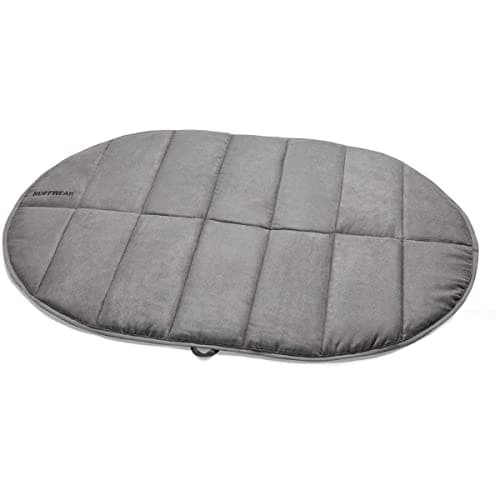
Closed-cell foam and synthetic down over a non-slip waterproof base, at 0.75 lb in medium, folding to 13 by 6 by 4.5 in.
Ruffwear publishes a medium at 33.25 by 23.6 in weighing 0.75 lb / 340 g, a large at 43.3 by 26.8 in weighing 1.05 lb / 475 g, a packed size of 13 by 6 by 4.5 in in an accordion fold, closed-cell foam and synthetic down insulation, a non-slip waterproof base and a microsuede sleeping surface.
Closed-cell foam is the specification that matters, and it is the same physics that applies to you: a dog lying on cold ground loses heat by conduction faster than by any other route, and fur does nothing about the side being compressed flat underneath them.
The drawback
Medium is 33.25 by 23.6 in, which a large dog that stretches out will overhang. Sizing up means the large at 43.3 by 26.8 in, which takes real tent floor.
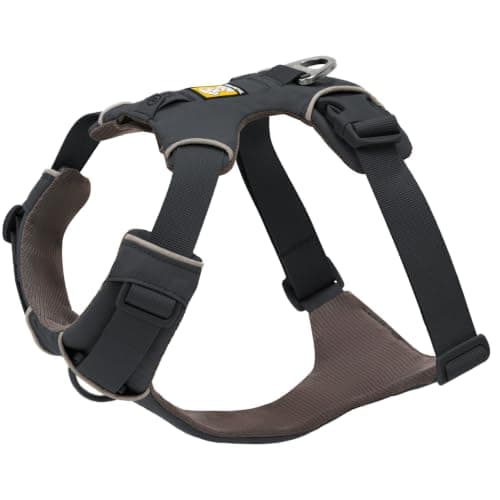
Four adjustment points and two leash attachments in 300D polyester ripstop with closed-cell foam padding and reflective trim.
Ruffwear publishes five sizes from XXS at 13 to 17 in chest girth to L/XL at 32 to 42 in, 300D polyester ripstop with a breathable mesh lining, closed-cell foam padding, four points of adjustment, two leash attachment points front and back, reflective trim and an ID pocket.
The front attachment point is the feature worth understanding. A leash clipped at the chest turns a pulling dog back toward you rather than letting them lean into it, which is the difference between managing a dog at a campground and being towed around one.
The drawback
Five sizes across a 13 to 42 in chest range means the fit steps are coarse, and a deep-chested or barrel-chested dog can fall between them.
Published specs
Sizes
XXS 13-17 in to L/XL 32-42 in chest girth
Fabric
300D polyester ripstop with breathable mesh lining
Insulation off the ground first, then a harness and a six-foot lead, a water bowl, a collar light and waste bags. A dog sleeping badly outdoors is usually cold from underneath, because body weight flattens fur the same way it flattens a sleeping bag.
QDo dogs need a sleeping pad for camping?
Yes, particularly short-coated, thin or older dogs. Conduction into cold ground is the biggest heat loss route when lying down, and fur on the compressed side does nothing. A closed-cell foam pad, even an old one cut to size, fixes it.
QCan I tie my dog to the tent at a campsite?
No. It is how tents get dragged and poles snapped when something startles the dog at night. Use a ground stake or a cable run between two fixed points, sized so the dog cannot reach the fire ring, the next site or the road, and never leave them tied unattended.
QWhere should dog food be stored when camping?
Exactly where your own food goes: a bear canister, a food locker or the vehicle overnight. Dog food is bear attractant and every food storage regulation treats it identically to human food. Never leave a full bowl out at the site.
How we picked
Everyone else in this category will tell you they tested twenty of these. We have not tested any of them, and we would rather say so than pretend. There is no gear closet here and no test lab.
What we did instead: pulled the published specifications from each manufacturer's own spec sheet or manual, named the standard behind every rating so you can check what it actually promises, did the arithmetic that turns a spec into a decision, and pulled today's real retail price rather than quoting one from memory. Every pick states a drawback, because a list where nothing is wrong with anything is an advert.
The limits of that method, stated plainly: published specs do not capture zipper quality, seam durability, or how a tent behaves at 2am in a storm. Where that matters, we say so on the pick. The full method is here.