The Best Bear Canisters and Food Storage, Judged on Certification First
In this one category the specification that matters is not weight or volume. It is whether the land manager where you are going accepts the thing you bought.
Food storage rules are set locally, by park, forest or district, and they change. Some areas require IGBC-certified hard-sided canisters and accept nothing else. Some accept certified bags. Some require you to use a provided locker or cable. Some have no requirement at all. The land manager's own page is the authority, and it is a two-minute check that decides which of these products is even eligible.
The Interagency Grizzly Bear Committee runs the testing program that produces the certification, and it publishes a list of certified products. An uncertified “bear proof” container does not satisfy a regulation that names IGBC certification, however sturdy it looks, and rangers do check in areas where it matters.
Product
Volume
Weight
Material
Certified
Accepted where
BearVault BV475 Trek
9.3 L
2 lb 4 oz
Polycarbonate
IGBC
Almost everywhere a container is required
Ursack Major
about 10.65 L
7.6 oz
UHMWPE fabric
IGBC, no. 3738
Many areas; not where hard-sided is specified
Sea to Summit Big River
3-65 L
4.5 oz at 13 L
TPU-coated 420D nylon
Not certified
Hanging systems and general containment
All figures as published by the manufacturers. The acceptance column is a summary of how the categories are usually treated, not a substitute for checking your destination.
Sizing: days of food, not liters
Both makers publish a capacity in days, which is more useful than volume. BearVault publishes about 5 to 6 days for one person in 9.3 L; Ursack publishes about 5 days in 10.65 L.
Two people for three nights therefore needs roughly one canister-and-a-bit, which in practice means two containers or one canister plus a hanging bag. Do the arithmetic before the trip, because discovering the food does not fit is a problem with no field solution: everything scented has to go in, including rubbish, which grows through the trip rather than shrinking.
Everything scented, not just food
Toothpaste, sunscreen, lip balm, soap, hand sanitiser, dog food, coffee grounds, cookware, the washing-up sponge and all rubbish go in the container along with the food. That is what people forget when sizing one, and it is why a canister that looks generous at home is full on day two. The full list is in how to store food safely when camping.
Canister or bag?
Hard canister. Accepted everywhere, protects the contents from crushing, doubles as a camp stool, and cannot be dragged off. Heavy, rigid, and it does not compress as food is eaten.
Certified bag. A pound and a half lighter, packs flat, and moulds to the contents. Not accepted everywhere, must be tied off correctly to a solid tree, and the contents can still be crushed.
For a first purchase, the canister is the safer buy precisely because it is accepted everywhere. Buy the bag second, once you know your regular destinations accept one and you have started counting ounces — the same weight-versus-versatility logic as in is expensive camping gear worth it.
Using them properly
A canister goes on the ground, 100 ft or more from where you sleep, ideally wedged where it cannot be rolled downhill or into water. Do not attach anything to it: a canister with a strap gives a bear leverage, which is the one thing the smooth cylindrical shape exists to deny.
A bag is tied off to a solid tree trunk with the integrated cord using a secure knot, at about chest height, not hung from a branch. Ursack publishes a 6 ft cord with 2,500 lb tensile strength for that purpose. Both go well away from the tent, and both are opened away from camp as well, so food smells are not concentrated where you sleep.
What this page is not
It is not wildlife safety guidance. We do not publish advice on what to do if you encounter a bear, how to behave in bear country, or how to store food in a way that keeps you safe — we are not qualified to, and the NPS and IGBC pages linked below are the authority. What this page compares is published product specifications and certification status, which is checkable.
We have also not tested any of these, and there is no way we could: the testing that matters here is done by the IGBC with live bears, and that certification is precisely why the certification column is the first thing on the table. See how we research, and wildlife safety at a campsite for how food storage fits into the wider picture.
The picks in full
1. Best all-round bear canister
BearVault BV475 Trek Bear Canister
BearVault
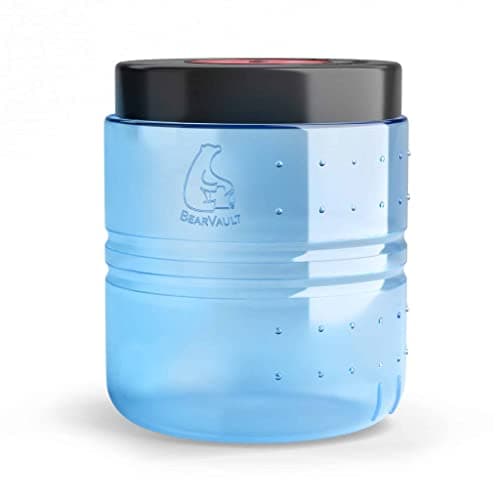
9.3 L of IGBC-certified transparent polycarbonate at 2 lb 4 oz, 8.7 in across and 10.5 in tall, with a tool-free lid.
BearVault publishes a 9.3 L volume, a 2 lb 4 oz (1,030 g) weight, dimensions of 8.7 in in diameter by 10.5 in tall, transparent polycarbonate construction, IGBC certification, a capacity guide of about 5 to 6 days of food for one person, and a tool-free lid.
Transparency is the feature that sounds trivial and is not. Finding a specific item in an opaque canister means unpacking the whole thing on the ground; being able to see what is where saves several minutes every meal and keeps food off the floor of a bear-active area.
The tool-free lid is the other design decision worth noting. Older canisters needed a coin or a screwdriver to open, which is exactly the item you lose. This one is designed to be opened by human fingers and not by claws, which is the whole engineering problem in one sentence.
The drawback
2 lb 4 oz is real weight, and a rigid cylinder is an awkward shape in a pack no matter how you load it.
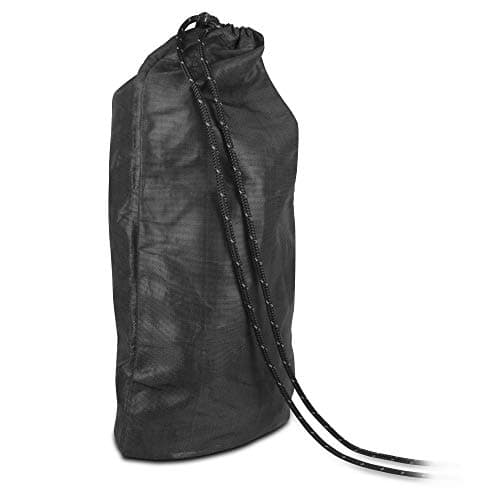
About 10.65 L of UHMWPE fabric at 7.6 oz, IGBC certified under number 3738, with an integrated 6 ft 2,500 lb cord.
Ursack publishes a capacity of about 10.65 L (650 cu in), a 7.6 oz weight, ultra-high molecular weight polyethylene fabric, IGBC certification as number 3738, an integrated six-foot cord with 2,500 lb tensile strength, dimensions of about 12.5 by 18 in when cinched, and a capacity guide of about 5 days of food for one person. The odor barrier bag and aluminum liner are sold separately.
Seven point six ounces against 2 lb 4 oz is a difference of more than a pound and a half, which in backpacking terms is enormous — more than most people save on a tent upgrade. It also packs flat when empty and takes the shape of whatever is inside it, which solves the canister's other problem.
Two honest limitations. A bag prevents access but not compression, so a determined bear can reduce a week's food to paste inside an intact sack. And acceptance varies: several areas that require bear-resistant storage specify hard-sided canisters only. Check before you rely on it.
The drawback
Not accepted everywhere a hard canister is required, and it does not stop a bear crushing the contents even when it cannot get in.
Published specs
Volume
about 10.65 L / 650 cu in
Weight
7.6 oz
Material
UHMWPE (Spectra) fabric
Certification
IGBC certified, cert. no. 3738
Cord
6 ft, 2,500 lb tensile strength, integrated
Capacity guide
about 5 days of food for one
Note
odor barrier bag and aluminum liner sold separately
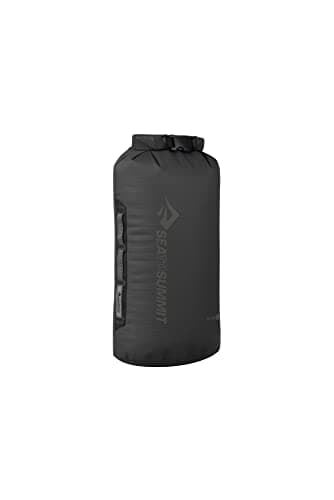
TPU-coated 420D nylon with a 10,000 mm waterhead, double-stitched tape-sealed seams and hypalon lash loops, at 4.5 oz for 13 L.
Sea to Summit publishes TPU-coated 420D nylon with a triple-coated base, a 10,000 mm waterhead, double-stitched and tape-sealed seams, a hypalon roll-top closure with hypalon lash loops for attachment and stacking, and weights of 4.5 oz at 13 L and 6.5 oz at 20 L, in sizes from 3 to 65 L.
Its place here is honest and limited. Where a site provides a cable or pole hanging system, you still need something to hang, and a tough waterproof bag with lash loops is exactly that. At a developed campground where food goes in a locker or a vehicle, it keeps everything contained, dry and easy to move in one trip.
It is not a substitute for certification and we are not presenting it as one. If your destination requires an IGBC-certified container, this is not it, and the two picks above are. What it does is cover the far more common case where the requirement is containment rather than bear resistance.
The drawback
Not bear-resistant and does not claim to be. This is a containment and weather bag, not a certified storage solution.
Only where the land manager requires one, and that is set locally by park, forest or district. Some areas require IGBC-certified hard-sided canisters and accept nothing else; some accept certified bags; many developed campgrounds provide lockers instead. Check the destination's own page.
QWhat does IGBC certified mean?
That the product has passed the Interagency Grizzly Bear Committee's testing program for bear-resistant products. Where a regulation names IGBC certification, an uncertified container does not satisfy it however sturdy it looks. Ursack publishes certification number 3738 for the Major.
QIs a bear bag as good as a canister?
Lighter by more than a pound and a half, and it packs flat - but it is not accepted everywhere a hard canister is required, and it prevents access rather than crushing, so a determined bear can ruin the contents inside an intact sack.
QWhat size bear canister do I need?
Think in days rather than liters. BearVault publishes about 5 to 6 days for one person in 9.3 L and Ursack about 5 days in 10.65 L. Remember that toothpaste, sunscreen, rubbish and cookware all go in too, which is what fills a canister faster than expected.
How we picked
Everyone else in this category will tell you they tested twenty of these. We have not tested any of them, and we would rather say so than pretend. There is no gear closet here and no test lab.
What we did instead: pulled the published specifications from each manufacturer's own spec sheet or manual, named the standard behind every rating so you can check what it actually promises, did the arithmetic that turns a spec into a decision, and pulled today's real retail price rather than quoting one from memory. Every pick states a drawback, because a list where nothing is wrong with anything is an advert.
The limits of that method, stated plainly: published specs do not capture zipper quality, seam durability, or how a tent behaves at 2am in a storm. Where that matters, we say so on the pick. The full method is here.