The Best Kids' Hiking Backpacks, Sized by Torso and Not by Age
A child should carry about ten percent of their body weight, which is less than you think and almost always water. Everything else about a kids' pack follows from that one number.
A child should carry roughly 10 percent of their body weight, including the pack itself. For a 50 lb seven-year-old that is 5 lb total - which a 7 oz pack and a liter of water almost fills on its own. Size the pack by measuring their torso from the bony bump at the base of the neck to the top of the hip bones, not by the age on the label. Children grow in torso length at wildly different rates and an age range tells you nothing.
That arithmetic is the whole reason this is a separate category rather than "a small adult pack". A 20 L adult daypack weighs a pound and a half empty and has adult-width webbing; put it on a 50 lb child and a third of their allowance is gone before anything goes in, with the straps sitting in the wrong places.
Ten percent is also a ceiling rather than a target. The point of a child carrying a pack is not load-sharing - adults carry the trip - it is that a child with their own water, their own snack and their own jacket is a participant rather than cargo, and stops asking an adult to stop and dig something out. That psychological shift is worth far more than the five pounds.
What a child should actually carry
Item
Weight
Who carries it
Water, 0.75 to 1.5 L
1.7 to 3.3 lb
the child - this is the main job
A snack or two
a few oz
the child
A light fleece or rain shell
6 to 12 oz
the child, on a cool day
A whistle
nothing
the child, on the sternum strap
First aid kit, map, headlamp, food, stove
pounds
an adult, always
Sleeping bag, on an overnight
2 to 4 lb
an older child in an 18 L pack, or an adult
Water is most of a child's allowance. Everything with consequences stays with an adult.
The last two rows are where families get this wrong in both directions. Handing a seven-year-old the first aid kit is a nice idea and a bad one, because you need to know where it is. Equally, a capable eleven-year-old carrying their own sleeping bag on an overnight is reasonable and makes them feel like part of the expedition.
What to look for
Specification
What to want
Why
Torso fit
a published range, measured against your child
age labels are meaningless; torso length is the actual fit
Empty weight
under 1 lb for a small child
the pack's own weight eats the 10 percent allowance
Reservoir
included, and filled halfway
a hose means they drink without stopping the group
Harness edges
fleece-lined or edgeless webbing
adult webbing chafes a collarbone through a t-shirt within a mile
Sternum strap
adjustable, with a whistle
it keeps the shoulder straps from sliding off narrow shoulders
Hipbelt
only needed above about 10 lb
below that it is a strap doing nothing; above it, it is essential
What decides whether a child keeps a pack on, rather than how much it holds.
Compared on published numbers
Pack
Volume
Reservoir
Empty weight
Torso / load
Hipbelt
Osprey HydraJet 12
12 L (732 cu in)
1.5 L included
0.84 lb
not published
no
Osprey Jet 18
18 L (1,098 cu in)
sleeve only, sold separately
0.515 kg (1 lb 2 oz)
load 5 to 15 lb
airmesh wings
CamelBak Mini M.U.L.E.
1.5 L cargo
1.5 L CRUX included
210 g (7 oz)
torso 12 to 16 in
no
Figures as published by each manufacturer. Prices on this page carry their own as-of date.
Read the blank cells as the real problem with this category. Only CamelBak publishes a torso range and only the Jet 18 publishes a load range, so for the HydraJet 12 you are matching a 14.57 in pack height against your child's back by eye. That is workable - a pack whose backpanel is longer than the torso will push on the hips - but it is not a specification.
How to measure a child's torso in thirty seconds
Have them stand up straight. Find the bony bump at the base of the neck where the slope of the shoulders starts - that is the C7 vertebra. Put your hands on their hips with your thumbs meeting at the spine; that line is the iliac crest. Measure between the two along the spine, in inches. That number is the pack size. A 12 to 16 in torso is roughly 4 to 8 years old, and by 13 many children are into the smallest adult sizes covered in how to fit a backpack.
Fit it once, properly, and then leave it alone
The order is the same as for an adult pack and it is almost always done wrong. Loosen everything. Put the pack on with some weight in it. If there is a hipbelt, set that first, sitting on the iliac crest rather than the waist. Then pull the shoulder straps snug but not tight - they should follow the shoulders with no gap at the top and no weight hanging off them. Then clip the sternum strap across the chest, not the throat.
With a child, add one step: check it again after ten minutes of walking, because they will have been fiddling with it. After that, resist adjusting it every time they complain - a properly fitted pack that a child is simply tired of is a different problem from a badly fitted one, and the fix for the first is a snack and a break.
Carrier or pack?
If the child is under about three, none of these apply - they are being carried, and the product is a framed child carrier rather than a backpack. Those are a separate category with their own fit rules, and they are not covered here.
Between three and five, a very small pack with a half-full bladder and a snack is realistic for an hour or two, and the honest expectation is that an adult will end up carrying it some of the time. From about six, a child can carry their own water and layer for a half-day walk without it becoming a negotiation. The rest of the planning side is in family camping with kids and the kit list is in best camping gear for kids.
Which to buy
Buy the Osprey HydraJet 12 if your child is roughly six to eleven and this is their first real hiking pack. The reservoir is in the box, the fleece-lined edgeless harness is what stops the chafing that makes children refuse packs, and 0.84 lb leaves most of the allowance for water. Fill the bladder halfway rather than full.
Buy the Osprey Jet 18 if they are nearer nine to thirteen, or if there is an overnight coming and they will carry their own sleeping bag. The published 5 to 15 lb load range and the airmesh hipbelt wings are what make eighteen liters sensible rather than ambitious, and 400D packcloth survives being dragged. Budget for the reservoir separately.
Buy the CamelBak Mini M.U.L.E. if the child is small - a 12 to 16 in torso, roughly four to eight. It is the only pack here with a published torso range, it weighs 7 oz, and 1.5 L of cargo is honestly all a small child needs beyond water. Treat it as a hydration pack with a snack pocket, which is exactly what it is, and buy the Jet 18 when they outgrow it.
The picks in full
1. Best overall
Osprey HydraJet 12
Osprey
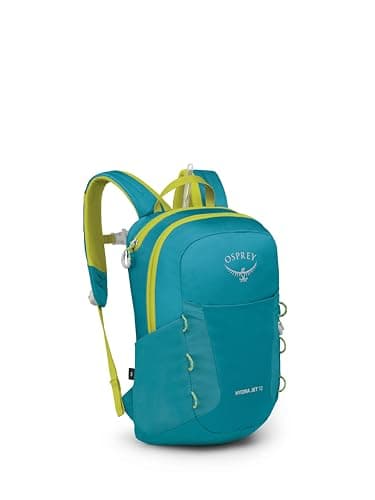
12 L with a 1.5 L reservoir in the box at 0.84 lb, on an AirScape backpanel with a rescue whistle on the sternum strap.
Osprey publishes a 12 L (732 cu in) volume, a 1.5 L reservoir included, a 0.84 lb weight, a 14.57 by 9.84 by 8.27 in size, an AirScape backpanel, a smooth edgeless fleece-lined harness with an adjustable sternum strap, and a rescue whistle on that sternum strap.
This wins because the reservoir is in the box, and water is the only thing a child should reliably be carrying. A hydration bladder means they drink without stopping the group and without asking an adult to open a pack, which in practice is the difference between a child who stays hydrated and one who gets a headache at hour three.
The edgeless fleece-lined harness is not a frill. Adult pack webbing has stitched edges that chafe a child's collarbone through a thin t-shirt within a mile, and it is the commonest reason a kid declares a pack uncomfortable and refuses it. The whistle is the other detail worth paying for, for reasons nobody wants to need.
The drawback
A full 1.5 L reservoir is 3.3 lb on its own, which is already the whole carry allowance for a small child - fill it halfway. Twelve liters runs out of room fast once a jacket goes in.
2. Best for an older child, and the one with a real hipbelt
Osprey Jet 18
Osprey
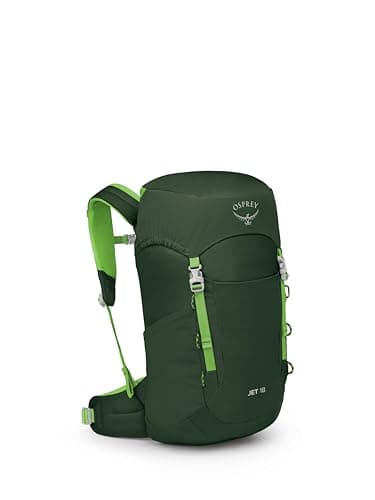
18 L on a published 5 to 15 lb load range, with airmesh hipbelt wings and 400D recycled nylon, at 1 lb 2 oz.
Osprey publishes an 18 L (1,098 cu in) volume, a 0.515 kg (1 lb 2 oz) weight, an 18.11 by 9.45 by 8.66 in size, a published load range of 2.3 to 6.8 kg (5 to 15 lb), a main and bottom fabric of 400D recycled nylon packcloth, an AirScape backpanel, airmesh wrap hipbelt wings, dual stretch mesh side pockets, a large front stretch mesh pocket, a small external zippered pocket, lower web-loop daisy chain attachment points, an external reservoir sleeve and top-load access.
A published load range is unusual and genuinely useful. Most kids' packs state a volume and leave you to guess what the suspension can actually carry; Osprey saying 5 to 15 lb tells you both that it needs some weight in it to sit properly and where it stops being comfortable. Use the bottom of that range for a younger child.
The hipbelt wings are what make 18 L sensible. Below about 10 lb a hipbelt does nothing and a child does not need one; above it, weight has to move off the shoulders onto the hips or the straps dig in. If your child is going to carry a sleeping bag on an overnight, this is the pack that handles it.
The drawback
No reservoir included - the sleeve is there but the 1.5 L bladder is a separate purchase. Fifteen pounds is the top of its published range, which is more than most children under 11 should carry anyway.
3. Best for a small child, and the only one with a published torso range
CamelBak Mini M.U.L.E.
CamelBak
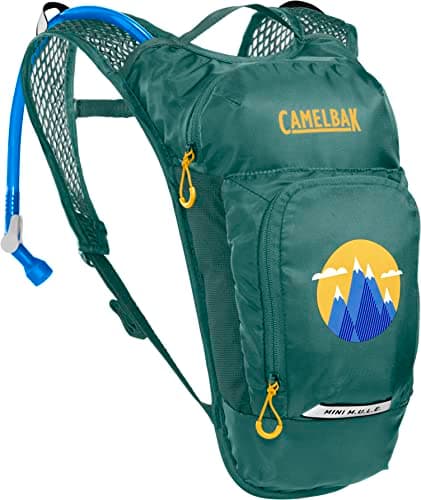
A 1.5 L CRUX reservoir and 1.5 L of cargo at 210 grams, with a published fit for a 12 to 16 in torso.
CamelBak publishes a 1.5 L (50 oz) CRUX reservoir included, 1.5 L (50 cu in) of cargo capacity, a 210 g (7 oz) weight, a 14 by 7.5 by 7.7 in size, a published fit for a 12 to 16 in (30 to 40 cm) torso, three exterior pockets including a stretch overflow compartment, a padded mesh back panel, and BPA, BPS and BPF free materials.
A published torso range is the single most useful number on this page, and CamelBak is the only maker here that states one. Twelve to sixteen inches is roughly a 4 to 8 year old, and measuring a child's torso takes thirty seconds against guessing from an age label that means nothing.
Two hundred and ten grams is the other reason. For a small child, the pack's own weight is a real fraction of what they can carry, so a seven-ounce pack leaves almost the whole allowance for water. Fill the bladder half full, let them drink from a hose whenever they want, and the pack has done its entire job.
The drawback
A liter and a half of cargo is a snack and a thin layer, nothing more - this is a hydration pack with a pocket, not a day pack. The reservoir alone outweighs the pack six times over when full.
QHow much weight should a child carry in a backpack?
About 10 percent of their body weight, including the pack itself. For a 50 lb seven-year-old that is 5 lb total, which a 7 oz pack and a liter of water nearly fills on its own. Treat it as a ceiling rather than a target - the point is that a child has their own water and jacket, not that they share the load.
QWhat size hiking backpack does a kid need?
Size it by torso length, not age. Measure from the bony bump at the base of the neck to the line between the tops of the hip bones: 12 to 16 in is roughly 4 to 8 years old and suits a very small pack, and from there a 12 L pack covers day walks while 18 L handles an overnight. Children grow in torso length at very different rates, so age labels tell you nothing.
QShould a kid's pack have a hydration reservoir?
Yes, and it is the main reason to buy one. Water is most of a child's carry allowance anyway, and a hose means they drink when thirsty without stopping the group or asking an adult to open a pack. Fill it halfway rather than full - a full 1.5 L bladder is 3.3 lb, which is the entire allowance for a small child.
QAt what age can a child carry their own hiking backpack?
From about three a very small pack with a half-full bladder works for an hour or two, with the honest expectation that an adult carries it part of the time. From about six most children can carry their own water and a layer for a half-day walk. Under three they are being carried, which is a framed child carrier rather than a backpack.
QWhy do kids complain about backpacks that fit?
Usually the harness rather than the weight. Adult pack webbing has stitched edges that chafe a collarbone through a thin t-shirt within a mile, which is why the picks here use fleece-lined edgeless harnesses. Check the sternum strap is across the chest rather than the throat, and if the fit is genuinely right, the answer is a snack and a break rather than another adjustment.
How we picked
Everyone else in this category will tell you they tested twenty of these. We have not tested any of them, and we would rather say so than pretend. There is no gear closet here and no test lab.
What we did instead: pulled the published specifications from each manufacturer's own spec sheet or manual, named the standard behind every rating so you can check what it actually promises, did the arithmetic that turns a spec into a decision, and pulled today's real retail price rather than quoting one from memory. Every pick states a drawback, because a list where nothing is wrong with anything is an advert.
The limits of that method, stated plainly: published specs do not capture zipper quality, seam durability, or how a tent behaves at 2am in a storm. Where that matters, we say so on the pick. The full method is here.