ZOLEO vs Garmin inReach: The Difference Shows Up When Your Phone Dies
These are sold as rivals and they are, on price. But one of them is a radio your phone talks to, and the other two are not the same thing as each other either. The specification that decides it is the one nobody puts on the box.
Buy the ZOLEO if the budget is the constraint and a phone will always be in the pocket: it is the cheapest device, it has its own text number so anyone can reach you, and it is the only one whose maker publishes what the monthly plan costs. Buy the inReach Messenger for the battery and because it can charge your phone back up. Buy the inReach Mini 2 if you want a device that still composes messages after the phone is gone. The ZOLEO is not a smaller inReach. It is a radio with no screen.
This comparison exists because the two names turn up together in every search and the framing is usually price. ZOLEO is cheaper, Garmin is better, pick a lane. That framing survives about five minutes of reading the two spec sheets, because the devices are not doing the same job in the same way, and the thing that separates them is not on the front of either box.
What each maker publishes, side by side
ZOLEO
inReach Messenger
inReach Mini 2
Weight
150 g (5.3 oz)
0.25 lb (4 oz)
100 g (3.5 oz)
Size
3.58 x 2.6 x 1.06 in
3.1 x 2.5 x 0.9 in
about 4 x 2 in
Network
Iridium, plus cellular and Wi-Fi
satellite or cellular
Iridium
Battery
over 200 hours, mode not stated
28 days at 10-min tracking
14 days at 10-min; 30 days at 30-min
Water rating
IP68, 1.5 m for 30 min
not published
IPX7
Shock rating
MIL-STD 810G
not published
MIL-STD-810
Operating temperature
-4 F to 131 F
not published
not published
Screen / keypad
none published
not published
yes, composes on device
Its own text number
YES, assigned SMS and email
not published
not published
Charges your phone
no
YES
no
On-device navigation
no
no
yes
Plan price published
YES, on a plain page
not readable
not readable
Warranty
limited lifetime
1 year limited
not published on this listing
As published by ZOLEO on zoleo.com and by Garmin on the current listings for each device, read 2026-10-29. Blanks are genuine absences, not gaps in our reading.
The blanks in the Garmin columns are worth saying out loud, because they are not what you expect from the premium brand in a category. Garmin publishes no water rating, no shock rating and no operating temperature for the inReach Messenger on its current listing — a device whose entire purpose is working outdoors when things have gone wrong. ZOLEO publishes all three. We are not going to fill those cells from a review site or a forum post; a number we could not source is worse than a blank.
The screen is the whole decision
Here is the specification that actually separates these devices, and neither marketing page leads with it: what the device can do with no phone attached.
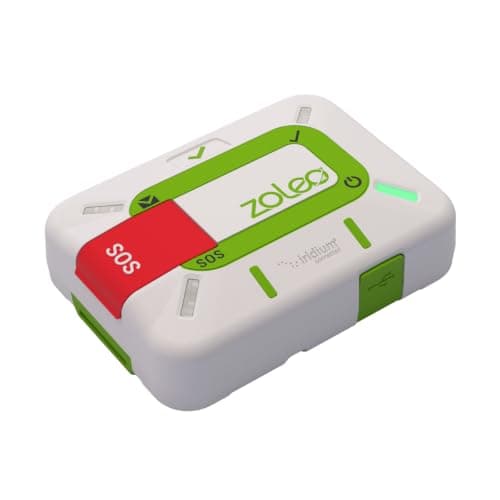
ZOLEO lists its controls as a covered SOS button and LEDs for messages, SOS, check-in and power. No screen. No keypad. Every messaging action on ZOLEO's own product page is described as happening “from the ZOLEO app on your phone or tablet” — including check-ins, and including SOS. The device is a satellite radio that your phone operates by Bluetooth.
That is not a criticism by itself. It is how most people use all three of these devices anyway, because typing a sentence on a two-inch screen is miserable. It becomes a criticism only in the one situation the device exists for: the phone is dead, wet, or in the river. At that moment the ZOLEO can raise an SOS and tell you it worked with an LED, and that is the complete list.
What this actually looks like on a trip
Your phone has been navigating all day in the cold and it is at 3 percent. With a ZOLEO you have an SOS button. With an inReach Messenger you can plug the phone into the messenger and charge it back up. With a Mini 2 you can leave the phone off entirely and type the message on the device. Three different answers to the same hour, and the price difference between the cheapest and dearest of them is smaller than the cost of one season's subscription.
The Spot X in our satellite messenger roundup answers it a fourth way, with its own dedicated US mobile number and on-device composing. If standalone operation is the thing you care about most, read that page before this one.
What ZOLEO does that neither Garmin does
It has its own phone number. ZOLEO assigns the device an SMS number and an email address. Someone who wants to reach you texts that number from any phone, with no app to install and no account to create. Both Garmins route inbound messages through Garmin's own app and services. For a parent, a partner or a colleague who will not install anything, the difference is whether they can contact you at all.
It uses the cheapest network available. ZOLEO moves between cellular, Wi-Fi and satellite. Garmin publishes cellular-or-satellite routing for the Messenger too, so this is not unique — but it is not published for the Mini 2, and ZOLEO is the only one of the three that includes Wi-Fi in the list. Most campsites that have anything have Wi-Fi.
It tells you what the plan costs. See below, because this one turned out to be the most useful finding on the page.
The running cost, and why only half of this section exists
A satellite messenger is a subscription with a device attached. The hardware is a one-time cost you will stop thinking about; the plan is forever. So the plan is the comparison that matters, and we could only complete one side of it.
ZOLEO publishes its plans on a plain, readable page. As published on 29 October 2026: Prepare at $19.99 a month with 50 satellite messages included and 50 cents each after that, or Protect at $34.99 a month with unlimited satellite messages. Both include unlimited cellular and Wi-Fi messages and 24/7 SOS monitoring. A one-time $19.99 activation fee applies, all plans carry a minimum 3-month term, and after that term you can pause the plan for $4.50 a month rather than cancelling and re-activating. That pause option is a real feature for a camper who uses the thing four weekends a year.
Garmin's plan prices are not in this comparison, and that is deliberate. Garmin's subscription pages render their pricing in JavaScript and returned nothing to read; the third-party guides that quote Garmin plan prices disagree with each other on tier names, monthly figures and whether an annual option still exists. Publishing a number we could not source from Garmin would be exactly the kind of stale figure that makes a comparison page worse than no page. Check Garmin's own site for current plan pricing before you buy, and treat the device price as the smaller half of the decision.
The honest summary of the money
ZOLEO is the cheaper device and it is the only one of the three whose total cost of ownership you can work out before you buy. Whether a Garmin plan ends up cheaper or dearer over three years is a real question, and we cannot answer it from a source we trust.
Battery, and what the numbers are not telling you
The Messenger publishes 28 days at 10-minute tracking. The Mini 2 publishes 14 days at the same interval and 30 days at 30-minute intervals. Those are comparable because Garmin states the mode.
ZOLEO publishes “over 200 hours” and does not state the mode on its own specification list. Two hundred hours is a little over eight days. Whether that is eight days of tracking, eight days of standby or eight days of something else is not published, so it cannot be set against the Garmin figures honestly. It is the one place on this page where ZOLEO is the vaguer of the two makers, and it is a significant one: battery life is the spec most likely to decide whether the device is working on day nine.
Which to buy
For most campers reading this site, the ZOLEO. The buyer we write for is outfitting a household for car camping and working up to a first backpacking trip. That person is at a campground or a trailhead with a phone in their pocket, and the realistic emergency is being four hours late rather than being unconscious in a gully. The ZOLEO is the cheapest route onto Iridium, its own text number means anyone can reach you, and its published plan pricing lets you decide with full information.
Take the inReach Messenger if trips run long. Twenty-eight days of tracking battery and the ability to resurrect a dead phone are worth the step up in price the moment a trip stops being a weekend.
Take the inReach Mini 2 if you want independence from the phone, or if you want navigation in the same device. It is the only one of the three that is a complete communicator on its own.
And if you are not sure a messenger is the right device class at all, start with satellite messenger vs PLB vs two-way radio. A personal locator beacon has no subscription, and for somebody who camps a handful of times a year that argument is stronger than anything on this page.
What we did not do
We have not carried, triggered or subscribed to any of these devices. Every weight, battery figure, rating and feature above is the maker's published figure with a link to where it was read, which is the only kind of number this site uses. See how we research.
The picks in full
1. Cheapest way onto Iridium, if you accept the phone
ZOLEO Satellite Communicator
ZOLEO
150 g on Iridium with its own SMS number, IP68 and MIL-STD 810G, over 200 hours of battery, and plan prices ZOLEO publishes on a plain page.
ZOLEO publishes a 150 g (5.3 oz) weight, a 3.58 by 2.6 by 1.06 in body, IP68 ingress protection to 1.5 m for 30 minutes, MIL-STD 810G shock resistance, over 200 hours of battery life, an internal GPS accurate to 2.5 m, USB-C power, PIN-paired Bluetooth LE to about 50 m, and an operating range of -4 F to 131 F. A subscription is required for any connected feature.
Two things here are genuinely better than the Garmins and both are easy to miss. The first is that ZOLEO moves between cellular, Wi-Fi and satellite, so a message sent from a campground with one bar does not burn a satellite credit. The second is the assigned SMS number and email address: people who want to reach you do not need an app, an account or an invitation link. They text a number. For a family where one person carries the device and four people might need to reach them, that is the whole ball game.
The ingress and shock ratings are also the strongest of the three, and ZOLEO is the only one of the three that publishes an operating temperature range at all.
The drawback
No screen and no keypad. ZOLEO describes every message, check-in and SOS as happening from the app on a paired phone or tablet, so a dead phone leaves you with a covered SOS button and four LEDs.
Published specs
Network
Iridium, and moves between cellular, Wi-Fi and satellite
Messaging
two-way text and email, composed in the ZOLEO app on a paired phone or tablet
Own number
an assigned SMS number and email address, so contacts reach the device directly
Message length
up to 900 characters, per the listing
Controls
a covered SOS button and LEDs for messages, SOS, check-in and power; no screen or keypad published
SOS
activates on button press with no countdown, to a 24/7 monitoring center
Weight
150 g / 5.3 oz
Size
3.58 x 2.6 x 1.06 in
Battery
over 200 hours; ZOLEO does not state the mode
Ingress
IP68, to 1.5 m for 30 minutes
Shock
MIL-STD 810G
GPS
internal, accurate to 2.5 m / 8.2 ft
Power
USB-C
Bluetooth
PIN-paired BLE, one connection at a time, to about 50 m
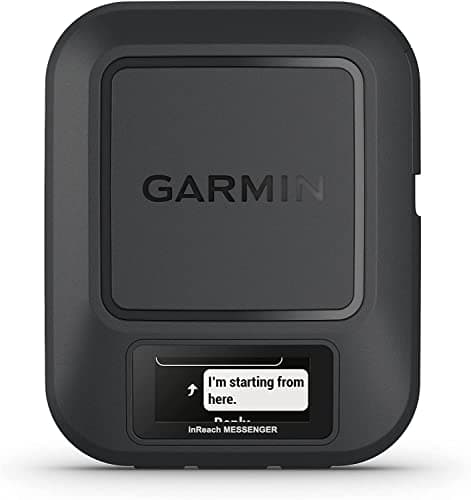
4 oz, up to 28 days of battery at 10-minute tracking, interactive SOS to Garmin's own coordination center, and it will charge your dead phone back up.
Garmin publishes two-way global text messaging through the Garmin Messenger app including group chats, preset check-in messages that do not count against the text allowance, message routing over cellular or satellite, an interactive SOS to the Garmin IERCC 24/7 coordination center, up to 28 days of battery at 10-minute tracking, a 0.25 lb (4 oz) weight, a 3.1 by 2.5 by 0.9 in body, pairing with other Garmin handhelds and wearables, and a 1 year limited warranty.
The battery figure is the headline and it deserves to be. Twenty-eight days at a 10-minute tracking interval is double what the Mini 2 publishes at the same interval, on a device that weighs less. For a trip measured in weeks rather than nights, that is the difference between carrying a charging plan and not thinking about it.
Safety charging is the other one, and it is a strange little feature that turns out to matter on exactly the page you are reading. If the Messenger can push charge back into a flat phone, then an app-dependent messenger is less app-dependent than it looks. Of the three devices here, it is the only one that can revive the thing it depends on.
The drawback
Messaging runs through the Garmin Messenger app, and Garmin publishes no water rating, no screen specification and no navigation feature for it on this listing. It is a messaging device, not a navigator.
Published specs
Network
satellite, global, subscription required
Messaging
two-way text through the Garmin Messenger app, including group chats
Routing
sends over cellular or satellite, whichever suits
Presets
preset check-in messages that do not count against the text allowance
SOS
interactive, to the Garmin IERCC 24/7 coordination center
Battery
up to 28 days at 10-minute tracking
Safety charging
can charge a depleted phone from the device
Weight
0.25 lb / 4 oz
Size
3.1 x 2.5 x 0.9 in
Pairing
phones, plus other Garmin handhelds, wearables and marine units
Warranty
1 year limited
Note
Garmin publishes no water rating, no screen specification and no navigation feature on this listing
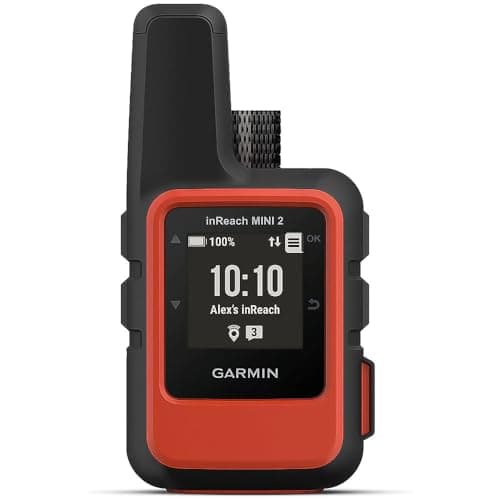
100 g on Iridium with interactive SOS, up to 14 days at 10-minute tracking and 30 days at 30-minute, MIL-STD-810 impact and an IPX7 water rating.
Garmin publishes two-way text messaging over Iridium with global coverage, interactive SOS, location sharing and GPS tracking, a 100 g (3.5 oz) weight, a size of about 4 by 2 in, up to 14 days of battery at the default 10-minute tracking interval and up to 30 days at 30-minute intervals, MIL-STD-810 impact resistance and an IPX7 water rating.
This is the lightest of the three and the only one you can operate as a communicator on its own. The site's satellite messenger roundup makes the same point from the other direction: typing on it without a paired phone is tedious, which is a complaint that only exists because the option does.
It is also the only one of the three with on-device navigation, which is a real difference in kind rather than degree. A messenger tells somebody where you are. A navigator helps you get out. Whether you need the second is covered in handheld GPS for hiking, which argues most campers do not.
The drawback
The most expensive of the three, and composing on a device this size is genuinely tedious. The point is that you can, not that you will enjoy it.
For messaging with a phone in your hand, it is competitive and cheaper, and it has an assigned SMS number that neither Garmin publishes. The gap is standalone operation: ZOLEO lists no screen or keypad and describes every message, check-in and SOS as happening in the app on a paired phone, while the inReach Mini 2 composes messages on the device itself.
QDoes ZOLEO work without a phone?
Only partly. ZOLEO's published controls are a covered SOS button and LEDs for messages, SOS, check-in and power. Its own product page describes messaging, check-ins and SOS alerts as being sent through the ZOLEO app on a phone or tablet, so with no phone paired you have an SOS button and indicator lights rather than a communicator.
QZOLEO vs inReach Mini 2: which is lighter?
The Mini 2, at a published 100 g (3.5 oz) against ZOLEO's 150 g (5.3 oz). The inReach Messenger sits between them at 0.25 lb (4 oz). All three are small enough that the weight is unlikely to decide it.
QHow much is a ZOLEO plan?
ZOLEO publishes Prepare at $19.99 a month with 50 satellite messages included and Protect at $34.99 a month with unlimited satellite messages, both with unlimited cellular and Wi-Fi messages and 24/7 SOS monitoring, as published on 29 October 2026. A one-time $19.99 activation fee applies and plans carry a minimum 3-month term, after which the plan can be paused for $4.50 a month. Check ZOLEO's site for current pricing.
QWhy does this page not list Garmin's subscription prices?
Because we could not source them from Garmin. Garmin's subscription pages render their pricing in JavaScript and returned nothing readable, and the third-party guides that quote Garmin plan prices disagree with one another on tier names and monthly figures. A plan price we could not verify would be a stale number presented as a fact, so the cell is left empty and we say why.
QWhich has better coverage, ZOLEO or inReach?
Both ZOLEO and the inReach Mini 2 publish use of the Iridium satellite network, which is the same constellation, so coverage is not the differentiator between them. ZOLEO additionally moves between cellular and Wi-Fi where those are available, and Garmin publishes cellular-or-satellite routing for the Messenger.
QWhat about the inReach Mini 3 and Mini 3 Plus?
Garmin now sells both alongside the Mini 2, at higher prices, and they add a color touchscreen display. We have not built them into this comparison because garmin.com would not serve us a readable specification page for any inReach model, so we would be comparing a device we could document against two we could not.
How we picked
Everyone else in this category will tell you they tested twenty of these. We have not tested any of them, and we would rather say so than pretend. There is no gear closet here and no test lab.
What we did instead: pulled the published specifications from each manufacturer's own spec sheet or manual, named the standard behind every rating so you can check what it actually promises, did the arithmetic that turns a spec into a decision, and pulled today's real retail price rather than quoting one from memory. Every pick states a drawback, because a list where nothing is wrong with anything is an advert.
The limits of that method, stated plainly: published specs do not capture zipper quality, seam durability, or how a tent behaves at 2am in a storm. Where that matters, we say so on the pick. The full method is here.