The Best Camping Toilets, from a Bucket to a Flushing Tank
There are only two designs in this category and they solve different problems. Pick the wrong one and the problem is not the toilet, it is where the contents have to go.
A bagged bucket produces a sealed package that goes in a trash receptacle. A flushing tank produces 2.6 gallons of liquid waste that must go into an approved RV dump station or a sewer connection — never a vault toilet, a pit toilet, a storm drain or the ground. Where you can legally empty it decides which one you should own.
If you camp at developed campgrounds with dump stations, or you travel in a vehicle that visits them, the tank is more pleasant to use and the disposal is straightforward. If you camp dispersed, on BLM or forest land, or at trailheads, the tank becomes a liability because there is often nowhere legal to empty it for a hundred miles.
The bagged systems use gelling powder that solidifies liquid and contains odor, which is what makes a sealed package safe to carry in a vehicle. Many permit areas now require exactly this, and the rules are in campsite toilets and hygiene.
Compared on published numbers
Toilet
Type
Capacity
Empty weight
Dimensions
Disposal
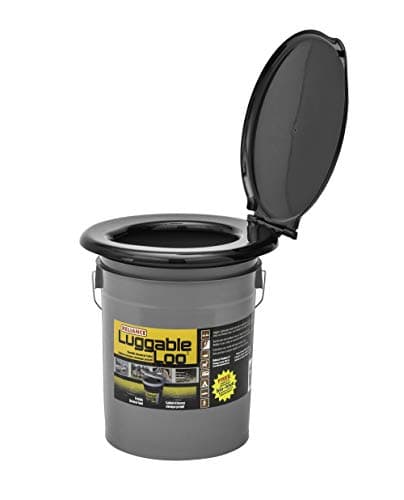
Reliance Luggable Loo
bucket with liner bags
5 gal bucket, 220 lb seat
3 lb
13.5 x 13 x 15.56 in
sealed bag to a trash receptacle
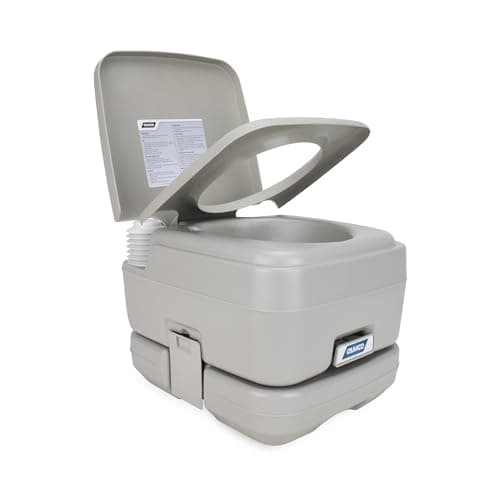
Camco Portable Travel Toilet
flushing holding tank
2.6 gal tank
about 11 lb, 33 lb full
12.375 x 14 x 16.25 in
approved RV dump station only
Figures as published by each manufacturer.
The third option: dig a hole
For backpacking and for most dispersed camping in soil, the correct answer is not a product at all. A cathole 6 to 8 inches deep and 4 to 6 inches across, at least 200 feet from water, trails and camp, is standard practice and needs a half-ounce trowel rather than a 3 lb bucket.
Catholes stop being the answer in three situations: where the land manager prohibits them, where there is no soil to dig in — rock, sand, snow, alpine zones — and where the site is used heavily enough that catholes accumulate. The tools are in best camp shovels and trowels.
Never empty a portable toilet into a vault toilet
It is the intuitive thing to do and it is prohibited nearly everywhere, because chemical additives kill the bacteria that vault systems rely on and bulk liquid overwhelms pumping schedules. The same goes for pit toilets, storm drains, streams and the ground. A flushing tank goes to an approved RV dump station or a sewer cleanout, and nowhere else. If you cannot name where you will empty it before the trip, buy the bagged bucket instead.
Privacy is the part people skip
Most portable toilets that get bought and never used failed on privacy rather than on the toilet. A pop-up shelter solves it in seconds and folds to a disc; a tarp between two trees does the same job for less money and more rigging.
Either way, site it downwind, away from the kitchen, and far enough from the tents that nobody has to walk past it. A pop-up privacy shelter typically doubles as a changing room and a shower stall, which is what makes it worth the space — see how to use a tarp at a campsite for the improvised version.
What to buy alongside it
Proper liner bags with gelling powder. Not bin bags. The powder is what makes the package safe to handle and legal to bin, and the bags are designed not to split.
Hand sanitizer at the toilet, not at the tent. If it is not within arm's reach it does not get used, and this is the single highest-value hygiene item at a campsite.
A dedicated sealed container for used paper if you are using catholes rather than a toilet.
Toilet chemical for a tank system, which controls odor and helps break down solids before the dump station.
Which to buy
Buy the Reliance Luggable Loo if you camp dispersed, at trailheads, or anywhere you might have to carry waste out, and buy the liner bags with it. Buy the Camco 2.6 gallon if your camping is at developed sites with dump stations and you would rather have a flush and a sealed bowl.
Buy neither if you are backpacking. A 0.60 oz trowel and knowing the Leave No Trace rules covers it, and carrying a toilet into the backcountry is a solution to a problem you do not have.
The picks in full
1. Best overall
Reliance Luggable Loo
Reliance
A 5 gallon bucket with a snap-on seat rated to 220 lb, at 3 lb and 13.5 by 13 by 15.56 in.
Reliance publishes a 5 gallon bucket capacity, a 220 lb seat capacity, dimensions of 13.5 L by 13 W by 15.56 H in, a weight of 3 lb, a snap-on seat and cover, and a design built around Double Doodie liner bags.
The bag-based approach is the reason this is the pick rather than the compromise. In most dispersed camping and in a growing number of permit areas, waste has to leave with you, and a lined bucket is the only design here that produces a sealed package you can carry out and dispose of in a trash receptacle.
The drawback
It is a bucket. Nothing is sealed until you snap the lid on, there is no flush and no odor barrier, and it depends entirely on using proper liner bags.
A 2.6 gallon detachable holding tank with a bellows flush and a sealing slide valve, in ABS resin.
Camco publishes a 2.6 gallon detachable holding tank with a sealing slide valve, a bellows-type pump flush drawing from a fresh water tank, an empty weight of about 11 lb and a full weight of about 33 lb, dimensions of 12.375 H by 14 W by 16.25 D in on the standard model, and ABS resin construction.
The slide valve is what makes this usable rather than unpleasant. It seals the bowl from the holding tank between uses, which contains both odor and sight, and it is the single feature that separates a real portable toilet from a bucket with a lid.
The drawback
About 11 lb empty and 33 lb full. That full figure is the whole problem: you have to carry 33 lb to an approved dump station, and it must be a dump station.
It depends on disposal. A bagged bucket like the Reliance Luggable Loo produces a sealed package for a trash receptacle and works anywhere. A flushing tank like the Camco 2.6 gallon is more pleasant to use but must be emptied at an approved RV dump station.
QWhere do you empty a portable camping toilet?
A flushing holding tank goes to an approved RV dump station or a sewer cleanout, and nowhere else. Never empty one into a vault or pit toilet, a storm drain, a stream or the ground: the chemicals kill the bacteria vault systems depend on.
QDo I need a camping toilet or can I dig a hole?
For backpacking and most dispersed camping in soil, a cathole 6 to 8 inches deep at least 200 feet from water is standard practice and needs only a trowel. Buy a toilet when catholes are prohibited, when there is no soil to dig, or at heavily used sites.
QHow heavy is a full portable toilet?
Camco publishes about 11 lb empty and about 33 lb full for the 2.6 gallon model. That full figure is the practical constraint, because you have to carry it to a dump station.
How we picked
Everyone else in this category will tell you they tested twenty of these. We have not tested any of them, and we would rather say so than pretend. There is no gear closet here and no test lab.
What we did instead: pulled the published specifications from each manufacturer's own spec sheet or manual, named the standard behind every rating so you can check what it actually promises, did the arithmetic that turns a spec into a decision, and pulled today's real retail price rather than quoting one from memory. Every pick states a drawback, because a list where nothing is wrong with anything is an advert.
The limits of that method, stated plainly: published specs do not capture zipper quality, seam durability, or how a tent behaves at 2am in a storm. Where that matters, we say so on the pick. The full method is here.