Sawyer vs LifeStraw: One of Them Publishes How Long the Filter Lasts
Both are hollow-fiber filters, both strain out the same organisms, and both cost about the same. The difference is not performance. It is that you can find out when a Sawyer is finished, and you cannot find out when a LifeStraw is.
Trail & Tarp earns a commission from qualifying purchases made through links on this page, at no extra cost to you. Full disclosure.
Quick picks
#
Product
Best for
Price
1
Best overall, and the one with the longest paper trail
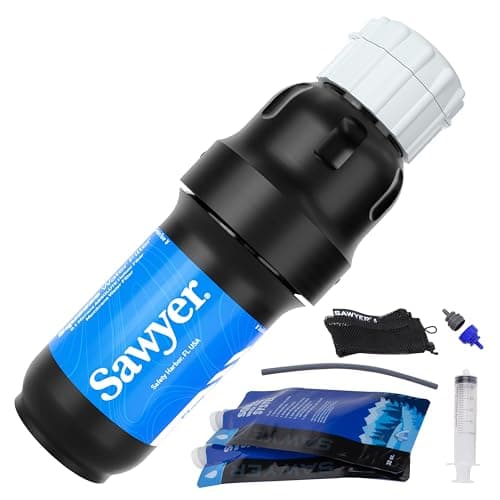
Sawyer Squeeze Water Filter (SP129)
0.1 micron absolute on a 2 oz filter, with two 32 oz pouches, a straw and hydration-pack adapters in the box, and a lifetime warranty on the filter itself.
One or two people who want a filter that outlives the trip it was bought for
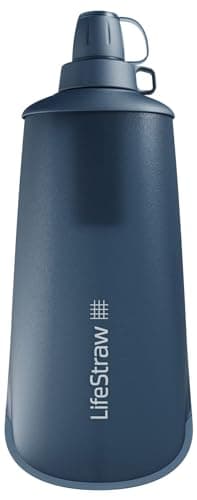
LifeStraw Peak Series Squeeze Bottle Water Filter System, 1 L
A 1 L collapsible squeeze bottle you can drink through directly, with a backwash accessory in the box and published protection against 99.999999 percent of bacteria.
Anyone who wants a water bottle that happens to filter, rather than a filter kit
Buy a Sawyer if you want to know what you are getting: both Sawyer filters publish a 0.1 micron absolute pore size and the Mini publishes a 100,000-gallon life. Buy the LifeStraw Peak if you will drink more water from a bottle than from a squeeze pouch, which for most people is true and matters more than the spec sheet. Neither brand removes viruses, and neither needs to for North American backcountry water.
These two names come up together because they occupy the same shelf at the same price and do the same job by the same method. Both use a hollow-fiber membrane: thousands of tiny straws with pores too small for bacteria and protozoa to pass through. Neither is a chemical treatment, neither uses a cartridge you replace on a calendar, and both are cleaned by pushing water backwards through the membrane.
So the choice is not about which filters better. It is about two much more boring things: what the maker is willing to tell you, and how the water gets from the lake into you.
What each maker publishes, side by side
Sawyer Squeeze
LifeStraw Peak Squeeze 1 L
Sawyer Mini
Pore size
0.1 micron absolute
not published
0.1 micron absolute
Filter life
not published on this listing
not published
up to 100,000 gallons
Bacteria
removes 99.99999%
protects against 99.999999%
removes 99.99999%
Protozoa / parasites
removes 99.9999%
protects against 99.999%
removes 99.9999%
Microplastics
100%
99.999%
100%
Weight
2 oz, filter only
3.9 oz, whole system
2 oz, filter only
Water container
two 32 oz pouches
1 L collapsible bottle
one 16 oz pouch
Drink straight from it
with the straw fitted
yes, it is a bottle
with the straw fitted
Fits 28 mm bottle threads
yes
not published
yes
Cleaning
backwash
backwash accessory included
cleaning plunger included
Warranty
lifetime on the filter
not stated on the listing
not stated on the listing
Figures as published on each product's current listing, read 2026-11-01. Blanks are genuine absences, not gaps in our reading.
The blank that matters: pore size and filter life
Look at the top two rows. Sawyer publishes a micron rating on both filters and a gallon figure on the Mini. The LifeStraw Peak listing publishes neither. It tells you what percentage of bacteria it stops and nothing about the hole size that stops them, or how many liters it will do it for.
Those are not trivia. Pore size is the specification that lets you compare a filter against any other filter and against what is in the water — it is why filter vs purifier vs tablets turns on a number and not a brand. And filter life is the thing that decides whether the filter in your pack is still working, which is a question with no other answer: a clogged hollow-fiber filter slows down, but a worn one does not announce itself.
We are not going to fill those cells from a review site or a forum thread. A pore size we could not source from LifeStraw would be worse than a blank, because a reader would act on it.
What a removal percentage does and does not tell you
LifeStraw's 99.999999 percent for bacteria is a bigger-looking number than Sawyer's 99.99999 percent, and the difference is almost meaningless in practice: both are log-reduction figures measured in a laboratory against a seeded sample, and both clear the thresholds any backcountry water source demands. A percentage tells you how a filter performed on a test bench when new. A pore size tells you what it physically cannot pass, for as long as the membrane is intact. They are not the same kind of claim.
What LifeStraw genuinely does better
The spec gap is real, but it would be dishonest to leave the impression that the Sawyer wins everything. It does not.
It is a bottle. The Peak Squeeze is a 1 L collapsible bottle with the filter in the flow path, so drinking is lifting it to your mouth. The Sawyer is a filter with a bag attached, and getting a drink means squeezing. People drink more from bottles. On a hot afternoon that is a more useful property than a pore-size figure.
The backwash accessory is in the box. Both brands expect you to clean the membrane by reversing the flow. LifeStraw includes a purpose-made accessory for it; Sawyer ships the Mini with a plunger and the Squeeze historically with a syringe. Either way, cleaning is the maintenance that keeps flow rate alive, and it is the step most people skip until the filter feels broken.
It reconfigures without parts. LifeStraw lists the same unit working as a bottle, a squeeze, a straw, a storage flask with the filter removed, and a module that connects to other Peak Series pieces. The Sawyer does most of that too, but each mode needs the right pouch or adapter fitted.
Neither of these removes viruses
This is the limit both brands share and it is worth stating plainly. Hollow-fiber membranes at 0.1 or 0.2 micron strain out bacteria and protozoa. Viruses are an order of magnitude smaller and pass straight through. In North American backcountry water that is an acceptable risk, because the realistic threats are giardia, cryptosporidium and bacterial contamination from animals upstream.
It stops being acceptable where water may carry human sewage, which in practice means much international travel. For that you want a purifier or a chemical treatment rather than either of these, and the distinction is set out in water filter vs purifier vs tablets.
A note on what is in stock
Two of the three picks here are Sawyers, and that is partly a supply decision rather than an editorial one. LifeStraw's cheaper Peak pieces were checked on 1 November 2026 and the Peak Solo personal straw was temporarily out of stock in both colors, the two-pack of Peak personal straws was unavailable, and the Peak 3 L gravity system was temporarily out of stock. The 1 L squeeze bottle above is LifeStraw's cheapest in-stock entry into the range.
If you are reading this later and the Peak Solo is back, it is the direct rival to the Sawyer Mini and the comparison above transfers: the question will still be whether LifeStraw has started publishing a pore size and a filter life.
Which to buy
For most campers on this site, the Sawyer Squeeze. It is the filter our roundup already leads with, the 28 mm thread means it survives the failure of its own pouches, and it is the only one of the three with a lifetime warranty stated on the listing.
Take the LifeStraw Peak Squeeze if you know yourself. If the honest truth is that you will not stop to squeeze water and will instead carry an unfiltered bottle from the campsite tap, buy the one you will actually drink from. A filter you use beats a filter with a better spec sheet.
Take the Sawyer Mini for a glovebox or a group. At roughly half the price of the other two it is the cheap way to put a filter in every pack, and it publishes the same pore size as its bigger sibling.
If you are filtering for more than two people at a time, neither of these is the right tool and a gravity system is — that comparison is in best water filters for camping.
What we did not do
We have not flow-tested, clogged or laboratory-tested any of these. Every pore size, removal percentage, weight and capacity above is the manufacturer's published figure with a link to where it was read, and the blanks are where a manufacturer published nothing. See how we research.
The picks in full
1. Best overall, and the one with the longest paper trail
Sawyer Squeeze Water Filter (SP129)
Sawyer
0.1 micron absolute on a 2 oz filter, with two 32 oz pouches, a straw and hydration-pack adapters in the box, and a lifetime warranty on the filter itself.
Sawyer publishes a 0.1 micron absolute inline filter weighing 2 oz, removal of harmful bacteria, protozoa, cysts and sediment plus 100 percent of microplastics, two reusable 32 oz BPA-free collapsible pouches, a drinking straw, a set of inline hydration pack adapters and a mesh storage bag, compatibility with standard 28 mm bottle threads, use in a gravity setup, and a statement that every unit is individually tested three times. The warranty line on the listing reads “Manufacturer Lifetime Warranty from Defects on the Filter”.
The 28 mm thread is the quiet reason this one wins on longevity. When the supplied pouches eventually split — and they do — the filter screws onto an ordinary bottle and carries on. You are buying a filter with a long life and a disposable delivery system, which is a better deal than it sounds.
This is the same filter our water filter roundup puts first, and the reasoning there still applies: there is no cartridge to replace on a schedule, so there is no moment where the filter is quietly past its life and you do not know.
The drawback
The soft pouches are the weak part and split at the seams eventually, and squeezing a liter through takes real effort compared with drinking from a bottle.
LifeStraw Peak Series Squeeze Bottle Water Filter System, 1 L
LifeStraw
A 1 L collapsible squeeze bottle you can drink through directly, with a backwash accessory in the box and published protection against 99.999999 percent of bacteria.
LifeStraw publishes protection against 99.999999 percent of bacteria including E. coli and salmonella, 99.999 percent of parasites including giardia and cryptosporidium, and 99.999 percent of microplastics along with silt, sand and cloudiness. It lists a re-engineered membrane with a custom backwash accessory, materials it describes as twice as thick and leak-proof, a 1 L collapsible bottle, and a 3.9 oz system weight.
The versatility is genuine and it is the reason to pick this one. The same object is a bottle you drink from, a squeeze you push water through into a pot, a straw you drink through at the water's edge, and — with the filter removed — a plain soft flask. The Sawyer does several of those too, but only with the right pouch attached, and the LifeStraw does them without reconfiguring anything.
Drinking directly is the part that matters on a hot day. A squeeze filter makes you stop, fill, attach and squeeze before you get a mouthful. A bottle with a filter in the lid makes you drink. That difference decides how much water people actually take on, which is a real safety point and not a convenience one.
The drawback
LifeStraw publishes neither a micron rating nor a filter lifespan on this listing, which are the two numbers that tell you what it strains and when it is finished. It is also the heaviest of the three.
Published specs
Bacteria
protects against 99.999999%
Parasites
protects against 99.999%
Microplastics
protects against 99.999%, plus silt, sand and cloudiness
Capacity
1 L collapsible squeeze bottle
Weight
3.9 oz for the system
Cleaning
custom backwash accessory included
Durability
LifeStraw states 2x thicker materials and a leak-proof build
Modes
bottle, squeeze into another container, straw, or storage once the filter is removed; connects to other Peak Series parts
Note
the listing publishes no micron rating and no filter lifespan
3. Cheapest way into a filter that publishes its numbers
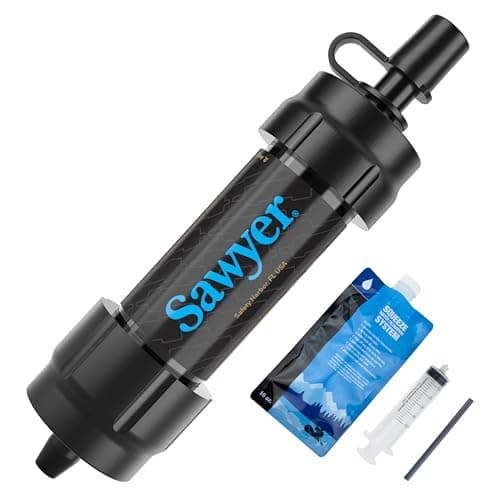
Sawyer Mini Water Filtration System (SP105)
Sawyer
The same 0.1 micron absolute rating as the Squeeze on a 2 oz filter rated up to 100,000 gallons, for roughly half the money.
Sawyer publishes a 0.1 micron absolute rating, a 2 oz filter, removal of 99.99999 percent of bacteria including salmonella, cholera and E. coli, removal of 99.9999 percent of protozoa including giardia and cryptosporidium, removal of 100 percent of microplastics, a filter rated up to 100,000 gallons, and a box containing the filter, a 16 oz reusable squeeze pouch, a 7 in drinking straw and a cleaning plunger.
The hundred-thousand-gallon figure is worth sitting with. At a generous four liters a day, that is several hundred years of drinking water. The number is a laboratory ceiling rather than a promise about your filter, but it is a published ceiling, and it tells you the maker expects the thing to outlast you rather than a season.
The honest limit is throughput. The Mini pushes water more slowly than the full Squeeze and comes with a smaller pouch, so it is the filter for one person topping up a bottle, not for filling a pot for four. For that job the gravity systems in the roundup are the answer.
The drawback
Flow is slower than the full Squeeze and the supplied pouch is only 16 oz, so filling anything larger than a bottle is tedious. It is a filter for one person.
Published specs
Filter rating
0.1 micron absolute
Bacteria
removes 99.99999%
Protozoa
removes 99.9999%
Microplastics
removes 100%
Filter life
rated up to 100,000 gallons
Weight
2 oz, filter only
Fits
the included pouch, standard 28 mm bottle threads, or a hydration pack
In the box
filter, 16 oz reusable squeeze pouch, 7 in drinking straw, cleaning plunger
Testing
Sawyer states every unit is individually tested three times
They filter comparably - both are hollow-fiber membranes that stop bacteria and protozoa and neither stops viruses. Sawyer is better documented: it publishes a 0.1 micron absolute pore size on both filters here and a 100,000-gallon life on the Mini, while the LifeStraw Peak listing publishes neither figure. LifeStraw is better to drink from, because the Peak Squeeze is a bottle rather than a pouch you squeeze.
QWhat micron is a LifeStraw?
LifeStraw does not publish a micron rating on the Peak Series squeeze listing. It publishes removal percentages instead - 99.999999 percent of bacteria, 99.999 percent of parasites and 99.999 percent of microplastics. Sawyer publishes 0.1 micron absolute for both the Squeeze and the Mini. We have not substituted a figure for LifeStraw from any third party.
QHow long does a Sawyer filter last?
Sawyer rates the Mini at up to 100,000 gallons on its current listing. That is a laboratory ceiling rather than a guarantee about any individual filter, but it is a published ceiling, and the Squeeze carries a stated lifetime warranty against defects on the filter itself. In practice a hollow-fiber filter is retired when backwashing stops restoring the flow rate.
QDo Sawyer or LifeStraw filters remove viruses?
No. Both are filters rather than purifiers, and hollow-fiber membranes at these pore sizes are too coarse to stop viruses. For North American backcountry water that is fine, because the realistic risks are giardia, cryptosporidium and bacteria. Where water may contain human sewage, which includes a lot of international travel, you need a purifier or a chemical treatment instead.
QCan you drink straight from a Sawyer filter?
Yes, with the included straw fitted - both the Squeeze and the Mini ship with one. It is less convenient than the LifeStraw Peak, which is a bottle you drink through without attaching anything, and that convenience gap is the main practical difference between the two brands.
QDoes the Sawyer fit a normal water bottle?
Yes. Sawyer publishes compatibility with standard 28 mm bottle threads for both the Squeeze and the Mini, which is why the filters outlive the pouches they ship with. When a supplied pouch splits at the seam, the filter screws onto an ordinary bottle and carries on. LifeStraw does not publish a thread standard for the Peak squeeze bottle.
How we picked
Everyone else in this category will tell you they tested twenty of these. We have not tested any of them, and we would rather say so than pretend. There is no gear closet here and no test lab.
What we did instead: pulled the published specifications from each manufacturer's own spec sheet or manual, named the standard behind every rating so you can check what it actually promises, did the arithmetic that turns a spec into a decision, and pulled today's real retail price rather than quoting one from memory. Every pick states a drawback, because a list where nothing is wrong with anything is an advert.
The limits of that method, stated plainly: published specs do not capture zipper quality, seam durability, or how a tent behaves at 2am in a storm. Where that matters, we say so on the pick. The full method is here.