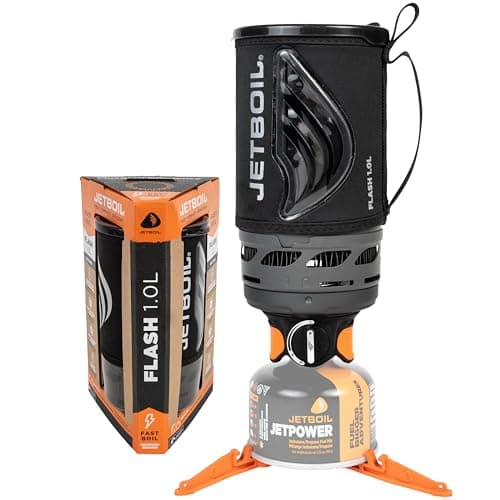
Jetboil Flash 1.0 L
Jetboil
2 cups in about 100 seconds, pot included, 13.1 oz. The boiling system.
$144.99 · Check price on Amazon
#ad how this is funded · price as of October 23, 2026
These are not two versions of the same stove. One is a boiling system that comes with its pot; the other is a burner you screw onto whatever pot you own.
Trail & Tarp earns a commission from qualifying purchases made through links on this page, at no extra cost to you. Full disclosure.
The short answer
If you boil water and rehydrate meals, buy the Jetboil: it is faster, it wastes less fuel in wind, and the pot is part of the design. If you actually cook — simmering, frying, using a pan you already own — buy the PocketRocket 2, which is a quarter of the weight and works with anything. The question is not which stove is better. It is whether you cook or you boil.
This distinction gets lost because both are sold as “backpacking stoves” on the same shelf. A Jetboil Flash is a heat exchanger, a burner and an insulated pot engineered as one unit. A PocketRocket 2 is just the burner. Everything that follows comes from that.
| Jetboil Flash 1.0 L | MSR PocketRocket 2 | |
|---|---|---|
| Weight | 13.1 oz | 2.6 oz minimum, 3.7 oz packaged |
| Boil time | 2 cups in about 100 seconds | 1 L in 3.5 min on MSR IsoPro |
| Pot | included, 1.0 L insulated | not included |
| Ignition | push button | none; matches or a striker |
| Fuel | isobutane-propane canister | threaded self-sealing isobutane canister |
| Fuel efficiency | not published as liters per canister | about 16 L of water per 227 g canister |
| Packed size | not published | 1.3 x 1.6 x 3.1 in |
Read that boil-time row carefully, because the marketing invites a false comparison. Jetboil quotes 2 cups (roughly 0.47 L) in about 100 seconds. MSR quotes a full liter in 3.5 minutes. Scale them and they are much closer than the headline numbers suggest — the Jetboil is still faster, but not four times faster.
The heat exchanger is the real feature. Those fins welded to the pot base capture heat that would otherwise escape around the sides, which does two things: it boils faster, and it wastes far less fuel. On a week-long trip that difference compounds into carrying fewer canisters.
Wind is the second win, and it is bigger than most people expect. An exposed burner loses most of its heat sideways in a breeze; a Jetboil's pot sits down inside a shroud that shelters the flame. On an exposed ridge the gap between these two stoves widens a lot.
Third: it is one object. Burner, pot, lid, cozy and stabilizer nest together and the canister packs inside. Nothing is forgotten at home because nothing is separate.
Weight, first and obviously. At 2.6 oz minimum it is a fifth of the Jetboil, and that is before you notice you are carrying the Jetboil's pot whether you want that pot or not.
Flame control, second. A bare burner simmers. An integrated system is designed to run hot and is notoriously difficult to turn down far enough to cook rice without welding it to the bottom. If your meals involve anything beyond adding boiling water to a bag, this matters.
Pot freedom, third. The PocketRocket takes whatever you put on it: a 2 L pot for two people, a frying pan, the cookware set you already own. The Jetboil is optimized around its own 1.0 L cup, which is one person's dinner.
Neither one is a two-person dinner stove
A 1.0 L Jetboil cup boils enough for one freeze-dried meal and a drink, then needs refilling and reboiling. The PocketRocket will happily heat a 2 L pot but it is a narrow burner under a wide pan, so it heats the middle and not the edges. If you are cooking real food for two or more, both of these are the wrong tool and a wider two-burner setup is the right one — see best camp stoves.
A BRS-3000T publishes 25 g / 0.88 oz and 2,700 W of output, which is a third of the PocketRocket's weight for a fraction of the price. It has no ignition, it is less stable under a big pot, and its thin titanium arms are known to deform under heavy loads over time.
It is genuinely the right answer for a minimalist solo hiker boiling water, and genuinely the wrong answer for anyone who wants a stove to last a decade. The full field is in best backpacking stoves.
Both stoves run on isobutane-propane canisters, and canister pressure falls as the temperature drops. Near and below freezing, output from any upright canister stove sags regardless of which burner sits on top.
The Jetboil's efficiency partially compensates, because it needs less heat to do the same job. Neither is a genuine winter stove, though. The fuel argument in full is in propane vs butane camp stoves.
| If this is you | Buy |
|---|---|
| Freeze-dried meals, coffee, solo or a pair | Jetboil Flash |
| Exposed, windy country | Jetboil Flash |
| Long trips where fuel weight compounds | Jetboil Flash |
| You cook real food and want to simmer | MSR PocketRocket 2 |
| You already own pots you like | MSR PocketRocket 2 |
| Counting every ounce | MSR PocketRocket 2, or a BRS-3000T |
| Cooking for a family at a campground | neither; a two-burner stove |
The honest summary: most people who think they want the fast stove actually want the flexible one, and most people who say they will cook properly on a backpacking trip end up boiling water. Be honest about which of those you are, and the choice makes itself.
Jetboil
2 cups in about 100 seconds, pot included, 13.1 oz. The boiling system.
#ad how this is funded · price as of October 23, 2026
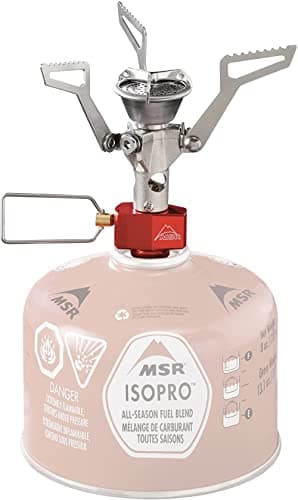
MSR
2.6 oz minimum, 1 L in 3.5 min, about 16 L per canister. The burner that simmers.
#ad how this is funded · price as of October 23, 2026
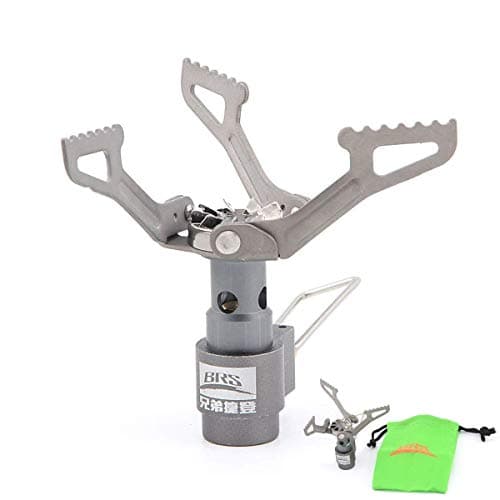
BRS
25 g and 2,700 W. The minimalist third option, with the durability caveat.
#ad how this is funded · price as of October 23, 2026
Yes, but less dramatically than the headline numbers suggest. Jetboil publishes 2 cups in about 100 seconds; MSR publishes a full liter in 3.5 minutes. Scaled to the same volume the Jetboil is still quicker, thanks to its heat exchanger, but not by the factor the two figures imply.
Poorly. Integrated systems are designed to run hot and are hard to turn down far enough for anything that can scorch. A bare burner like the PocketRocket 2 controls the flame much better, which is why it suits people who cook rather than just boil.
Yes. The heat exchanger captures heat that escapes around the sides of a normal pot, so less gas does the same job, and the shrouded pot shelters the flame from wind. On long trips that compounds into carrying fewer canisters.
Neither is ideal. A 1.0 L Jetboil cup is one person's meal and needs reboiling; the PocketRocket is a narrow burner that heats the middle of a wide pan unevenly. For two or more eating real food, a two-burner camp stove is the right tool.
Every figure on this page comes from a published source. We have not tested this gear, so the numbers are the manufacturer's or the standard body's, not ours. How we research.