The Best Camping Privacy Tents, and the Spec That Stops Them Blowing Away
A privacy tent is a four-foot box with the sail area of a small kite and the mass of a loaded daypack. Every one of them pops up in ten seconds. Not every one of them comes with what it needs to stay there.
Buy on what is in the box, not on the footprint. All three of these pop up in about ten seconds and all three are roughly four feet square, so the thing that separates them is whether the anchoring hardware that keeps a 5 lb box from cartwheeling across a campground is included or sold separately. Two of these ship with sandbags. One ships with pockets to put your own in.
A privacy tent is the piece of camping gear people buy last and wish they had bought first. It is the enclosure that turns a portable shower into a shower and a bucket toilet into a bathroom, and without one both of those products are things you use at 5am while watching the access road.
What each maker publishes, side by side
Shelter
Footprint
Height
Fabric
Anchoring included
Weight
BRIAN & DANY
47.2 x 47.2 in
74.8 in
190T silver-coated, UPF 50+
8 pegs, 4 guy lines, 4 sandbags
5.95 lb
Wakeman
3.3 x 3.3 ft
6.2 ft
190T polyester, no rating published
4 stakes, guy lines; sandbag pockets but no sandbags
5.24 lb
Alvantor
4 x 4 ft
7 ft
300D Teflon-coated oxford, UPF 50+
8 stakes, 4 guy lines, 4 sandbags
7.4 lb
Figures as published on each product's current listing, read 2026-11-04.
Anchoring is the whole decision
Everything about a privacy tent is a compromise with the wind. It is a vertical panel about four feet wide and six or seven feet tall, which is roughly 25 square feet of sail, attached to between five and seven and a half pounds of fabric and frame. A gust that a dome tent shrugs off will pick one of these up and run with it.
That is why the anchoring column above matters more than the footprint column. Stakes are not the answer on their own, because privacy tents get pitched exactly where stakes do not work: the gravel pad beside the RV, the hardstanding at a campground, the sand at the beach, the packed dirt by the toilet block. Sandbags or weighted pockets are what hold them, and only two of these three come with the bags.
The cheapest fix if yours did not come with sandbags
Two 1 L water bottles in the sewn-in pockets, or a pair of supermarket bags of play sand, will hold a shelter this size in ordinary weather and cost almost nothing. The failure mode to plan around is not a storm — it is walking away from an empty tent on a breezy afternoon. Weight it before you leave it, every time, because an empty one goes first.
Height is the second thing, and only if you shower in it
Two of these publish 6.2 ft of height and one publishes 7 ft. For a toilet surround or for changing out of a wet swimsuit, 6.2 ft is irrelevant — you are sitting or stooping either way. For washing, it is the difference between the product working and not.
Raise your arms to wash your hair and your hands go about 14 inches above your head. A six foot adult therefore wants something over seven feet to do that without touching the roof, which is exactly one of the three shelters here. If the enclosure is for a shower rather than a toilet, buy the height and stop reading the rest of the spec sheet.
Floors: the spec that depends entirely on what you are doing in there
All three have some kind of floor and the right answer flips depending on use.
Showering: you want the floor out, or you want to stand on a mat you can tip. Water has to go somewhere, and a sealed floor turns the shelter into a paddling pool. The Wakeman and the BRIAN & DANY both publish removable bottoms, which is the right design for this.
Changing or toileting: you want the floor in. Bare feet on a gravel pad is the thing that makes people stop using a changing tent, and a fixed PE floor like the Alvantor's also stops a portable toilet sinking into soft ground.
Greywater from washing does not simply vanish into the pitch, incidentally. Where it is allowed to go is covered in campsite toilets and hygiene, and it matters more than most people assume.
What none of these publishes
Not one of the three publishes a hydrostatic head rating. Two say “waterproof” or “water-repellent” and one says nothing about water at all, and none of them puts a millimeter figure next to it — which is the number a tent in any other category on this site would be judged on. Treat all three as rain shelters rather than rain protection, and read tent waterproof ratings explained for why the absence is conspicuous.
None publishes a wind rating either, which is harder to forgive given the shape. And only the Alvantor publishes a warranty longer than a month.
Which to buy
The BRIAN & DANY for most people. It is the one that arrives ready to stand up on a gravel pitch, it has a roof that sheds rain, and it ventilates through windows rather than an open top.
The Wakeman if it is a toilet surround at a soil pitch, or a second one for the car, and budget a couple of dollars of play sand for the pockets.
The Alvantor if anyone over about five foot ten is going to shower in it, or if it will live at a seasonal site rather than travel. It is the only one built like it expects a second season.
And if you have not sorted out the water yet, the enclosure is the second purchase — best camping showers sorts the mechanisms by how the water gets hot.
What we did not do
We have not pitched, weighted or wind-tested any of these. Every footprint, height, fabric and box-contents figure above is the manufacturer's published figure with a link to where it was read, and the blanks — the missing hydrostatic heads, the missing wind ratings — are where a manufacturer published nothing. See how we research.
The picks in full
1. Best overall
BRIAN & DANY Pop Up Shower Tent
BRIAN & DANY
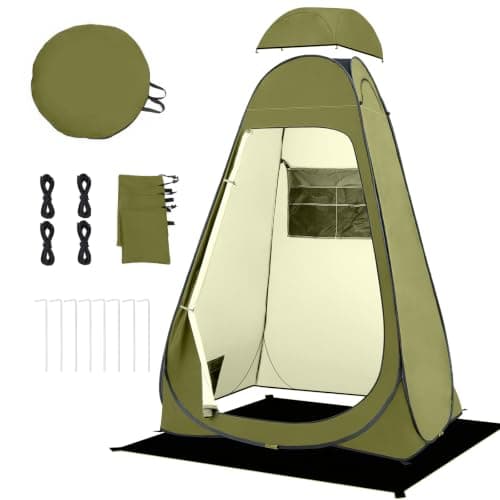
47.2 in square and 74.8 in tall in UPF 50+ silver-coated polyester, on a steel frame, with eight pegs, four guy lines and four sandbags in the box.
BRIAN & DANY publishes a 47.2 by 47.2 in footprint at 74.8 in tall, 190T silver-coated polyester rated UPF 50+ which the maker states blocks up to 98 percent of UV, a 2.6 mm flexible steel frame, a removable bottom mat, a separate roof panel to shed rain, a mosquito net and two zippered windows, two straps for a shower head, a towel strap, two mesh pouches, and a 5.95 lb weight.
It wins on the box contents, which is a strange thing to say about a tent until you have watched one leave. Eight pegs, four guy lines and four sandbags is the most complete anchoring kit here, and sandbags are the part that matters: pegs hold in soil and do nothing on the gravel pad, sand or hardstanding where these shelters usually get pitched.
The second reason is the roof. Most privacy tents are open-topped or mesh-topped, which is fine until it rains on the clothes you came in to change out of. A separate rain panel is the difference between a changing room and a funnel.
The drawback
At 5.95 lb it is the middle weight here, and the separate rain roof is another panel to lose. The maker publishes no hydrostatic head figure, only that the fabric is water-repellent.
Published specs
Footprint
47.2 x 47.2 in
Height
74.8 in
Fabric
190T silver-coated polyester, UPF 50+, which the maker states blocks up to 98 percent of UV
Frame
2.6 mm flexible steel
Floor
removable bottom mat
Anchoring
8 pegs, 4 guy lines and 4 sandbags, all included
Weather
a separate roof panel over the top to shed rain
Ventilation
mosquito net and 2 zippered windows
Inside
2 shower-head straps, a towel strap, 2 mesh pouches
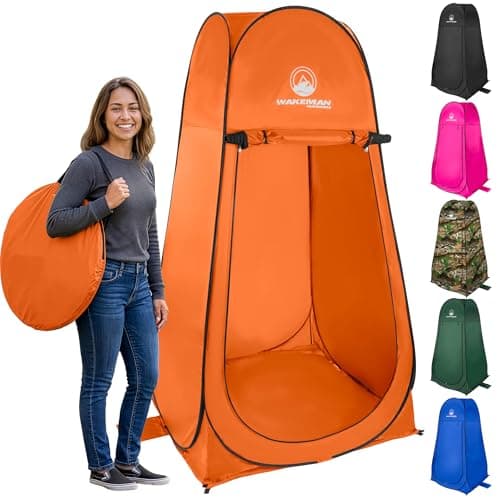
3.3 ft square and 6.2 ft tall in 190T polyester at 5.24 lb, with a removable floor and a door you can roll back.
Wakeman publishes a 3.3 by 3.3 ft footprint at 6.2 ft tall, a 2.5 by 4.1 ft dual-sided zippered door that rolls back on loops and toggles, 190T polyester, a removable bottom, four stakes and guy lines, two sewn-in sandbag pockets, a 5.24 lb weight, a 1.8 ft diameter carry bag and a 30 day warranty.
This is the honest cheap answer and the door is the reason to pick it over the other budget shelters. A dual-sided zip that rolls back and clips open sounds trivial and is not: a privacy tent you have to unzip from the inside with wet hands, in the dark, is the one that stays in the bag after the first trip.
Read the anchoring line carefully before you buy. The pockets are there, the sandbags are not, and Wakeman is explicit about it. On a soil pitch the four stakes are enough. On gravel, sand or a hardstanding RV pad they are not, and you will want two bags of play sand or a couple of water bottles in those pockets.
The drawback
It has sandbag pockets but no sandbags, so on gravel or sand you are buying or filling your own. Wakeman publishes no UV rating and no waterproof rating, and the warranty is 30 days.
Published specs
Footprint
3.3 x 3.3 ft
Height
6.2 ft
Door
2.5 x 4.1 ft, dual-sided zip, rolls open on loop and toggles
Fabric
190T polyester
Floor
removable bottom
Anchoring
4 stakes and guy lines, plus 2 sewn-in sandbag pockets; sandbags NOT included
Weight
5.24 lb
Packed
1.8 ft diameter carry bag
Warranty
30 days
Note
Wakeman publishes no UV rating and no waterproof rating for this shelter
3. Best if you are tall, or actually showering in it
Alvantor Shower Tent Pop Up Changing Room
Alvantor
A full 4 by 4 ft and 7 ft tall in 300D Teflon-coated poly-oxford, with a PE floor, a mesh top and eight stakes plus four sandbags.
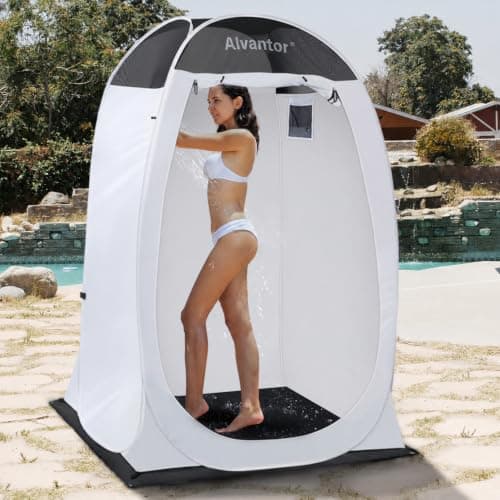
Alvantor publishes a 4 by 4 ft footprint at 7 ft tall, 300D poly-oxford with an authorized Teflon coating and a vinyl shield rated UPF 50+, fiberglass ribs, a PE floor with a wear-resistant tube along the bottom edge, a mesh top, a large double-sided zip entrance, inside pockets, a rope for towels and a coat hook, four sandbags, four guy lines, eight stakes, a 7.4 lb weight, a 20.8 in packed diameter and a 1 year limited warranty.
The seven feet is what you are paying for. At 6.2 ft, which is what the other two publish, a six-foot adult washing their hair has their forearms in the roof. Ten more inches changes showering from a contortion into something you would do twice.
The 300D fabric is the other half. The two cheaper shelters here use 190T polyester, which is a thin curtain by any standard; 300D oxford with a Teflon finish is closer to a gazebo than a changing cubicle, and it is the only one of the three with a year of warranty behind it.
The drawback
Four times the price of the Wakeman and 7.4 lb, the heaviest here. The mesh top ventilates well and also means rain comes straight in, which is the opposite trade from the pick above.
Published specs
Footprint
4 x 4 ft
Height
7 ft
Fabric
300D poly-oxford with a Teflon coating, vinyl shielded, UPF 50+
Frame
fiberglass ribs
Floor
PE floor, with a wear-resistant tube along the bottom edge
Anchoring
4 sandbags, 4 guy lines and 8 stakes, all included
Ventilation
mesh top and a large double-sided zip entrance
Inside
pockets, a rope for towels or clothes, and a coat hook
Readily, if they are not weighted. A shelter this shape is about 25 square feet of sail attached to five to seven pounds of fabric, and it gets pitched on gravel, sand or hardstanding where stakes do not bite. Two of the three here ship with sandbags; the Wakeman has sewn-in pockets but no bags, so you supply the weight. An empty unweighted one is the one that leaves.
QHow tall should a camping shower tent be?
Over seven feet if anyone near six foot will wash their hair in it, because raised hands sit roughly 14 inches above your head. The Alvantor here publishes 7 ft; the other two publish 6.2 ft, which is fine for a toilet surround or for changing but cramped for showering.
QCan you use a privacy tent as a toilet tent?
Yes, and it is the most common use. For that job you want the floor left in rather than removed, so the toilet does not sink into soft ground and so bare feet are not on gravel. Height matters much less than it does for a shower, which makes the cheaper shelters a reasonable buy for this use.
QAre pop up shower tents waterproof?
None of the three here publishes a hydrostatic head rating, which is the figure a tent in any other category would be judged on. Two describe the fabric as waterproof or water-repellent and one makes no water claim at all. Treat them as rain shelters rather than rain protection, and note that only one of the three has a roof panel over the top at all.
QShould the floor come out of a shower tent?
For showering, yes - water needs somewhere to go and a sealed floor makes a paddling pool. For changing or for a toilet, leave it in. Two of the three here publish removable bottoms and the Alvantor has a fixed PE floor, so the right pick partly depends on which job the shelter is for.
How we picked
Everyone else in this category will tell you they tested twenty of these. We have not tested any of them, and we would rather say so than pretend. There is no gear closet here and no test lab.
What we did instead: pulled the published specifications from each manufacturer's own spec sheet or manual, named the standard behind every rating so you can check what it actually promises, did the arithmetic that turns a spec into a decision, and pulled today's real retail price rather than quoting one from memory. Every pick states a drawback, because a list where nothing is wrong with anything is an advert.
The limits of that method, stated plainly: published specs do not capture zipper quality, seam durability, or how a tent behaves at 2am in a storm. Where that matters, we say so on the pick. The full method is here.